

UAE bans Pakistan-born batter Usman Khan for 5 years

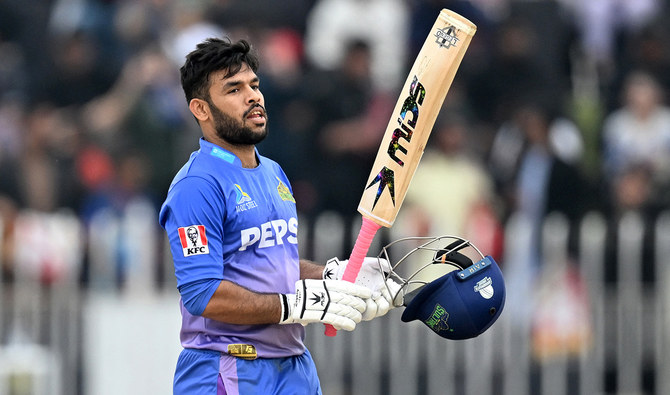
Multan Sultans' Usman Khan celebrates after scoring a half-century (50 runs) during the Pakistan Super League (PSL) Twenty20 cricket match between Multan Sultans and Islamabad United at the Rawalpindi Cricket Stadium in Rawalpindi on March 10, 2024. (AFP/File)
Short Url
Updated 06 April 2024
Follow

UAE bans Pakistan-born batter Usman Khan for 5 years

  • Emirates Cricket Board decision comes after the batter seemed to show interest in playing for his country of birth
  • Khan has been training with Pakistan after he struck back-to-back centuries in the recent Pakistan Super League 

DUBAI, United Arab Emirates: The Emirates Cricket Board banned Pakistan-born Usman Khan for five years on Friday after the batter seemed to show interest in playing for his country of birth.

Khan has been training with Pakistan after he struck back-to-back centuries in the recent Pakistan Super League and caught the eyes of the selectors.

The 28-year-old Khan played the PSL as foreign player for finalist the Multan Sultans, but it seems he is interested in representing Pakistan.

“After a detailed investigation, Usman was found to have misrepresented to ECB about his decision to play for the UAE team and has used the opportunities and development provided by the ECB to him to seek out other prospects,” an ECB statement said.

The ECB said Khan “is found to have breached his obligations owed to ECB and will therefore not be allowed to participate in ECB-sanctioned tournaments/leagues as well as local events organized under the aegis of councils/academies in UAE for a period of five years.”

The five-year sanction means Khan will be ineligible to play the two main Twenty20 leagues in the United Arab Emirates — ILT20 and Abu Dhabi T10 — until 2029.

The ECB said Khan participated in the ILT20 this year as a local UAE player, and it had an employment contract with the batter for one year.

“This was done to give him security and allow him to fulfil his eligibility criteria that would allow him to represent UAE in international cricket,” the ECB said.

Pakistan is due to play 11 T20s ahead of the T20 World Cup in June in the Caribbean and the United States. Pakistan’s preparations include five T20s against New Zealand from later this month at home. Khan is likely to be named.


Pakistan steps up EU trade engagement as India deal raises export fears

Updated 58 min 47 sec ago
Follow

Pakistan steps up EU trade engagement as India deal raises export fears

  • Deputy PM chairs inter-ministerial meeting, calls GSP+ “crucial” for growth
  • Move follows India–EU trade pact that industry warns could hit exports, jobs

ISLAMABAD: Pakistan’s Deputy Prime Minister and Foreign Minister Mohammad Ishaq Dar on Friday chaired a high-level inter-ministerial meeting to review and strengthen trade and economic relations with the European Union, as Islamabad scrambles to safeguard market access following India’s new trade deal with the bloc.

The meeting is part of a broader diplomatic and policy push this week after India and the EU confirmed a free trade agreement granting Indian exporters sweeping tariff-free access to Europe — a development Pakistani exporters and analysts warn could erode Pakistan’s competitiveness, particularly in textiles, its largest export sector.

The EU is Pakistan’s second-largest export market, accounting for about $9 billion in annual shipments, mostly textiles and apparel. Industry leaders have warned that India’s tariff-free access could undercut Pakistan’s long-standing advantage under the EU’s Generalized Scheme of Preferences Plus (GSP+), which allows duty-free access in return for commitments on labor rights, human rights and governance.

At Friday’s meeting, Dar emphasized the centrality of GSP+ to Pakistan’s trade strategy with Europe.

“He emphasized that GSP Plus remains a crucial framework for mutually beneficial trade and underlined the need to maximize its potential for Pakistan’s economic growth,” the Foreign Office said in a statement.

Dar also stressed the importance of enhancing trade cooperation with the EU and exploring new avenues for economic engagement, as Pakistan assesses how to respond to shifting trade dynamics in Europe.

The inter-ministerial huddle follows a series of rapid consultations this week, including a meeting between Prime Minister Shehbaz Sharif and the EU’s ambassador to Pakistan, as well as briefings by trade bodies to Finance Minister Muhammad Aurangzeb on the potential impact of the India–EU agreement. 

Exporters have warned that unless Pakistan lowers production costs, particularly energy tariffs, and secures continued preferential access, the country could face declining market share in Europe and job losses across its labor-intensive textile sector.

Pakistan’s Foreign Office has said Islamabad is aware of the India–EU agreement and continues to view its trade relationship with the EU as mutually beneficial, but officials acknowledge that the new deal has intensified pressure to defend Pakistan’s position within the bloc.