

Pakistan steps up EU trade engagement as India deal raises export fears

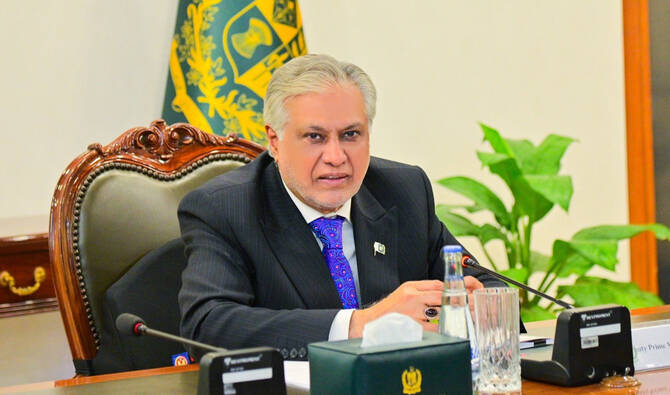
Pakistan’s Deputy Prime Minister and Foreign Minister Mohammad Ishaq Dar chairs a high-level inter-ministerial meeting in Islamabad on January 30, 2026. (MOFA)
Short Url
Updated 30 January 2026
Follow

Pakistan steps up EU trade engagement as India deal raises export fears

  • Deputy PM chairs inter-ministerial meeting, calls GSP+ “crucial” for growth
  • Move follows India–EU trade pact that industry warns could hit exports, jobs

ISLAMABAD: Pakistan’s Deputy Prime Minister and Foreign Minister Mohammad Ishaq Dar on Friday chaired a high-level inter-ministerial meeting to review and strengthen trade and economic relations with the European Union, as Islamabad scrambles to safeguard market access following India’s new trade deal with the bloc.

The meeting is part of a broader diplomatic and policy push this week after India and the EU confirmed a free trade agreement granting Indian exporters sweeping tariff-free access to Europe — a development Pakistani exporters and analysts warn could erode Pakistan’s competitiveness, particularly in textiles, its largest export sector.

The EU is Pakistan’s second-largest export market, accounting for about $9 billion in annual shipments, mostly textiles and apparel. Industry leaders have warned that India’s tariff-free access could undercut Pakistan’s long-standing advantage under the EU’s Generalized Scheme of Preferences Plus (GSP+), which allows duty-free access in return for commitments on labor rights, human rights and governance.

At Friday’s meeting, Dar emphasized the centrality of GSP+ to Pakistan’s trade strategy with Europe.

“He emphasized that GSP Plus remains a crucial framework for mutually beneficial trade and underlined the need to maximize its potential for Pakistan’s economic growth,” the Foreign Office said in a statement.

Dar also stressed the importance of enhancing trade cooperation with the EU and exploring new avenues for economic engagement, as Pakistan assesses how to respond to shifting trade dynamics in Europe.

The inter-ministerial huddle follows a series of rapid consultations this week, including a meeting between Prime Minister Shehbaz Sharif and the EU’s ambassador to Pakistan, as well as briefings by trade bodies to Finance Minister Muhammad Aurangzeb on the potential impact of the India–EU agreement. 

Exporters have warned that unless Pakistan lowers production costs, particularly energy tariffs, and secures continued preferential access, the country could face declining market share in Europe and job losses across its labor-intensive textile sector.

Pakistan’s Foreign Office has said Islamabad is aware of the India–EU agreement and continues to view its trade relationship with the EU as mutually beneficial, but officials acknowledge that the new deal has intensified pressure to defend Pakistan’s position within the bloc.


Pakistan PM calls for faster CPEC implementation, pledges security for Chinese workers

Updated 27 February 2026
Follow

Pakistan PM calls for faster CPEC implementation, pledges security for Chinese workers

  • Shehbaz Sharif pushes expanded cooperation in agriculture, IT and mining under CPEC phase two
  • Chinese envoy reaffirms Beijing’s support for Pakistan’s sovereignty and economic development

ISLAMABAD: Prime Minister Shehbaz Sharif on Friday called for speeding up projects under the China-Pakistan Economic Corridor (CPEC) and pledged stronger security guarantees for Chinese workers and investments, during a meeting with China’s ambassador in Islamabad.

Sharif made the remarks as the two countries strive to launch the second phase of CPEC, a multibillion-dollar infrastructure and energy initiative launched in 2015 as part of China’s Belt and Road Initiative (BRI).

CPEC’s first phase focused largely on power generation and transport infrastructure aimed at easing Pakistan’s chronic energy shortages and improving connectivity. The second phase seeks to expand cooperation into industrial development, with an emphasis on special economic zones and export-oriented growth.

“While highlighting the importance of accelerating ongoing CPEC projects, the Prime Minister stressed on the need to enhance cooperation in agriculture and IT and mining & minerals,” said a statement circulated by the PM Office after the meeting.

“He also underscored Pakistan’s resolve to provide a secure and conducive environment for Chinese personnel, investments, and institutions in Pakistan,” it added.

Chinese nationals and projects in Pakistan have faced security threats in the past, including attacks by militant groups targeting infrastructure sites and convoys. Islamabad has repeatedly vowed to tighten security and has deployed special protection units for Chinese workers.

China is Pakistan’s closest ally in the region and a key economic partner, with CPEC widely regarded by Islamabad as central to long-term economic growth.

During the meeting, the prime minister conveyed greetings to Chinese President Xi Jinping and Premier Li Qiang, particularly on the occasion of the Chinese New Year.

China’s Ambassador to Pakistan, Jiang Zaidong, reiterated Beijing’s support for Pakistan’s sovereignty and socioeconomic development, according to the statement. Both sides also exchanged views on regional and international issues and agreed to maintain close coordination.