TEHRAN: Iran’s commander of the Revolutionary Guard Hossein Salami said on Friday “no threat will go unanswered” in retaliation for the airstrike widely attributed to Israel that destroyed the Iranian Consulate in Syria’s capital and killed seven of the guard’s members, including two top generals.
This came after thousands marched chanting “death to Israel” during the slain officers’ funeral procession in the capital.
The marches in the capital, Tehran, along with protests in other Iranian cities, took place at a time of heightened concerns about possible retribution by Iran for Monday’s strike that killed 12 people, including four Syrian citizens and a member of the Lebanese militant Hezbollah group, according to officials.
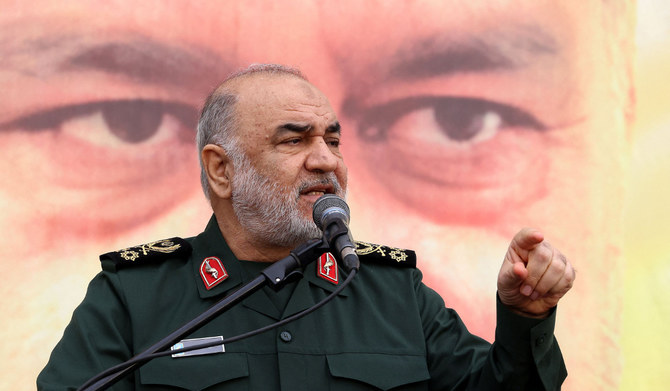
The protesters in the capital headed to Tehran University where Salami gave his speech before the weekly Friday prayers.
“We warn you, no enemy act against our holy system will go unanswered,” he said, speaking on a podium and showing a big placard with the Arabic phrase “Flood of the Free” emblazoned on it.
“The collapse of (Israel’s regime) is very possible and close,” Salami said, adding that the US has become “wildly hated by the world, especially in Muslim-dominated countries” for supporting Israel.
He said that Israel’s current survival depended on US support.
Salami also said that “resistance groups in Gaza are surrounded by Israel ... and weapons cannot be sent to them,” referring to the Israel-Hamas war that broke out on Oct.7.
He claimed that “messages sent from inside Gaza show that they have no problem to continue enduring (the war).”
The public funeral coincided with Iran’s annual rally Quds Day, or Jerusalem Day, a traditional show of support for the Palestinians that has been held on the last Friday of Ramadan since the 1979 revolution.
Iranian leaders have reiterated promises of revenge.


![]()

IRGC chief vows payback for Israeli strike on consulate in Damascus
Short Url
https://arab.news/zrum3
IRGC chief vows payback for Israeli strike on consulate in Damascus
- “The collapse of (Israel’s regime) is very possible and close,” Salami said, adding that the US has become “wildly hated by the world, especially in Muslim-dominated countries” for supporting Israel


Latest updates


Recommended


© 2026 SAUDI RESEARCH & PUBLISHING COMPANY, All Rights Reserved And subject to Terms of Use Agreement.