

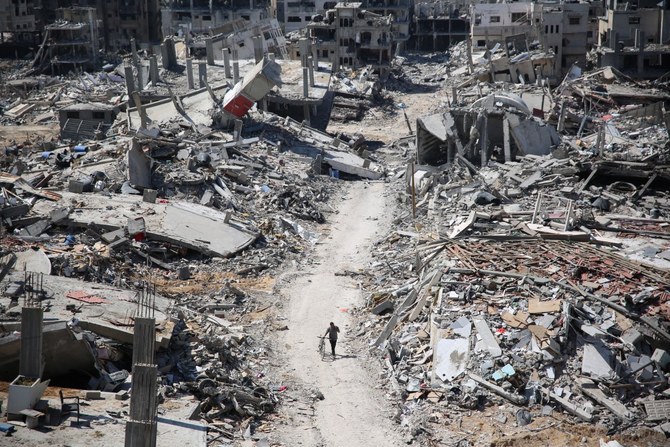

LONDON: A BBC report highlighted significant errors in the evacuation warnings issued by the Israel Defense Forces, causing confusion among residents in Gaza.
The analysis revealed that out of the 26 bombing alerts examined by the BBC, 17 contained “contradictory information and sometimes misnamed districts,” making them confusing for people in Gaza to decipher and respond to.
These errors included instances in which neighborhoods mentioned in the text of the warnings were not highlighted on the accompanying maps, and vice versa. Additionally, the evacuation zones marked on the maps often split blocks in two, potentially adding to the confusion.
Some warnings also inaccurately listed neighborhoods in one district when they were actually located in another, and there were discrepancies in block numbers between the text and maps.
The IDF refuted the accusations, claiming in a statement that the alerts analyzed by the BBC were only one element of its “extensive efforts to encourage the evacuation (of) civilians out of harm’s way.”
It emphasized that the system, which divides Gaza into numbered blocks, is designed to assist civilians in fleeing danger.
However, experts warned that such errors could violate Israel’s obligations under international law to “provide effective advance warning of attacks affecting the civilian population.”

(BBC/File)
The BBC based its report on extensive evidence, including interviews with residents and analysis of posts on IDF’s Arabic-language social media channels.
Additionally, the broadcaster noted the difficulty in compiling a list of phone calls due to the damage to Gaza’s phone network.
This challenge was exacerbated by the fact that during the period under investigation — since Dec. 1 — Israel enforced an electricity, phone, and internet blockade on the Gaza Strip, rendering it impossible for people to receive the warnings.
Despite these inconsistencies, Israel presented its block warning system at the International Court of Justice in January as part of its defense against allegations of genocide by South Africa.
Throughout the conflict, the BBC has faced allegations of biased reporting regarding Israel.
Some Israeli-affiliated newspapers have accused the BBC of distorting the narrative to tarnish the IDF’s reputation in its reports on warning civilians in Gaza.
This investigation coincides with scrutiny against Tel Aviv for its alleged use of the Lavender artificial intelligence tool to identify and strike terrorists in Gaza, resulting in hundreds of “collateral deaths” among civilians.
The IDF denied the existence of a kill list, describing the tool as merely assisting analysts in the target identification process.
They maintain that their practices focus on protecting civilians and have “saved countless lives in Gaza.”

keywords


