

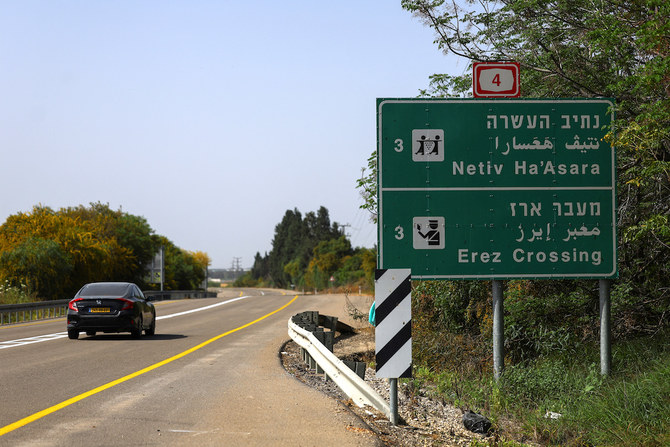


JERUSALEM: Israel said it approved the reopening of the Erez crossing into northern Gaza and the temporary use of Ashdod port in southern Israel, following US demands to increase humanitarian aid supplies into Gaza.
During a call with Israeli Prime Minister Benjamin Netanyahu on Thursday night, US President Joe Biden demanded “specific, concrete” steps to alleviate the humanitarian crisis in Gaza, saying conditions could be placed on US aid if Israel did not respond.
The growing pressure on Israel came after the killing of seven aid workers in an Israeli strike on Monday night, which triggered global outrage at the continuing problems with aid deliveries into the besieged enclave.
A meeting of the security cabinet late on Thursday approved immediate steps to increase humanitarian aid to the civilian population in the Gaza Strip, a statement said.
In addition to reopening the Erez crossing point, which has been closed since it was destroyed during the Oct. 7 attack on Israel, the security cabinet also approved increasing Jordanian aid through the Kerem Shalom crossing point, the statement said.
US Secretary of State Antony Blinken said that the measures the Israeli government has announced to expand the flow of aid into Gaza are welcome but may not be enough to meet the Biden administration’s demands for dramatic improvements in humanitarian conditions in the territory.
Blinken said that opening more border crossings, if fully implemented, has the potential to surge assistance to Palestinians caught in the fighting between Israel and Hamas. However, the US also wants to see tangible steps to bolster the protection of civilians and aid workers, he said.
In addition, he called for an “independent, thorough and fully publicized investigation” into the recent killings of aid workers. Seven employees of the charity World Central Kitchen, including six international volunteers, were killed in multiple Israeli airstrikes on their convoy in Gaza late Monday.
The incident sparked international outrage and put Israel on the defensive about its conduct in its six-month-old war against Hamas, particularly the high number of civilian deaths in Gaza.
“We welcome that steps that have been announced by Israel,” Blinken said. “These are positive developments but the real test is results and that’s what we’re looking to see in the coming days and the coming weeks.”
At the same time, he said the US wanted to see a “better system for de-confliction and coordination” so that aid can be safely delivered and distributed inside Gaza.
“All of these things are critical and that really needs to be measured by results,” Blinken told reporters in the town of Leuven, outside Brussels, where he was meeting with US and European trade and commerce officials.
The decision to reopen the Erez crossing, the main crossing point from Israel into northern Gaza before the war, represented a major shift after Israeli officials previously rejected calls for more entry points into Gaza to be opened up.
UNRWA, the main UN aid agency in Gaza, also welcomed the reopening of the crossings, but said Israel needs to do more.
“We call on the Israeli authorities to reverse their decision that bans UNRWA from reaching northern Gaza with food supplies,” it said in a statement.
“The clock is ticking fast toward famine and UNRWA must be allowed to do its work, and reach the north on a regular basis with food and nutrition supplies.”
The agency last month said it had been told by Israel it would no longer approve food convoys to the north, where the humanitarian crisis is most acute.
Israel has faced growing international pressure to do more to help civilians in Gaza, where most of the population has been driven from their homes and now depends on aid to survive.
It has previously insisted that it was placing no restrictions on emergency supplies getting into the besieged enclave, blaming problems on international agencies inside Gaza that have been handling distribution to people in need.
That argument has been severely undermined by the killing of the World Central Kitchen staff, who had coordinated their movements with the Israeli military before their vehicles were hit by an air strike.
Israel has also braced for a possible attack from Iran, or one of its proxy militia groups like Hezbollah, following the killing of two of Iranian generals along with five military advisers in an air strike on an Iranian diplomatic compound in the Syrian capital Damascus on Monday.

keywords


