Somalia expels Ethiopian envoy amid naval base dispute

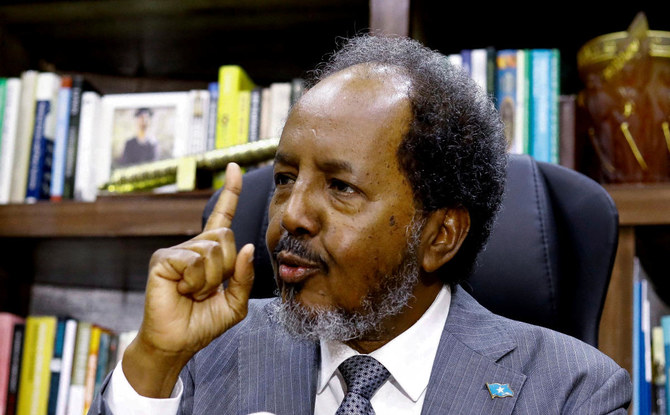
Somalia’s President Hassan Sheikh Mohamud speaks during an interview with Reuters, in his office in Mogadishu, Somalia, Feb. 20, 2024. (Reuters)
Short Url
Updated 12 August 2024
Follow

Somalia expels Ethiopian envoy amid naval base dispute

  • Somalia has given Ethiopia’s ambassador 72 hours to leave the country and ordered the closure of the Ethiopian consulates in Somaliland and the semi-autonomous region of Puntland
  • Somali officials said the moves were linked to a dispute over a memorandum of understanding landlocked Ethiopia agreed to on Jan. 1 to lease 20 km (12 miles) of coastline in Somaliland

NAIROBI: Somalia said on Thursday it was expelling Ethiopia’s ambassador, closing two Ethiopian consulates and recalling its own ambassador to Addis Ababa amid a dispute over Ethiopia’s plan to build a naval base in the breakaway region of Somaliland.
Ethiopian foreign ministry spokesperson Nebiyu Tedla said Ethiopia did not have any information on the matter, which was first officially announced by Somalia’s prime minister’s office.
“This follows ... the actions of the Federal Democratic Republic of Ethiopia which infringe upon Somalia’s sovereignty and internal affairs,” Somalia’s foreign ministry said in a statement.
Somalia has given Ethiopia’s ambassador 72 hours to leave the country and ordered the closure of the Ethiopian consulates in Somaliland and the semi-autonomous region of Puntland, the foreign ministry said.
Senior officials from Somaliland and Puntland, which is engaged in another constitutional dispute with Mogadishu, said the edicts would not apply in their territories.
“The embassy shall remain open irrespective of what Mogadishu says,” Rhoda Elmisaid, Somaliland’s deputy foreign minister, told Reuters in a private message sent via the social media platform X. “Somaliland is an independent sovereign nation.”
Mohamud Aydid Dirir, Puntland’s information minister, told the Voice of America Somali radio service: “Somalia’s decision will not work. It cannot shut the consulates in Puntland and Somaliland.”
Two Somali officials said the moves were linked to a dispute over a memorandum of understanding landlocked Ethiopia agreed to on Jan. 1 to lease 20 km (12 miles) of coastline in Somaliland — a part of Somalia which claims independence and has had effective autonomy since 1991.
Ethiopia said it wanted to set up a naval base there and offered possible recognition of Somaliland in exchange — prompting a defiant response from Somalia and fears the deal could further destabilize the Horn of Africa region.
Somali President Hassan Sheikh Mohamud previously called the port deal illegal and said in February his country would “defend itself” if Ethiopia were to go ahead with it.
Tensions between Mogadishu and Puntland also rose over the weekend when Puntland’s state council said it had withdrawn from the country’s federal system and would govern itself independently in a dispute over constitutional changes.
Somalia’s move to expel the ambassador and shut down the consulates raises concerns over the fate of 3,000 Ethiopian soldiers stationed in Somalia as part of an African Union peacekeeping mission fighting militants from Al-Shabab, an Al-Qaeda affiliate.
Mohamud said in February he did not plan to kick them out.


India rolls out strictest anti-pollution curbs as toxic smog engulfs Delhi

Demonstrator wearing an oxygen mask and holding oxygen tanks takes part in protest.
Updated 14 December 2025
Follow

India rolls out strictest anti-pollution curbs as toxic smog engulfs Delhi

  • Private monitors in several parts of northern Delhi recorded AQI spikes between 550 and 700s
  • Authorities invoked stage four of the capital region’s emergency pollution-control framework

NEW DELHI: India’s capital choked under a thick blanket of smog on Sunday, with the government imposing anti-pollution curbs after monitoring stations in some areas recorded extremely hazardous air quality.

Home to 30 million people, Delhi has not recorded a single “clean air” day in 2025, with Air Quality Index readings hitting high above the 50 score throughout the year.

On the AQI scale from 0 to 500, good air quality is represented by levels below 50, while levels above 300 are dangerous.

Worsening since late October, official records over the weekend were in the severe to severe-plus range of 400–500, but as 24-hour averages, they did not capture the peaks. Private monitors in several parts of North and North West Delhi recorded AQI spikes above 550 and even into the 700s in real-time.

On Saturday evening, the Ministry of Environment’s Commission for Air Quality Management invoked stage four — the highest level — of the Graded Response Action Plan for Delhi and surrounding areas.

To “prevent further deterioration of air quality in the region,” the commission suspended all non-essential construction, shut stone crushers and mining operations, stopped entry of trucks into the capital region, and ordered schools to shift to hybrid classes or online, where possible.

While authorities blamed the pollution on “adverse meteorological conditions,” residents have been demanding more government action.

“The situation is so bad in Delhi that we don’t have any option but to force kids to do online classes. The government has failed us; it has not done anything to address the issue,” said Nabanita Nayak, who decided for her teenage children to attend school online only, despite concerns over their screen addiction.

“If the kids are too much in front of laptops, that’s also an issue. As a mother, I am worried.” 

Delhi’s pollution has been worsening since Diwali in late October, when the average AQI has been above 370, or “very poor.” Since mid-November, it has been over 400, which means “severe” air quality, with certain areas recording 500 and above, which is classified as a “hazardous” level.

“I don’t feel proud living in Delhi. It’s the capital city of the country … We talk about being a developed nation by 2047 — we have deadlines,” said Jagriti Arora, who is keeping her 7-year-old daughter at home to prevent allergy flare-ups caused by air pollution.

“The government has to do something … China had a big problem with pollution, but now they’ve managed to bring it down.”

Delhi’s air quality deteriorates in winter due to local emissions and seasonal weather conditions. Cold temperatures and low wind speeds result in a temperature inversion, which traps pollutants close to the ground instead of letting them disperse. This allows emissions from millions of vehicles, ongoing construction, and nearby industrial activity to accumulate in the air. Urban waste burning and dust from construction sites further add to it.

“This is not a new thing. This has been happening now for over 10 years,” Arora said. “You can see it. You don’t need to actually look at an AQI meter to see how bad the pollution is these days.”