

Speakers at Pakistani conference urge Islamabad to follow Saudi Arabia in digitizing economy 

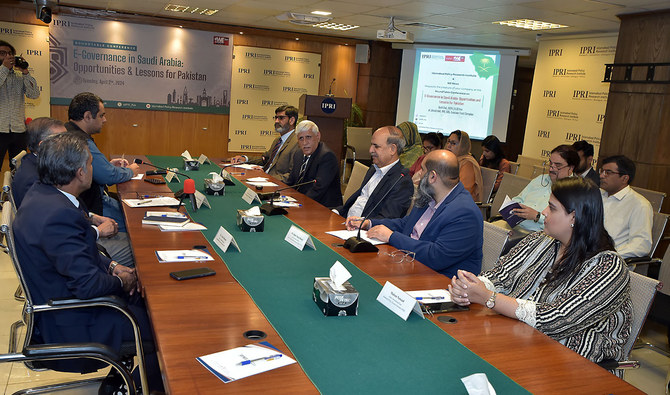
The photo taken on April 2, 2024, shows a panel discussion at a conference, held at the Islamabad Policy Research Institute in Islamabad, Pakistan. (Photo courtesy: WE World News)
Short Url
Updated 02 April 2024
Follow

Speakers at Pakistani conference urge Islamabad to follow Saudi Arabia in digitizing economy 

  • ’E-Governance in Saudi Arabia: Opportunities and Lessons for Pakistan’ hosted at Islamabad Policy Research Institute 
  • Speakers praise Kingdom for diversifying its economy away from being an oil-based one toward digital revolution

ISLAMABAD: Pakistan should draw lessons from Saudi Arabia in digitizing its economy to harness the true potential of its workforce, speakers at a roundtable conference organized by an Islamabad-based think tank said on Tuesday. 

The conference, titled: ‘E-Governance in Saudi Arabia: Opportunities and Lessons for Pakistan,’ was held at the Islamabad Policy Research Institute (IPRI) in collaboration with WE World News. 

Dr. Majid Bhatti, chief executive officer of the National Information Technology Board (NTB), was the chief guest at the event, while Ambassador Vice Admiral (retired) Khan Hasham bin Saddique, who previously served as Pakistan’s ambassador to Saudi Arabia, also attended.

“It was underscored and appreciated that Saudi Arabia with a population of around 40 million has made great strides in information technology, and its desire to digitize the society has transformed it within a span of less than a decade,” IPRI said in a press release.

The speakers praised the Kingdom for diversifying its economy away from being an oil-based one toward a digital revolution, noting that Saudi Arabia had acquired the best talent and expertise from around the world in its pursuit of setting up infrastructure for e-commerce and e-governance. 

“While drawing parallels, it was noted that though Pakistan possesses some of the great talent and industrious initiatives, it is a lack of digital foundations that ails it,” the statement said. 

“This is why Saudi Arabia today is successfully erecting a triangular pyramid of digital society, digital economy and digital governance; and this is rapidly transforming its economy from oil to digital in context.”

Pakistan’s fundamental problem as it took the digital and e-governance route, speakers said, was a lack of facilities to opt for digital financial transactions. 

“This aspect must be studied at length, and similarly by setting up smart cities, Pakistan can address many of its governance-related problems in a better way by documenting it on digitization,” the statement said. 

Speakers at the conference emphasized the importance of digital literacy in Pakistan and the need for transparent infrastructure, adding that factors such as a high cost of energy, lack of infrastructure and absence of regulations were hindering Pakistan from taking strides in e-governance. They said a state-sponsored policy to facilitate the private sector was the need of the hour in order to harness Pakistan’s full potential.


‘Fully stand with Bangladesh’: Pakistan PM backs decision to boycott India match

Updated 04 February 2026
Follow

‘Fully stand with Bangladesh’: Pakistan PM backs decision to boycott India match

  • Pakistan’s government have not allowed the national cricket team to play its World Cup match against India on Feb. 15
  • Pakistan has accused India of influencing ICC decisions, criticized global cricket body for replacing Bangladesh in World Cup

ISLAMABAD: Prime Minister Shehbaz Sharif on Wednesday backed his government’s decision to bar the national men’s cricket team from playing against India in the upcoming T20 World Cup tournament, reaffirming support for Bangladesh. 

Pakistan’s government announced on social media platform X last week that it has allowed its national team to travel to Sri Lanka for the World Cup. However, it said the Green Shirts will not take the field against India on their scheduled match on Feb. 15. 

Pakistan’s participation in the tournament was thrown into doubt after Pakistan Cricket Board (PCB) Chairman Mohsin Naqvi criticized the International Cricket Council (ICC) for replacing Bangladesh with Scotland. The decision was taken after Bangladesh said it would not let its team travel to India out of security concerns. 

During a meeting of the federal cabinet, Sharif highlighted that Pakistan has said that politics should be kept away from sports. 

“We have taken this stand after careful consideration and in this regard, we should stand fully with Bangladesh,” Sharif said in televised remarks. 

“And I believe this is a very reasonable decision.”

Pakistan has blamed India for influencing the ICC’s decisions. The global cricket governing body is currently led by Jay Shah, the head of the Board of Control for Cricket in India. Shah is the son of Indian Home Minister Amit Shah. 

Pakistan’s boycott announcement has triggered media frenzy worldwide, with several Indian cricket experts and analysts criticizing Islamabad for the decision. An India-Pakistan cricket contest is by far the most lucrative and eagerly watched match of any ICC tournament. 

The ICC has ensured that the two rivals and Asian cricket giants are always in the same group of any ICC event since 2012 to capitalize on the high-stakes game. 

The two teams have played each other at neutral venues over the past several years, as bilateral cricket remains suspended between them since 2013 due to political tensions. 

Those tensions have persisted since the two nuclear-armed nations engaged in the worst fighting between them since 1999 in May 2025, after India blamed Pakistan for an attack in Indian-administered Kashmir that killed tourists. 

Pakistan denied India’s allegations that it was involved in the attack, calling for a credible probe into the incident.