

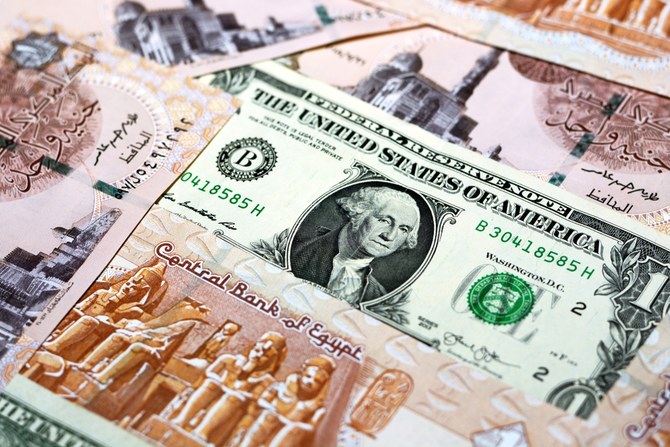

CAIRO: The International Monetary Fund will tie payments to Egypt under an $8 billion financial program to Cairo’s letting market conditions determine the price of its currency and its making foreign exchange available to businesses and private individuals, the IMF said on Monday.
Egypt, which signed the loan agreement on March 6, will have immediate access to $820 million this week and another $820 million after a review to be completed by the end of June.
Subsequent reviews will be made every six months, with each unlocking payments of $1.3 billion provided certain conditions are met, with the last payment in autumn of 2026, mission chief Ivanna Vladkova Hollar told a news conference.
The IMF’s executive board approved the program on Friday, expanding on a $3 billion Extended Fund Facility signed in December 2022 after the crisis in neighboring Gaza further shook Egypt’s already precarious economy.
Egypt allowed its currency to weaken sharply after the 2022 agreement, but within months had re-pegged it to the dollar, prompting the IMF to put the program on hold.
Under last month’s agreement Egypt again let its currency plunge and has since let its price fluctuate.
“This is an important reform that needs to be sustained. It’s not a one-off reform,” Hollar said.
“At each individual review, the expectation is that the conditions that we’re seeing now in the market are going to continue to hold, in the sense that we do not see a return to a system of FX rationing and lack of FX availability,” she said.
The Gaza crisis exacerbated Egypt’s chronic foreign crisis by slowing tourism growth and triggering attacks from Yemen on shipping in the Red Sea, halving Suez Canal revenue. Tourism and canal revenue are two of its main sources of foreign exchange.
Among other reforms the IMF is seeking is that Egypt ensure a level playing field between private and state firms and that the state reduce its role in the economy.
An additional loan from the IMF’s Resilience and Sustainability Facility would be discussed during the next review, Vladkova Hollar said.
“To qualify, countries need to have in place a strong set of policies that are intended to address the bases of climate change,” she added.
The IMF forecasts that Egypt’s inflation will remain high in the near term, with average inflation for the coming fiscal year, which begins on July 1, expected at 25.5 percent, falling to 15.25 percent by the end of that year, she said. Inflation rose to a record high of 38 percent in September before easing in February to 35 percent.
The country, whose budget has been stretched in recent years, needs to replace untargeted fuel subsidies with targeted spending designed to reach households in need, she added.
Egypt raised fuel prices late last month as part of a program to reduce subsidies. Fuel subsidies would continue to fall as part of Egypt’s quarterly pricing committee meetings, Hollar said.


