

Amid row over Iran pipeline, Pakistan says has ‘right’ to buy gas from neighbors 

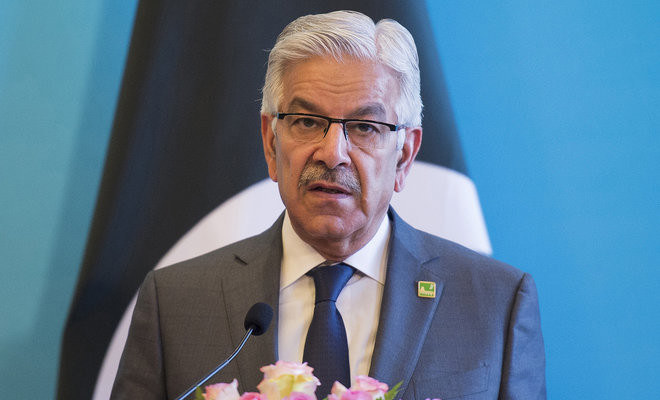
In this file photo, Pakistan's Foreign Minister Khawaja Muhammad Asif speaks during a joint press conference with China's Foreign Minister Wang Yi and Afghanistan's Foreign Minister Salahuddin Rabbani after the first China-Afghanistan-Pakistan Foreign Ministers' Dialogue in Beijing on Dec. 26, 2017. (AFP/File)
Short Url
Updated 02 April 2024
Follow

Amid row over Iran pipeline, Pakistan says has ‘right’ to buy gas from neighbors 

  • Defense Minister says US should give Pakistan alternative for cheaper gas if it opposes pipeline from Iran 
  • Pakistan and Iran pipeline project has for years faced delays, funding challenges and threat of US sanctions 

ISLAMABAD: Defense Minister Khawaja Muhammad Asif this week responded to Washington’s criticism of the Iran-Pakistan gas pipeline project, saying it was the South Asian country’s right to buy gas at competitive rates from neighboring countries considering its economic crisis. 

The Pakistan-Iran gas pipeline, known as the Peace Pipeline, is a long-term project between Tehran and Islamabad that has faced delays and funding challenges for several years. The pipeline would transport natural gas from Iran to neighboring Pakistan.

Last week, the US said it did not support the pipeline project going forward and cautioned about the risk of sanctions in doing business with Tehran. Petroleum Minister Musadik Malik said last month Pakistan was seeking a US sanctions waiver for the project.

“If America tells us not to take gas from Iran and sanctions will be imposed on us, then it should also give us an alternative,” Asif told reporters on Monday. 

“If a neighbor is giving us gas at competitive rates then it is our right [to buy it],” he said. “America should view all these things in the context of our economic situation.”

Pakistan has pursued the pipeline as a way of alleviating severe energy shortages that have crippled its economy but the cash-strapped country also needs billions of dollars in aid from the US. 

On February 23, Pakistan approved the construction of a part of the pipeline amid fears of a potential $18 billion penalty for failing to complete the project on time.

India, unlike Pakistan, quit the project in 2009, citing costs and security issues — a year after it signed a nuclear deal with Washington. 

Pakistan, for its part, has made little progress on its section of the line for lack of funds and warnings it could be in violation of US sanctions on Iran, which sits on the world’s largest reserves of gas. Iran has spent hundreds of millions of dollars and nearly completed the 900-km (560 mile) pipeline to the Pakistan border


Planning minister says Pakistan to set up advanced technology centers to support economic growth

Updated 13 sec ago
Follow

Planning minister says Pakistan to set up advanced technology centers to support economic growth

  • Ahsan Iqbal says planned centers to focus on artificial intelligence, quantum computing and nanotechnology
  • He also cites satellite technology as key tool for climate monitoring, early warning and disaster management

ISLAMABAD: Pakistan plans to set up technology Centers of Excellence, including facilities focused on quantum computing and nanotechnology, as it seeks to benefit from rapid advances in artificial intelligence and emerging technologies, state media reported on Friday.

The announcement was made by Planning and Development Minister Ahsan Iqbal, who said the government aims to position Pakistan to compete in future technologies that are expected to drive economic growth and reshape global industries.

Quantum computing, which uses the principles of quantum mechanics to process information far more quickly than conventional computers, has applications ranging from complex data analysis and cryptography to climate modeling and materials science. Nanotechnology focuses on engineering materials at the molecular level and is widely used in energy storage, medicine and electronics.

Addressing a ceremony in Islamabad, Iqbal said countries that master artificial intelligence, robotics, quantum computing and space technologies would lead the global economy in the coming decades.

“During the address, the minister said Pakistan’s efforts to align itself with rapid advancements in artificial intelligence, robotics, space innovation and emerging technologies reflect the country’s ambition to participate confidently in shaping the future,” Radio Pakistan reported.

“Ahsan Iqbal further announced that the government plans to establish three Centers of Excellence, including a National Center for Quantum Computing and a National Center for Nanotechnology, aimed at upgrading the national economy,” it added.

He informed the ceremony that measures were underway to develop a new Silicon Valley in Pakistan “to promote cross-fertilization of ideas and innovation by bringing talent, research and industry together under one roof.”

The minister also highlighted the role of technology in tackling climate challenges, noting that satellite systems are increasingly used worldwide for disaster management, early warning systems and climate monitoring.

Pakistan, one of the world’s most climate-vulnerable countries, can benefit from satellite technology to track weather patterns, manage floods and improve disaster preparedness, he said, adding that more than 9,000 satellites currently orbit the Earth and are transforming how economies and governments operate.

Iqbal said the planned centers would support Pakistan’s broader “Uraan Pakistan” vision, which focuses on exports, digital development, energy and infrastructure, environmental resilience and social equity, Radio Pakistan reported.