

Japan resumes funding to embattled Palestinian refugee agency UNRWA

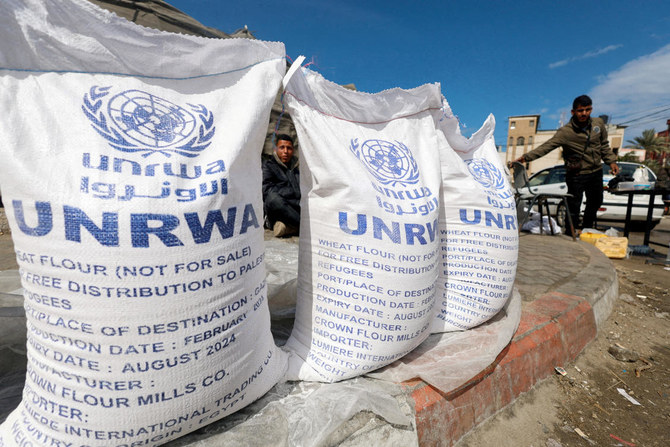
Displaced Palestinians wait to receive United Nations Relief and Works Agency (UNRWA) aid, amid the ongoing conflict between Israel and the Palestinian Islamist group Hamas, in Rafah, in the southern Gaza Strip. (File/Reuters)
Short Url
Updated 02 April 2024
Follow

Japan resumes funding to embattled Palestinian refugee agency UNRWA

  • Countries including Australia and Canada restored funding to the UNRWA

TOKYO: Japan on Tuesday said it will lift its suspension of funding to the UN Palestinian refugee agency (UNRWA) as the relief body works to regain trust after an allegation that some of its staff were involved in the Oct. 7 attack on Israel.
Japan, the sixth-biggest donor to the agency, and 15 other countries paused about $450 million in funding following the allegation by Israel in January, throwing the agency’s operations in the war-torn Gaza Strip into turmoil.
Countries including Australia and Canada have since restored funding to the UNRWA, the largest relief body operating in Gaza, which has been besieged by Israel since the attack.
Japan’s Foreign Minister Yoko Kamikawa, who met UNRWA head Philippe Lazzarini in Tokyo last week, said the agency’s role in addressing the Gaza crisis was “indispensable” even as it works to improve governance and manage risks.
“Japan will lift the moratorium on its financial contributions to UNRWA and provide assistance while ensuring and confirming the appropriateness of Japan’s funds,” Kamikawa told reporters, adding that about $35 million of originally planned funding was ready to be released.
A senior foreign ministry official later told a press briefing that Japan could not comment on the veracity of Israel’s allegations due to an ongoing investigation by the UN Office of Internal Oversight Services.
The UNRWA fired some staff following the allegations. It later said some employees released into Gaza from Israeli detention reported having been pressured by Israeli authorities into falsely stating that staff took part in the Oct. 7 attack, according to a report by the agency dated February.
A separate review of the UNRWA’s activities and neutrality led by former French foreign minister Catherine Colonna is expected to publish its final report later this month.

Battleground: Jerusalem
The biblical battle for the Holy City

Enter


keywords

Dense toxic fog shrouds Delhi as air quality hits severe levels

Updated 12 sec ago
Follow

Dense toxic fog shrouds Delhi as air quality hits severe levels

  • Danish badminton star withdraws from India Open due to Delhi’s air pollution
  • Air quality worst since the peak winter smog season in November last year

NEW DELHI: Residents of Delhi woke up to hazardous air quality on Sunday as a thick blanket of toxic smog and fog engulfed the Indian capital region, pushing air pollution into “severe” levels for the first time this year.

Home to 30 million people, Delhi has not recorded a single “clean air” day since September 2023, with Air Quality Index readings hitting high above the 50 score throughout the past two years.

On the AQI scale from 0 to 500, good air quality is represented by levels below 50, while levels above 300 are dangerous.

Based on Central Pollution Control Board data, the overall AQI was around 439–444, with several stations across Delhi reaching almost 500 — the worst since the peak winter smog season in early November.

The air quality is so bad that a Danish badminton star, Anders Antonsen, withdrew from the ongoing India Open, saying the city was not fit to host the tournament. Antonsen, who is the discipline’s No. 3, said in an Instagram story that the decision was due to “extreme pollution.”

While the athlete chose to pay a $5,000 fine rather than spend a few days in Delhi, its residents are left with little choice but to endure its toxic air.

“To protect myself, I use an N90 mask and drink lots of water. Still, in the first week of January, the smog impacted me with a bad throat and cold, hitting me badly. You are always exposed and risk your health,” said Akriti Chaudhary, a student activist in Delhi.

“The situation is worse for those people who live in the industrial area of Delhi and don’t have the luxury of green cover. They suffer a lot. Different parts of the population suffer differently, but the fact is that all suffer one way or another.”

For Dr. D. Raghunandan, a climate expert and member of a newly launched citizen initiative, SSANS, which acts as a pressure group to urge the government to act to improve air quality, the pollution has already become unavoidable.

“You just have to live with it. There is no way you can avoid it. Like 90 percent of Delhi’s population can’t escape it. Those who have a lot of money can stay indoors with air purifiers,” he said.

“We are concerned that not much is being done to contain the problem. What little is being done is cosmetic. You just have a few small water guns going around the city on tempos and spraying water.”

He compared Delhi’s problem to what China’s capital faced before.

“Look at the way the badminton event has panned out. Gradually, the pollution will start hitting. Ten years ago, Beijing was worse than Delhi in air pollution. And many large companies and corporations decided to leave Beijing,” Raghunandan told Arab News.

“Do you think those guys are going to stay in Delhi? If the pollution stays like this, they’ll move out.”