

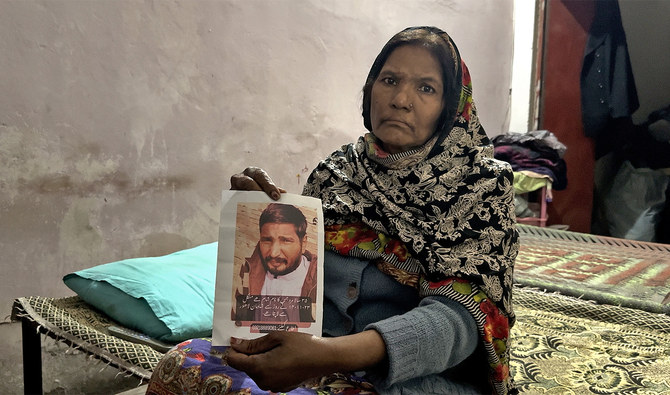

LAHORE: In a busy maze of little streets deep inside the Shah Jamal area of Lahore, one prayer dominated the Easter Day service at the United Church of Lahore on Sunday: for the return of 35-year-old Shaam Arif Massey, who wandered outside his home in November last year and never returned.
The disappearance of Shaam, who grew up with a learning disability after traumatic brain injuries sustained as a child, has shaken the tight-knit Christian community of Fazlia Colony and its surrounding areas, home to roughly 300 Christian families and where Shaam’s family has lived for 40 years in a two-bedroom home built by his grandfather.
Though it was Easter Sunday, there were few signs of celebration in the neighborhood where Shaam’s case has become symbolic of the larger plight of Pakistan’s Christian community, which forms less than 2 percent of the Muslim-majority nation’s population of 241 million and lives mostly in poverty or in fear of attacks.
Parveen Massey, Shaam’s mother and a cleaner at Lahore’s Jinnah Hospital, told Arab News she returned home from work on Nov. 13 last year to find that Shaam was not sitting on his usual spot on the front steps of the family home.
“I asked my grandsons, ‘Where’s Shaam?’ They said he hadn’t come home since morning. I said, ‘Why didn’t you tell me? I would have rushed home from work’ ... Nobody told me and the entire day had passed,” Massey said.
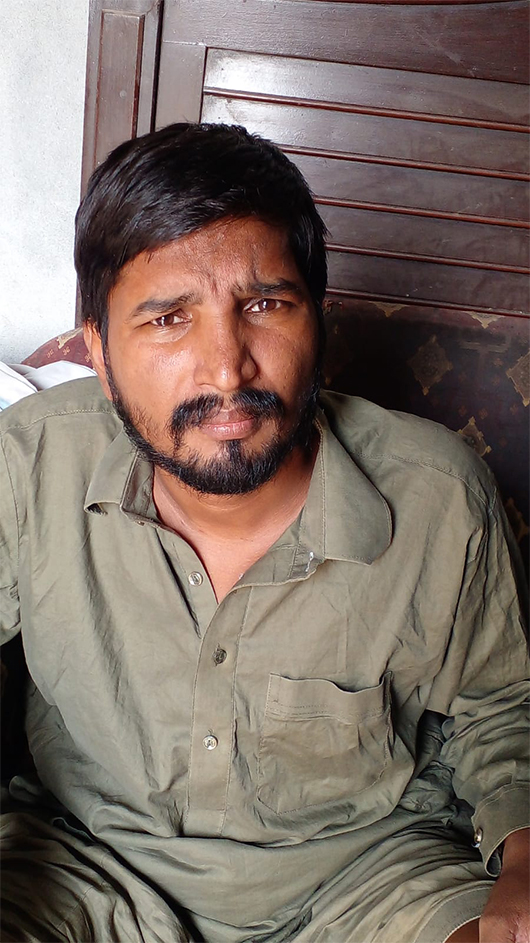
The picture shared by Parveen Massey on March 31, 2024, shows an undated photograph of 35-year-old Shaam Arif Massey, who went missing in Lahore, Pakistan, in November 2023. (AN photo)
The police complaint was registered the same evening.
“But five months on, the police haven’t even come to see our house or where we live. In five months, they’ve never checked in on us. I just go by myself, alone and stand at their [police station] gate.”
The concerned police station is the Icchra Police Station located a few hundred meters from the Massey home. Shaam’s mother last visited two weeks ago, with policemen shooing her away saying they were trying to find Shaam.
“But I’m the only one looking,” she said as she showed a copy of the First Information Report (FIR), or police complaint.
“DEAD ENDS”
After a brain injury at age seven which led to a trail of unfortunate events from missing prescriptions to hospital malpractice and the family’s inability to afford his care bills, Shaam received unknown medications and tranquilizers over many years at various mental health institutes in Lahore, according to his family.
Once the medications were discontinued several years ago, Shaam stopped speaking for the most part and spent his days on the small rooftop of his home feeling the sun and air on his face with his dog Daisy by his side — until the day he disappeared without a trace.
At the Ichhra Police Station, the famed building where the murder case against Pakistani Prime Minister Zulfiqar Ali Bhutto was first filed back in 1974, the officer assigned to Shaam’s case, Assistant Sub Inspector (ASI) Akbar Ali, was not available for comment.
His colleague sub-inspector Muhammad Ali agreed to speak with Arab News but had few answers on the case, including if police were reviewing CCTV footage.
“I can tell you that back when the government started the Safe City surveillance program, things were easy. It was easy to track crime and missing persons,” he said, referring to an AI-driven policing system launched in 2015.
“But now the cameras aren’t maintained, their line of vision is blurred by objects and trees that nobody bothers adjusting, and frankly, we just don’t have enough of them [cameras] … And so, we get to dead ends in such cases.”
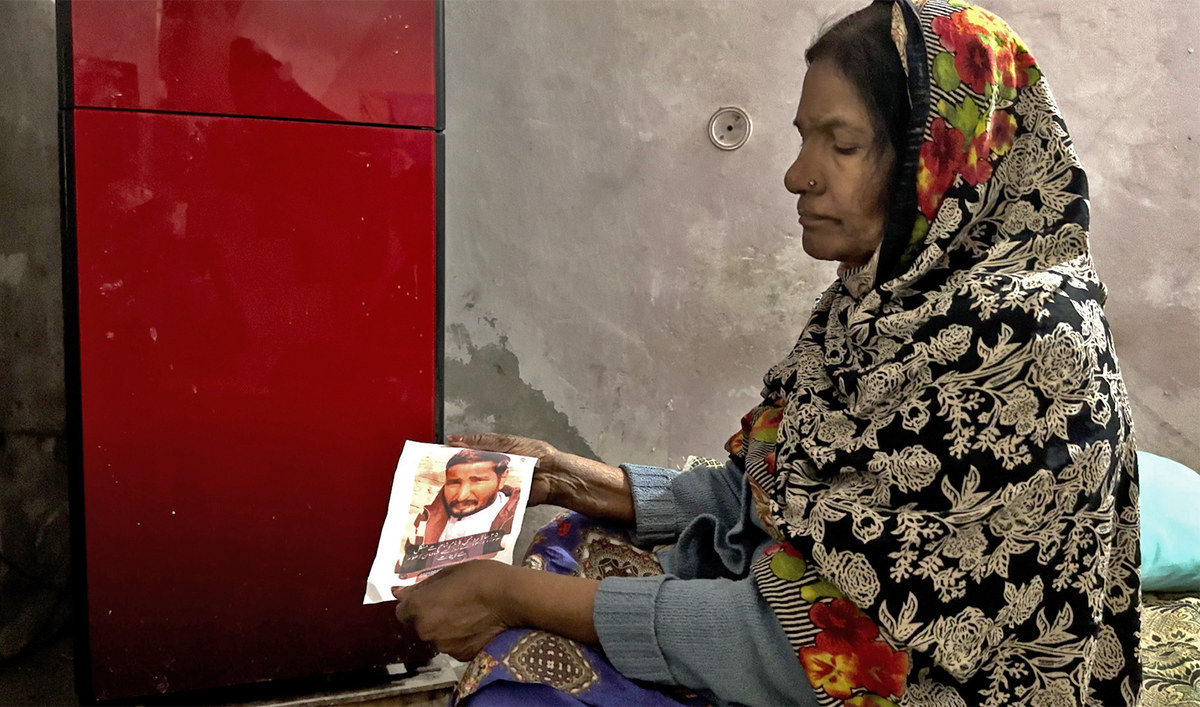
Parveen Massey holds a picture of her missing son, Shaam Arif Massey, who went missing in 2023, in Lahore, Pakistan, on March 31, 2024. (AN photo)
Sardar Ramesh Singh Arora, Punjab Minister for Minorities Affairs, did not respond to phone calls seeking comment.
With little help from police, Shaam’s family, including his older sister Fazeelat Fakhar who works as a babysitter at the homes of Lahore’s elite families, has turned to using connections through employers to push police to prioritize the case.
But nothing has worked.
“Back when Shaam went missing, it was winter, it was so cold,” Fakhar said, her eyes filling with tears.
“From my heart, I’ve tried everything. I’ve looked for my brother non-stop but there’s just no sign of him.”
Fakhar said she had visited dozens of police stations, bus stations and shrines around the area over the last five months and left her brother’s photograph wherever she could:
“My mind and my heart say that he’s safe with an NGO somewhere and that he’s still alive.”
And though there is no breakthrough in the case, religious holidays like Easter bring new hope for Shaam’s return.
“He wasn’t with us for Christmas and now Easter has also passed,” Fakhar said. “But Easter is the day for miracles and we pray we can celebrate again when Shaam comes home.”


