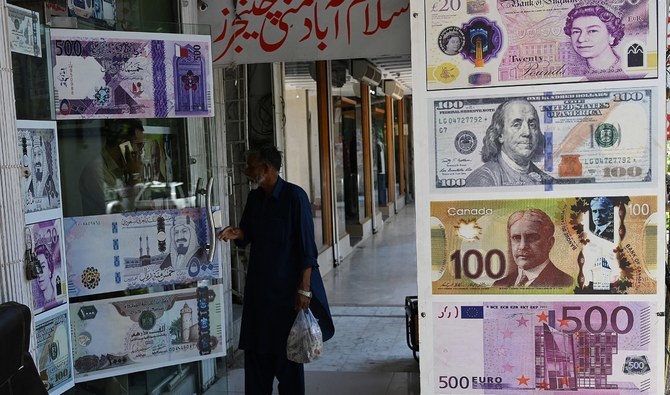
ISLAMABAD: A sustained surge is expected in Pakistan’s remittances in the next few months due to political and economic stability, improved control over illegal money flows and major religious festivals ahead, experts said on Sunday, as the country received $7.02 billion in remittances in the last three months, up from $5.99 billion in the same period last year.
Remittances bring billions of dollars annually from overseas Pakistanis and are vital to Pakistan’s economy. These inflows bolster foreign exchange reserves, stabilize the balance of payments, and support the Pakistani currency.
Pakistan has set a worker remittance inflow target of $28.5 billion for the current year. Despite an overall slight decline of 1.2 percent on a year-on-year basis in the first eight months (July 2023 till February 2024) of this fiscal year, remittance inflows remain substantial and have seen an upward surge in the last three months.
More than 9 million Pakistani expats sent $18.083 billion during the first eight months of this fiscal year, compared to $18.308 billion sent during the same period previous year. Remittance inflows in February 2024 saw a 13 percent growth to $2.25 billion from $1.99 billion recorded in the same month last year, according to the State Bank of Pakistan (SBP).
This follows a 26 percent surge in January, with remittances reaching $2.39 billion compared to $1.90 billion in January 2023. Similarly, December 2023 recorded a 13 percent increase in remittances to $2.38 billion from $2.10 billion in December 2022.
Financial experts say less fluctuation in currency rates, successful reviews of the country’s $3 billion International Monetary Fund (IMF) program, crackdown on currency smugglers and post-election stability were the reasons behind the increase in remittances
“Recent months have seen effective control over the gap between interbank and open market rates, leading to more remittances through legal channels as when this gap is wide, expatriates tend to resort to unofficial channels for money transfers,” Tahir Abbas, head of research at Arif Habib Limited securities firm, told Arab News, adding this upward trend is expected to continue for the next four months, driven by factors such as Ramadan, Zakat collection, and Eid festivals.
“Next three months are expected to have a huge boost with over $2.5 billion remittances each due to two Eid festivals. To sustain this positive trend in the long term, the government must prioritize digitalization efforts, intensify crackdowns on illegal channels, and maintain a balanced approach to managing the country’s balance of payments.”
Sheheryar Butt, portfolio manager at Darson Securities, said the stability in currency exchange rate over the recent months had instilled confidence among overseas Pakistanis to remit money through legal channels.
“Another contributing factor is the seasonal impact observed during Ramadan or its proximity, leading to increased remittances sent to families,” he said, adding the emigration of a large number of Pakistanis abroad was also resulting in additional inflows.
“While Pakistan’s remittance figures are expected to remain substantial given the large number of Pakistanis working abroad, realizing significant growth in remittances necessitates the government’s further incentives to encourage legal remittance channels.”
Ahsan Mehanti, the chief executive officer of the Arif Habib Corporation, said this ongoing upward trend in remittances would likely continue as Pakistan was effectively meeting IMF conditions, including privatization, power tariff adjustments, and economic reforms.
“Especially, if we succeed in negotiating a new, larger IMF program and continue implementing economic and structural reforms to maintain currency stability,” he added.
Mehanti said the Special Investment Facilitation Council (SIFC) also played a significant role through its crackdown on illegal money channels and efforts to enhance investments, particularly from Gulf countries, which bolstered expatriate confidence in the Pakistani system.
Pakistani expatriates agreed with the financial experts, citing stability in rupee’s value, improved political and economic conditions, and government’s efforts to control currency gaps as key factors boosting their confidence in legal remittance channels.
“It is simple if there will be a significant gap between open market and interbank rate then everyone sends through unofficial channels as we will get more money against our remittances,” Tanvir Ahmed, a Pakistani taxi driver working in Dubai, told Arab News.
“Earlier, I along with a few friends preferred to send money through unofficial ways as there was a difference of over 10-15 rupees which is significant but now it is not more than 1-2 rupees so we are happy to send through official channels.”
Naveed Ahmed, a Pakistani engineer based in Riyadh, emphasized the importance of rupee’s stability for overseas Pakistanis.
“It is crucial for us because everyone desires the best value for their hard-earned money and stability if we intend to invest back home,” he told Arab News.
“Recently, the government, aligned with Pakistan army, has taken good steps to control currency smuggling which has stabilized it and increased confidence of expatriates to send more money to Pakistan,” Ahmed said, adding he had remitted more money back home in recent months to help his brother start a business.


Experts predict sustained surge in Pakistan remittances amid political, economic stability
https://arab.news/r5kmw
Experts predict sustained surge in Pakistan remittances amid political, economic stability

- Pakistan received $7.02 billion in remittances in last three months, up from $5.99 billion last year
- The South Asian country has set worker remittance inflow target of $28.5 billion for current year

Debris removal steps up at Karachi fire-hit plaza as death toll nears 60
- KMC teams remove debris under safety precautions as search for the missing continues
- Authorities are keeping agencies on alert amid rain forecast as the site remains unstable
ISLAMABAD: Municipal and rescue teams stepped up debris removal operations at a fire-hit shopping plaza in Pakistan’s largest city of Karachi on Wednesday, as officials said the death toll from the blaze has climbed to nearly 60 and the search for missing victims continues.
Teams from the Karachi Metropolitan Corporation (KMC) are clearing rubble from Gul Plaza, a multi-story shopping complex where a fire broke out late Saturday, under strict safety measures, with debris being transported to a designated ground in the city’s Meva Shah area, an official statement said.
“Rescue teams are continuously engaged in search and clearance operations to locate any remaining victims,” the statement circulated by the KMC said, adding that authorities were aiming to complete the process as soon as possible while ensuring safety.
Located in Karachi’s densely populated Saddar district, the fire at Gul Plaza burned for more than 24 hours before being brought under control. The blaze gutted more than 1,200 shops, triggered partial structural collapse and left dozens of people trapped inside.
With rain forecast in the coming days, authorities have placed all relevant departments on alert and are making contingency preparations to prevent further risks at the site, the KMC statement said.
The disaster at the shopping mall has renewed scrutiny of fire safety standards in Karachi’s commercial buildings, where overcrowding, illegal construction and weak enforcement have repeatedly contributed to deadly incidents.
Following the Gul Plaza fire, the Sindh Building Control Authority has warned developers and building owners to address fire safety violations or face legal action.
Deadly fires remain a recurring threat in the city of more than 20 million people, despite periodic crackdowns ordered after major disasters.


