Russia launches barrage of 99 drones and missiles on Ukraine’s energy system, officials say

1 / 3
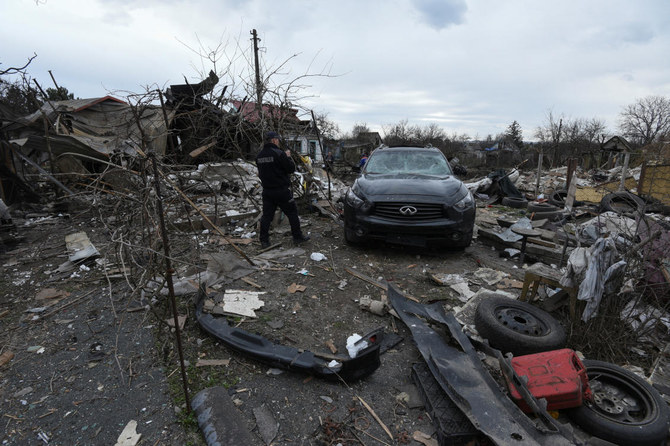
A police officer inspects a residential area heavily damaged during a Russian missile and drone strike in the city of Kamianske, Dnipropetrovsk region, Ukraine Mar. 29, 2024. (Reuters)
2 / 3
Russian aerial attacks killed three people in frontline Ukrainian regions on Mar. 28, 2024, local officials said, while Kyiv arrested two people it claimed were collaborating with Russia’s intelligence services. (AFP)
3 / 3
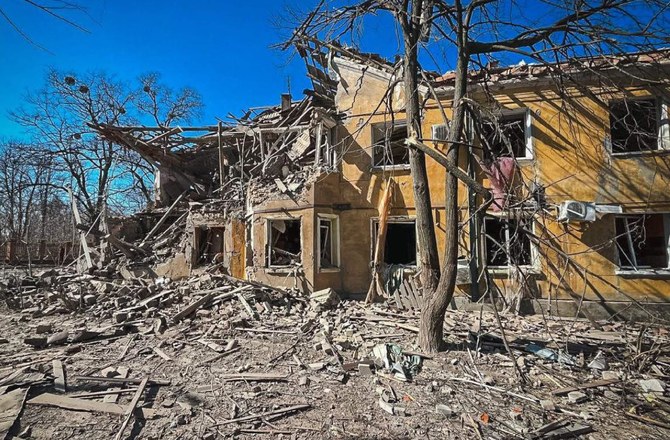
This handout photograph taken and released by Ukrainian Emergency Service on March 28, 2024, shows rescuers working at the site of a missile attack in Mykolaivka, Donetsk region. (AFP)
Short Url
Updated 30 March 2024
Follow

Russia launches barrage of 99 drones and missiles on Ukraine’s energy system, officials say

  • Air raid warnings rang out across the nation, with 10 Ukrainian regions coming under fire, the country’s interior minister, Ihor Klymenko, said
  • Ukraine’s state-owned grid operator, Ukrenergo, said Friday’s attack deliberately targeted thermal and hydroelectric power plants across central and western regions

KYIV: Moscow launched a large-scale attack on Ukraine’s energy infrastructure Friday, with a mass barrage of 99 drones and missiles hitting regions across the country, Ukraine’s armed forces said.
Air raid warnings rang out across the nation, with 10 Ukrainian regions coming under fire, the country’s interior minister, Ihor Klymenko, said.
Russia has escalated its attacks on Ukraine in recent days, launching several missile barrages on the capital, Kyiv, and hitting energy infrastructure across the country in apparent retaliation for recent Ukrainian aerial attacks on the Russian border region of Belgorod. Such sporadic attacks, however, have been common throughout the war.
Large-scale blackouts have already affected Ukraine’s eastern city of Kharkiv, where 700,000 people lost power after the city’s thermal power plant was hit in a drone and missile attack on March 22.
In the winter of 2022-23, Russia targeted Ukraine’s energy infrastructure, causing frequent blackouts. Many in Ukraine and the West expected that Russia might repeat that strategy this winter, but Russia instead initially focused its strikes on Ukraine’s defense industries.
Ukraine’s state-owned grid operator, Ukrenergo, said Friday’s attack deliberately targeted thermal and hydroelectric power plants across central and western regions.
In a statement, Ukrainian President Volodymyr Zelensky confirmed that Ukraine’s Kaniv and Dniester hydroelectric power stations had come under attack and accused Moscow of risking an ecological disaster similar to the destruction of the Kakhovka Dam in June 2023.

Opinion

This section contains relevant reference points, placed in (Opinion field)

Both Kyiv and Moscow have accused the other of destroying the dam, but the various Russian allegations — that it was hit by a missile or taken down by explosives — fail to account for a blast so strong that it registered on seismic monitors in the region.
The dam’s destruction led to deadly flooding, endangered crops, threatened drinking water supplies for thousands and unleashed an environmental catastrophe.
Zelensky also warned that other countries would be threatened if the dams were hit. Dnister Hydroelectric station, located near the city of Novodnistrovsk, Ukraine, is approximately 15 kilometers (9 miles) from the border with Moldova.
“Not only is Ukraine under threat, but Moldova too,” Zelensky said. “The water will not stop in front of the border.”
DTEK, Ukraine’s largest private electricity operator, also said that three of its thermal power plants had been damaged in the attacks. It announced emergency power shutdowns in the city of Odesa, leaving several neighborhoods without power.
Five people, including a 5-year-old girl, were wounded during the attack in Ukraine’s Dnipropetrovsk region, said local Gov. Serhii Lysak.
He later said that another man had been killed and one more injured in a separate drone attack Friday.
Elsewhere, Ukrainian police said rescuers had recovered the body of a 66-year-old woman from a building in the Mykolaiv region that was hit by a Russian missile Thursday night.
The bombardment in the west of Ukraine caused the Polish Armed Forces to scramble its own aircraft, the country’s operational command said on social media.
Last week, Warsaw demanded an explanation from Moscow after one of its missiles strayed briefly into Polish airspace during a major missile attack on Ukraine, prompting the NATO member to activate F-16 fighter jets.
Romania’s defense ministry also said on Friday that an investigation has been launched after fragments that appeared to be from a drone were identified on its territory Thursday evening in an agricultural area of Braila county, close to the border with Ukraine.
It did not provide additional details, although since the start of Russia’s full-scale invasion of neighboring Ukraine, NATO member Romania has confirmed drone fragments on its territory on several occasions.
Belgorod also came under fire Friday, Russia’s Ministry of Defense wrote on social media. It said that it shot down 15 Ukrainian shells, with falling debris damaging a number of residential buildings. No casualties were reported.
Regional Gov. Vyacheslav Gladkov later said on social media that one man had died as the result of a separate drone attack which struck an apartment block.


Louvre thieves escaped with 30 seconds to spare, probe reveals

Updated 2 sec ago
Follow

Louvre thieves escaped with 30 seconds to spare, probe reveals

  • Probe found only one of two security cameras was working near the site where the intruders broke in on the morning of Sunday October 19
PARIS: The thieves who stole crown jewels from the Louvre in October evaded police with just 30 seconds to spare due to avoidable security failures at the Paris museum, a damning investigation revealed on Wednesday.
The probe, ordered by the culture ministry after the embarrassing daylight heist, revealed that only one of two security cameras was working near the site where the intruders broke in on the morning of Sunday October 19.
Agents in the security control room did not have enough screens to follow the images in real-time, while a lack of coordination meant police were initially sent to the wrong place once the alarm was raised, the report unveiled at the French Senate’s Culture Commission stated.
“It highlights an overall failure of the museum, as well as its supervisory authority, to address security issues,” the head of the commission, Laurent Lafon, said at the start of a hearing.
One of the most startling revelations was that the robbers left only 30 seconds before police and private security guards arrived on the scene.
“Give or take 30 seconds, the Securitas (private security) guards or the police officers in a car could have prevented the thieves from escaping,” the head of the investigation, Noel Corbin, told senators.
He said that measures such as a modern CCTV system, more resistant glass in the door cut open with angle grinders, or better internal coordination could have prevented the loss of the jewels — worth an estimated $102 million — which have still not been found.
Major security vulnerabilities were highlighted in several studies seen by management of the Louvre over the last decade, including a 2019 audit by experts at the jewelry company Van Cleef & Arpels.
Their findings stressed that the riverside balcony targeted by the thieves was a weak point and could be easily reached with an extendable ladder — exactly what transpired in the heist.
‘Stunned’
Corbin confirmed that under-fire Louvre boss Laurence des Cars had not been aware of the audit which was ordered by her predecessor, Jean-Luc Martinez.
“The recommendations were not acted on and they would have enabled us to avoid this robbery,” Corbin said, adding that there had been a lack of coordination between the two government-appointed administrators.
Police believe they have arrested all four intruders, who escaped on powerful motorbikes, having carried out the heist in the Apollo Gallery in around 10 minutes in total, according to the investigation.
The revelations on Wednesday are likely to pile more pressure des Cars, the first woman in the role who was appointed by President Emmanuel Macron in 2021.
Questions have swirled since the break-in over whether it was avoidable and why a national treasure that is the world’s most-visited museum appeared to be so poorly protected.
France’s lower house of parliament is carrying out its own inquiry, while des Cars and Martinez are set to be grilled by senators next week.
Last month, France’s state auditor said security upgrades had been carried out at a “woefully inadequate pace” and the museum had prioritized “high-profile and attractive operations” instead of protecting itself.
Senior police officer Guy Tubiana, a security adviser at the culture ministry who took part in the investigation, told senators he was “stunned” by what he had discovered at the museum.
“There was a succession of malfunctions that led to catastrophe but I never would have thought the Louvre could have so many malfunctions,” he said.
Staff at the Louvre at set to go on strike on Monday to demand management act against what they see as understaffing and overcrowding at the museum, which welcomed 8.7 million people last year.
At the weekend, the museum revealed that a water leak had damaged 300 to 400 journals, books and documents in the Egyptian department in late November.