PESHAWAR: Chinese contractors have halted construction on two major dam projects in Pakistan after a suicide bomber killed five Chinese engineers and a Pakistani driver this week, a provincial official told AFP on Friday.
The companies have demanded that Pakistan authorities come up with new security plans before reopening the sites where around 1,250 Chinese nationals are working, the official said.
The security of Chinese workers is a major concern to both countries, with nationals frequently targeted by militants hostile to outside influence.
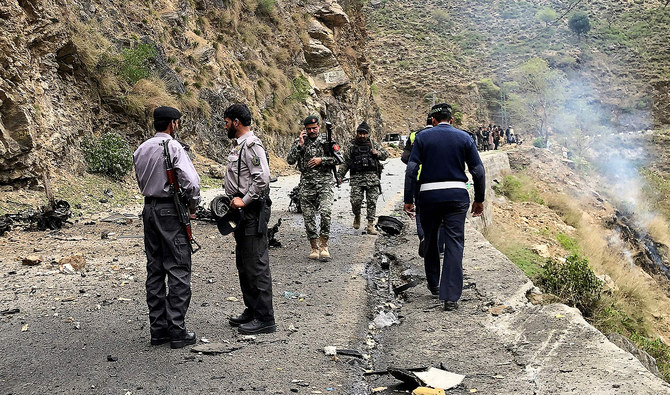
The workers were targeted on Tuesday by a suicide bomber who rammed into their vehicle on a mountainous road near one of the dam sites.
He detonated his explosives on impact, plunging their vehicle into a deep ravine.
A senior official from the Khyber Pakhtunkhwa interior department told AFP on condition of anonymity that since Wednesday, China Gezhouba Group Company has halted work on the Dasu dam in the province and Power China has stopped work on Diamer Bhasha dam, which straddles two provinces.
“They have demanded new security plans from the government,” he said.
“Around 750 Chinese engineers are engaged in the Dasu Dam project, while 500 are working on the Diamer Bhasha Dam,” he added.
He said the movement of Chinese engineers has been restricted to the compounds where they live, close to the sites.
China has not commented, but this week repeatedly urged Pakistan to ensure the safety of its nationals.
Beijing is Islamabad’s closest regional ally, readily providing financial assistance to bail out its often-struggling neighbor.
China has inked more than two trillion dollars in contracts around the world under its Belt and Road investment scheme, with billions pouring into infrastructure projects in Pakistan.
But Pakistanis have long complained that they are not getting a fair share of jobs or wealth created by the projects.
Tuesday’s attack sparked a flurry of diplomatic activity at the Chinese embassy in Islamabad, with Prime Minister Shehbaz Sharif and the foreign and interior ministers offering condolences in quick succession.
China’s foreign ministry declared the countries “iron-clad friends” but asked Pakistan to “take effective measures to ensure the safety and security of Chinese nationals, projects, and institutions.”
Tuesday’s attack came just days after militants attempted to storm offices of the Gwadar deepwater port in the southwest, considered a cornerstone of Chinese investment in Pakistan.
In 2019, gunmen stormed a luxury hotel in Balochistan province overlooking the flagship Chinese-backed deepwater seaport in Gwadar that gives strategic access to the Arabian Sea — killing at least eight people.
In June 2020, Baloch insurgents targeted the Pakistan Stock Exchange, which is partly owned by Chinese companies, in the commercial capital of Karachi.


Pakistan official says China halts work on two projects after deadly attack
https://arab.news/pb32r
Pakistan official says China halts work on two projects after deadly attack

- The companies have demanded Pakistan authorities come up with new security plans before reopening the sites
- The security of Chinese workers, who are frequently targeted by militants, is a major concern to both countries

Pakistan to promote mineral sector at Saudi forum this month with 13 companies
- Delegation will take part in the Future Minerals Forum in Riyadh from Jan. 13-15
- Petroleum minister will lead Pakistan, participate in a 90-minute country session
ISLAMABAD: Around 13 Pakistani state-owned and private companies will attend the Future Minerals Forum (FMF) in Saudi Arabia from Jan. 13 to 15, an official statement said on Friday, as the country seeks to ramp up global engagement to develop its mineral resources.
The FMF is an international conference and investment platform for the mining sector, hosted by mineral-rich countries to attract global investors, companies and governments.
Petroleum Minister Ali Pervaiz Malik confirmed Pakistan’s participation in a meeting with the Saudi envoy, Nawaf bin Said Al-Malki.
Pakistan hosts one of the world’s largest copper-gold zones. The Reko Diq mine in southwestern Balochistan, with an estimated 5.9 billion tons of ore, is partly owned by Barrick Gold, which calls it one of the world’s largest underdeveloped copper-gold deposits. Its development is expected to boost Pakistan’s struggling economy.
“Upon an invitation of the Government of the Kingdom of Saudi Arabia, the Federal Minister informed the Ambassador that Pakistan will fully participate in the upcoming Future Minerals Forum (FMF), scheduled to be held in Riyadh later this month,” Pakistan’s Press Information Department (PID) said in an official statement.
The Pakistani minister will lead his country’s delegation at the FMF and take part in a 90-minute country showcase session titled “Unleashing Potential: Accelerating Pakistan’s Mineral Revolution” along with local and foreign investors.
Pakistan will also establish a dedicated pavilion to highlight the vast potential of its rich geological landscape to the global mineral community.
The Saudi envoy welcomed Pakistan’s decision to participate in the forum and discussed enhancing bilateral cooperation in the minerals and energy sectors during the meeting.
According to the statement, he highlighted the potential for cooperation between Saudi Arabia and Pakistan in the minerals and energy sectors, expressing confidence that the FMF would provide a platform to expand collaboration.
Pakistan’s mineral sector, despite its rich reserves of salt, copper, gold and coal, contributes only 3.2 percent to the country’s GDP and just 0.1 percent to global mineral exports.
However, many countries, including the United States, have shown interest in Pakistan’s underdeveloped mineral sector, particularly in copper, gold and other critical resources.
In October, Pakistan dispatched its first-ever shipment of rare earth and critical minerals to the United States, according to a Chicago-based US public relations firm’s report.


