

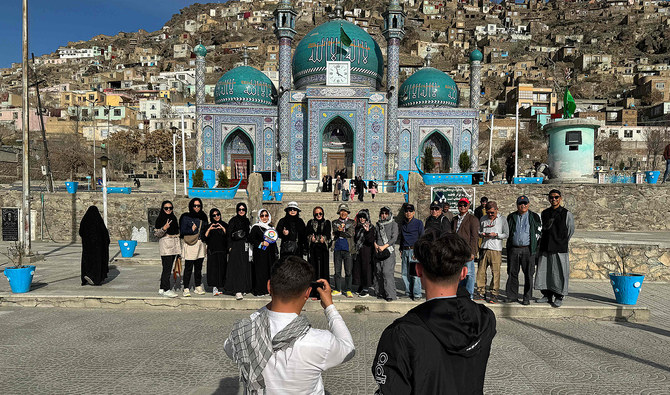

MAZAR-I-SHARIF: His soldier son toured Afghanistan with insurgents in his crosshairs, but American traveler Oscar Wells has a different objective — sight-seeing promoted by the Taliban’s fledgling tourism sector.
“It is a unique place, it touches my heart,” the 65-year-old Indiana farmer told AFP, praising “its magnificent mountains” with “people living in the old way.”
Marvelling at the 15th century Blue Mosque in northern Mazar-i-Sharif, Wells is among a small but rising number of travelers coming to Afghanistan since the war’s end.
Decades of conflict made tourism extremely rare, and while most violence has now abated, visitors are confronted with extreme poverty, dilapidated cultural sites and scant hospitality infrastructure.
They holiday under the austere control of Taliban authorities, without consular support after most embassies were evacuated following the fall of the Western-backed government in 2021.
They must register with officials on arrival in each province, comply with a strict dress code and submit to searches at checkpoints by men armed with Kalashnikovs.
Islamic State attacks also still pose a potential threat in the country.
“The first thing your loved ones say is: ‘You’re crazy to go there!’” said French tourist Didier Goudant, a 57-year-old lawyer, of a country that Western governments warn against visiting.
Security concerns worried Nayuree Chainton, the 45-year-old Thai owner of a travel agency in Bangkok, who made a trip for six days recently with a group to test the waters.
“I feel safe despite the checkpoints in the cities,” she said, during a visit to a shrine in the capital Kabul.
The number of foreign tourists visiting Afghanistan rose 120 percent year-on-year in 2023, reaching nearly 5,200, according to official figures.
The Taliban government has yet to be officially recognized by any country — in part because of its heavy restrictions on women — but it has welcomed foreign tourism.
“Afghanistan’s enemies don’t present the country in a good light,” said information and culture minister Khairullah Khairkhwa.
“But if these people come and see what it’s really like... they will definitely share a good image of it,” he said.
But Wells and Goudant — on a trip with firm Untamed Borders, which also offers tours of Syria and Somalia — describe their visit as a way to connect with Afghanistan’s people.
Tourists “like us are curious and want to be in contact with the population, to try to help them a little” said Goudant, on his second trip, which included skiing in central Bamiyan province.
He said part of his visits is making donations to local groups, something he describes as “small-scale humanitarian work” in a country that has seen foreign aid drastically shrink since the Taliban takeover.
For Wells, there is a “sense of guilt for the departure” of US troops.
“I really felt we had a horrible exit, it created such a vacuum and disaster,” he said. “It’s good to help these people and keep relations.”
Untamed Borders brought around 100 tourists to Afghanistan last year, with a nine-day package starting in neighboring Pakistan costing $2,850.
The end of the fighting means tourists “can do more things,” said founder James Willcox.
“But on the other hand it is disruptive,” he added, noting a woman tour guide with the company fled to Italy after the Taliban return.
While the Taliban government has shut girls and women out of education, and much of public life, foreign women are granted greater freedoms.
For solo traveler Stefanie Meier, a 53-year-old American, who spent a month traveling from Kabul to Kandahar via Bamiyan and Herat in the west, it was a “bittersweet experience.”
“I have been able to meet people I never thought I would meet, who told me about their life,” she said, adding that she didn’t face any issues as a woman on her own.
She experienced “disbelief that people have to live like this,” she added. “The poverty, there are no jobs, women not being able to go to school, no future for them.”
With little by way of official information, tourists band together on social media and messaging apps to trade tips.
While two airlines serve Afghanistan’s major cities, backpackers prefer the bus, and don’t shy away from the 20-hour journey from Kabul to Herat.
An active WhatsApp group named Afghanistan Travel Experience brings together over 600 people from places as far flung as Mexico, India and Italy who are already in the country or on their way out.
They pepper the group with questions, such as one from user Alberto asking if it is “haram” (not allowed) to travel with a dog, or if it’s a problem to have visible tattoos.
Another, Soo, asked: “Is there a co-working space in Mazar?”


