

Saudi Arabia committed to preserving environment, water resources, minister tells WEF

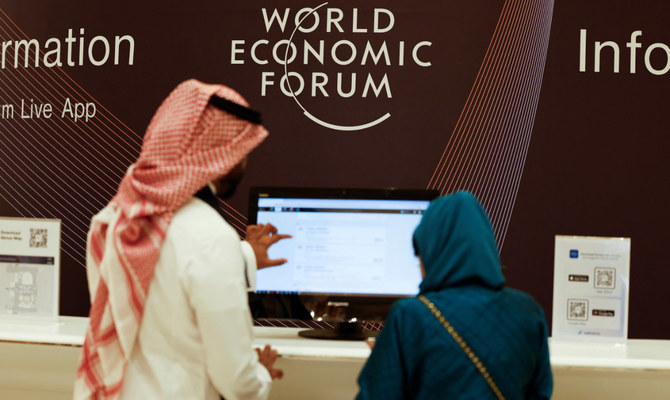
Visitors attend the World Economic Forum (WEF) in Riyadh, Saudi Arabia, April 28, 2024. (Reuters)
Short Url
Updated 28 April 2024
Follow

Saudi Arabia committed to preserving environment, water resources, minister tells WEF

  • Nation providing incentives for private sector to become more engaged, Abdulrahman Al-Fadley says

DUBAI: Saudi Arabia has detailed plans for the protection of its lands and environmental resources, the Minister of Environment, Water and Agriculture said on Sunday.

Speaking at the World Economic Forum in Riyadh, Abdulrahman Al-Fadley said: “We have devised our plans based on the preservation of our environment and the management of our water resources. The Kingdom is also providing incentives for the private sector to become more engaged and more responsible toward the environment.”

With 40 percent of lands around the world degraded and further degrading at an alarming rate, critical action is needed as the UN Convention to Combat Desertification COP16 is set to take place in Riyadh in December.

Al-Fadley said Saudi Arabia had preserved millions of hectares of land and set up programs for cloud seeding and increasing the number of dams in the country.

“This will not only be beneficial to the Kingdom but for the whole region,” he said. “With us hosting COP16 we are hoping to give the meeting the importance it commands. We don’t want matters to go back to the status quo after COP16 ends.”

Tariq Al-Olaimy, a member of the Global Shapers Community Foundation Board at the WEF, commended King Salman for his land restoration efforts.

“When you put nature first, you are equally putting people first,” he said. “Nature is our greatest collaborator … There is no successful growth story without successful land restoration and this starts inwardly, through our religion, community, values and moral clarity.”

Ibrahim Thiaw, secretary of the UNCCD, warned of global repercussions if the world did not pay heed to environmental safekeeping.

“Entire ecosystems are being destroyed through actions and inactions,” he said. “There has been a 29 percent increase in droughts in the past few years and that is affecting 1.8 billion people around the world. For poor nations that is disastrous and carries a large death toll of animals, people and agriculture. We have to be more proactive and not just emergency-ready. We must attempt to avoid emergencies.”

Thiaw said the Panama Canal’s functionality had been reduced by 12 percent, which was causing a problem for supplies.

“Demand is increasing while resources are shrinking,” he said. “As humanity we have been looking at resources as if they are unlimited. We have not been managing them. Companies need to reset their relationship with nature and we need to focus on land restoration to keep going.”

Naoki Ishii, director of the Center for Global Commons, had similar concerns.

“We are on a collision course,” he said. “The only solution is to modify our economic system. COP16 must be transformative for all of us. We need the political momentum to implement positive changes.

“If we are able to push those efforts, economically and ideally speaking, that will be a game changer.”


Saudi Arabia leads GCC IPO market in 2025, raises $4.1bn: Markaz 

Updated 7 sec ago
Follow

Saudi Arabia leads GCC IPO market in 2025, raises $4.1bn: Markaz 

RIYADH: Saudi Arabia strengthened its role in the Gulf Cooperation Council’s initial public offering market in 2025, raising $4.1 billion in proceeds, the highest in the region, according to an analysis. 

In its latest report, Kuwait Financial Center, also known as Markaz, said the Kingdom accounted for 79 percent of total GCC IPO proceeds during the year, underscoring growing investor interest in the nation’s capital markets. 

Saudi Exchange witnessed 13 IPOs in 2025, raising $3.7 billion, while the parallel market Nomu raised $336 million through 23 offerings. 

Developing a robust capital market ecosystem is crucial for countries in the GCC region, as they continue to pursue economic diversification efforts to reduce reliance on oil. 

Overall, the GCC region raised $5.1 billion through 40 offerings in 2025, representing a 61 percent decline compared to the previous year. 

“Corporate IPOs raised $3.9 billion, or 76 percent of the total GCC IPO proceeds during the year, through 37 offerings. While IPOs offered by government-related entities only accounted for 24 percent, amounting to $1.2 billion through 3 offerings,” said Markaz.  

In the region, the UAE came second with $544 million in proceeds through two IPOs. 

The Abu Dhabi Securities Exchange raised $163 million through Alpha Data’s IPO, while Dubai Financial Market raised $381 million through Alec Holdings’ IPO. 

Oman raised $333 million, or 7 percent of total GCC IPO proceeds, through the Asyad Shipping Co. IPO on the Muscat Securities Market. 

Kuwait saw the IPO of Action Energy Co. during the fourth quarter of 2025. The offering raised $180 million, constituting 4 percent of total GCC IPO proceeds for the year. 

Sectoral breakdown  

The industrials sector raised $1.9 billion, accounting for nearly 37 percent of total proceeds in 2025, with the largest contribution coming from Saudi Arabia’s flynas, which raised $1.1 billion. 

This was followed by the real estate sector with $1.2 billion, or 23 percent of total proceeds, from seven IPOs, including Umm Al Qura for Development and Construction and Dar Al Majed Real Estate Co. 

The healthcare sector raised $508 million, constituting 10 percent of total proceeds, through three IPOs — SMC Hospitals on Tadawul’s Main Market and Basma Adeem and Wajd Life Trading Co. on the Nomu parallel market. 

“The consumer discretionary sector saw $479 million in proceeds, constituting 9 percent of the total proceeds, through 10 IPOs, all in Saudi Arabia, while the financial services sector saw $400 million from Derayah Financial Co’s IPO on Tadawul, constituting 8 percent of the total GCC IPO proceeds during the year,” added Markaz.  

The next-largest contributors were the technology and energy sectors, each accounting for 4 percent of total proceeds, followed by materials and consumer staples at 3 percent each. 

Post-listing performance  

Top IPO gainers in 2025 benefited from attractive offer pricing, strong post-listing liquidity and exposure to sectors with clear growth or defensive characteristics. 

Markaz said listings on Tadawul, across both the Main Market and Nomu, saw performance supported by broad investor participation and sustained demand. 

The largest gainer was Ratio Speciality Co., listed on Nomu in March 2025, with its share price advancing 190 percent from its offering price of SR10. 

By contrast, some IPOs recorded negative performance, weighed down by overvaluation, limited liquidity and exposure to low-growth or margin-pressured sectors. 

“Companies faced structural challenges and muted post-listing investor interest, which negatively impacted performance throughout the year. The weakest performer was Smoh Almadi, listed on Nomu in January 2025, with shares that dropped by 60 percent after its offering price at SR22,” added Markaz.  

GCC markets’ performance  

Markaz said Oman’s Muscat Securities Market emerged as the best-performing index in the GCC region in 2025, advancing 28.1 percent year on year. 

Kuwait ranked second, posting gains of 25.3 percent. Dubai Financial Market rose 17.2 percent, while the Abu Dhabi Exchange gained 6.1 percent. 

Bahrain Bourse and the Qatar Stock Exchange recorded increases of 4.1 percent and 1.8 percent, respectively. 

However, Saudi Arabia’s Tadawul All Share Index declined 12.8 percent during the year. 

Looking ahead, GCC IPO activity is expected to rise in 2026 compared with 2025, driven by stable global interest rates and ongoing divestment initiatives, according to Markaz. 

“With strengthening investor confidence and evolving regulatory frameworks, the region is likely to attract a broader range of companies preparing for public offerings,” added the report.