US says it doesn’t support Pakistan-Iran gas pipeline project going forward

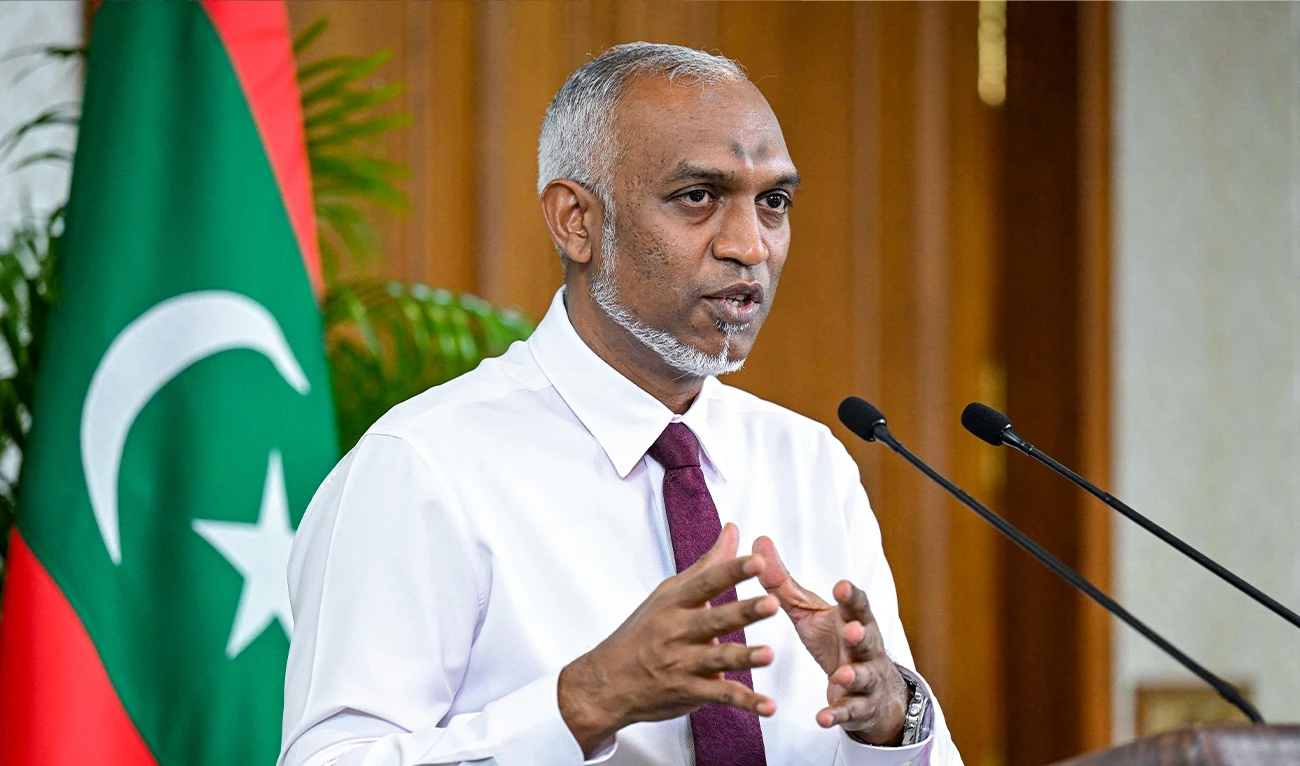
US State Department Spokesperson Matthew Miller speaks during a press briefing in Washington, US, on March 26, 2024. (US State Department)
Short Url
Updated 27 March 2024
Follow

US says it doesn’t support Pakistan-Iran gas pipeline project going forward

  • US State Department cautions about the risk of sanctions in doing business with Tehran
  • Pakistan-Iran gas pipeline has been facing delays and funding challenges for several years

WASHINGTON: The US said on Tuesday it does not support a Pakistan-Iran gas pipeline project from going forward and cautioned about the risk of sanctions in doing business with Tehran.
WHY IT IS IMPORTANT
The Pakistan-Iran gas pipeline, known as the Peace Pipeline, is a long-term project between Tehran and Islamabad, and has faced delays and funding challenges for several years. The pipeline would transport natural gas from Iran to neighboring Pakistan.
Iran and Pakistan had signed a five-year trade plan in August 2023 and set a bilateral trade target at $5 billion.
Pakistan’s Petroleum Minister Musadik Malik said this week that his country was seeking a US sanctions waiver for the gas pipeline from Iran.
KEY QUOTES
“We always advise everyone that doing business with Iran runs the risk of touching upon and coming in contact with our sanctions, and would advise everyone to consider that very carefully,” a US State Department spokesperson told reporters in a press briefing.
“We do not support this pipeline going forward,” the spokesperson added, saying that Donald Lu, the State Department’s top official for South and Central Asia, had said as much to a congressional panel last week.
CONTEXT
A few weeks ago, Pakistan and Iran engaged in tit-for-tat strikes when they exchanged drone and missile strikes on militant bases on each other’s territory.
Washington’s relations with Iran have been thorny for a long time and the US has issued multiple rounds of sanctions on Iranian entities.
Officially allies in fighting extremism, Pakistan and the US have had a complicated relationship over the years, bound by Washington’s dependence on Pakistan to supply its troops during its long war in Afghanistan but plagued by accusations Islamabad played a double game.
Some Pakistani politicians have also accused Washington of meddling in Pakistan’s domestic politics, charges that Washington denies.
Pakistan’s JF-17 fighter jet draws ‘strong interest’ at Riyadh defense exhibition

Updated 29 min 30 sec ago
Follow

Pakistan’s JF-17 fighter jet draws ‘strong interest’ at Riyadh defense exhibition

  • Jets showcased as Pakistan seeks to expand defense exports
  • Interest in JF-17 has heightened after May 2025 conflict with India 

ISLAMABAD: Pakistan’s JF-17 Thunder fighter jet has drawn “strong interest” at the World Defense Exhibition in Riyadh, Pakistan’s state broadcaster said on Sunday, as Islamabad promotes the aircraft to international buyers at one of the region’s largest defense industry events.

The exhibition brings together defense officials, manufacturers and military delegations from dozens of countries, offering a platform for arms exporters to showcase equipment and pursue new contracts amid heightened global and regional security concerns.

Saudi Arabia has sought to position Riyadh as a regional hub for defense and aerospace exhibitions, using such events to foster partnerships and attract international manufacturers as part of broader diversification efforts. 

Last year Islamabad signed a mutual defense pact with Riyadh and is reportedly discussing another defense agreement involving Saudi Arabia and Turkiye, although details have not been made public.

“At the World Defense Exhibition in Riyadh, the Pakistan Air Force’s JF-17 Thunder has attracted strong interest from visitors and defense experts, standing out among fighter jets displayed by the US, Saudi Arabia and other countries,” state broadcaster Pakistan Television reported.

Islamabad is attending the exhibition in the backdrop of talks with at least 13 countries, six to eight of which are in an advanced stage, for deals involving JF-17 jets made jointly with China as well as training aircraft, drones, and weapons systems, according to recent media reports. 

Interest in the JF-17 jets has been bolstered by its operational visibility following the Pakistan-India military confrontation in May 2025, which Pakistani officials and defense analysts have cited as reinforcing the aircraft’s combat credibility.

Islamabad has increasingly positioned the JF-17 as a cost-effective multirole combat aircraft for countries seeking alternatives to high-end Western fighter jets. The aircraft is already in service with several foreign air forces and remains central to Islamabad’s defense export strategy.

Countries engaged in talks include Sudan, Saudi Arabia, Indonesia, Morocco, Ethiopia, and Nigeria as well as the government in eastern Libya led by Khalifa Haftar. Discussions on JF-17s and other weapons with Bangladesh and Iraq have been publicly acknowledged by Pakistan’s military, although more details have not been made public.

Almost all the potential buyers are Muslim-majority nations, like Pakistan. Many are from the predominantly Muslim Middle East, where Pakistan has historically been a security provider.

Separately, Pakistan’s Defense Minister Khawaja Asif met his Saudi counterpart, Khalid bin Salman bin Abdulaziz Al Saud, at the sidelines of the event. 

Asif congratulated the Saudi leadership and the defense minister on the “successful and splendid” organization of the World Defense Show, state broadcaster Radio Pakistan reported. 

“He described this global defense event as an important milestone in promoting defense cooperation in the region,” Radio Pakistan said.