



KARACHI: With a team of over 80 volunteers, the ‘Together We Can’ (TWC) charity in Karachi is pulling off the impressive feat of delivering free suhoor meals to at least 20,000 people daily in the southern Pakistani city of Karachi, with generous donations and volunteer work from family and friends, the founder of the organization said.
TWC, a registered charity, was set up in 2020 as a ration drive by a group of friends from Pakistan and Dubai to help the needy at a time when income streams had dried up due to the coronavirus pandemic.
Besides free food delivery, TWC has also built 380 water pumps, over 30 solar-powered water tanks and around 12 mosques in the impoverished Thar desert region in Sindh. The organization also provides medical assistance in far-flung areas of the province.
“TWC’s Ramadan journey started in 2020. People mostly focus on [providing] iftar meals and no one focuses on suhoor,” the charity’s president, Nurain Sheikh, told Arab News on Sunday.
The year it started, the initiative prepared 200 packets for distribution at suhoor.
“By the end of the first 30 days, [number of packets] went up to 5,000. The next year, we started with 5,000 only, and it ended at around 16,000-17,000 people. Now, as you see, we start with 20,000 only and it goes up to 35,000-38,000 [by the end of Ramadan]. Last year, we roughly closed at 35,000.”
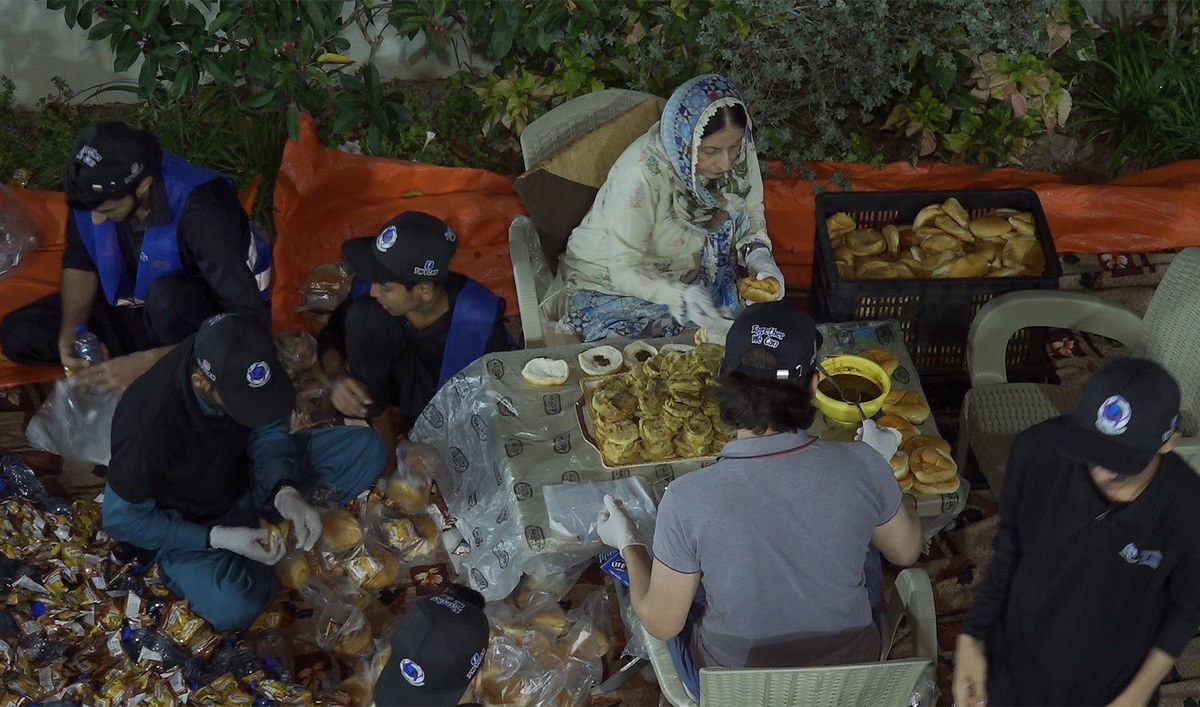
Volunteers of Together We Can charity prepare suhoor meals in Karachi, Pakistan on March 24, 2024. (AN photo)
The number of food packets delivered depends on both demand and how many vans can be arranged to collect and drop off the meals in different neighborhoods of Karachi, Sheikh said, with a focus on poor areas like Ibrahim Hyderi and Machar Colony.
“The areas have been chosen based on the circumstances of people residing there,” Sheikh said.
“Our own staff and other people we know tell us about the conditions they live in. Believe me, there is an area where when we distributed burgers or bun kabab, the children said, ‘What is this? Is this something to eat? We haven’t seen a burger before’.”
The charity drive is made possible by a network of friends and family and loyal staff.
“All of this work is done by our staff, their relatives, and the house help of our friends and families. All of our donors are also friends and family, friends of friends and friends of family,” Sheikh said.
“VOLUNTEERS”
The backbone of the meal delivery service are over 80 volunteers who start work at 8pm preparing and packing the meals, and work until 4 am, or the morning Fajr prayers.
Though the volunteers are not paid for their work, Sheikh said they are rewarded daily “with a lavish dinner or some token of love and appreciation.”
The menu for suhoor includes biryani rice, water, fruit juices and bun kebab sandwiches, which comprise a shallow-fried spicy patty called shami kebab, omelet, onions and chutney served inside a bun.
“Every parcel has either water or juice, with compulsory nimco and either biryani or a bun kabab,” Sheikh said.
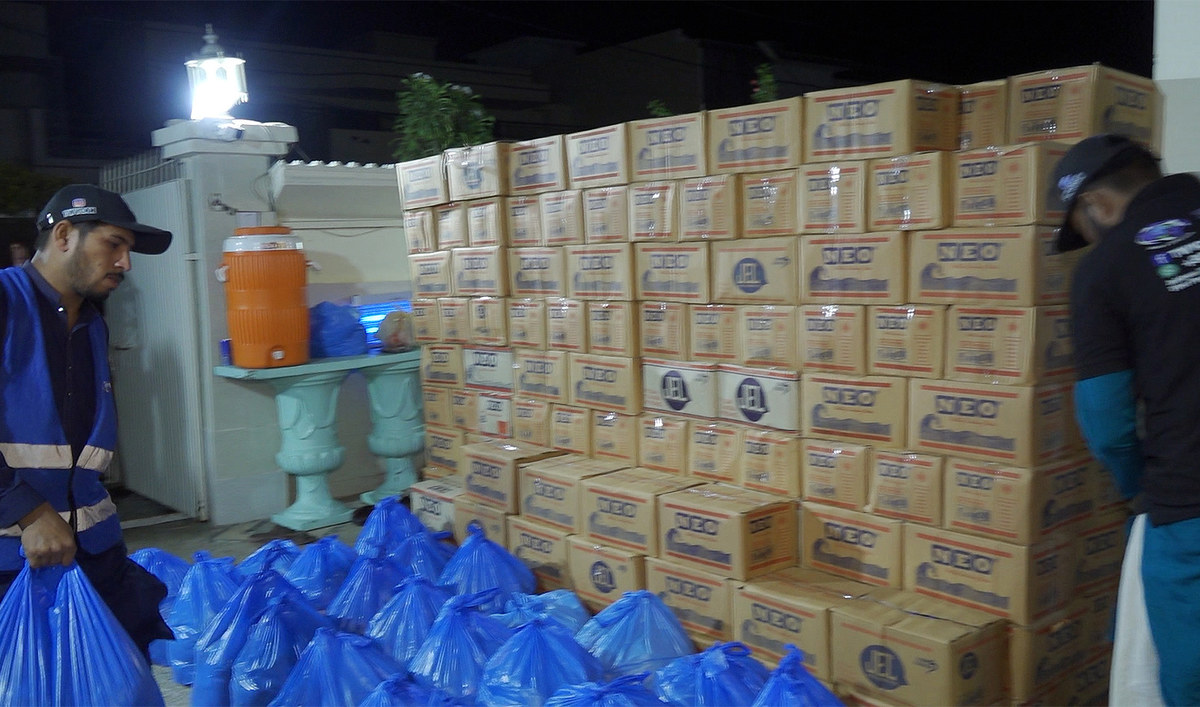
Volunteers of the Together We Can charity stack food boxes in Karachi, Pakistan on March 24, 2024. (AN photo)
He said around 830 cartons of juice or water, with 24 bottles in each, were distributed daily.
“For biryani, around 75kg of rice make 1,000 packets. A total of 1,500 kg of rice is used every day to make 20,000 packets of 300 gms each. In addition, we make 5,000 bun kebabs.”
Volunteers who have been working with the charity since its launch said the quantity of packs distributed had increased over the years.
“Earlier, the quantity for suhoor packs was small but it kept increasing with each year,” 30-year-old volunteer Mohammad Usman said.
“Now the setup has become huge. We really enjoy doing it. We distribute as well, we pack [it] and we don’t take any salary for this.”
“When I come back from my Taraweeh [voluntary Ramadan] prayers, after that I come here and make bun kababs,” said Shahnaz Danial, a middle-aged community worker.
“Then we go to distribute them. I usually go to Civil Hospital or Jinnah Hospital where the people are quite poor, and especially when I went to Civil [hospital], I was shocked to see that all the people were sleeping on the floor or footpath.”


