

China water-cannons Philippine vessel after US backs Manila in disputed sea

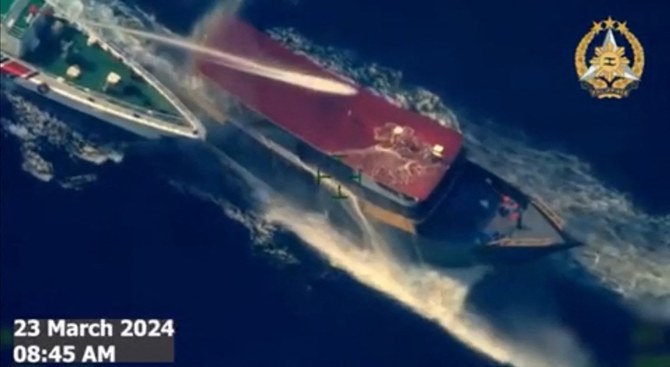
This frame grab from aerial footage released on March 23, 2024 by the Philippine military, shows a Chinese coastguard ship deploying water cannon against the Philippine vessel Unaizah May 4 during its supply mission in the South China Sea. (AFP)
Short Url
Updated 23 March 2024
Follow

China water-cannons Philippine vessel after US backs Manila in disputed sea

  • Philippines says its personnel were injured when Chinese vessels attacked
  • US secretary of state reiterated ‘ironclad’ support against China’s influence in the region

MANILA: China’s coast guard used water cannons against a Philippine vessel in the South China Sea, badly damaging one of them and injuring its crew, the National Task Force for the West Philippine Sea said on Saturday.

The skirmish took place days after US Secretary of State Antony Blinken visited Manila to reiterate Washington’s “ironclad” support against Chinese influence in the disputed region that Beijing claims almost in its entirety.

China’s military activity in the resource-rich territory has been increasing over the past few years, with the Chinese regularly encroaching on the Philippine part of the waters, the West Philippine Sea.

The Unaizah May 4 supply vessel was on its way to Ayungin Shoal — the Filipino name for the Second Thomas Shoal, an outcrop garrisoned by a unit of Philippine troops — when China’s coast guard and maritime militia “executed dangerous maneuvers against the routine RoRe (rotation and resupply) mission” and two Philippine coast guard vessels that came to its rescue, the National Task Force for the West Philippine Sea said.

“Their reckless and dangerous actions culminated with the water cannoning of UM4 causing severe damage to the vessel and injuries to Filipinos onboard.”

The injured personnel were transferred to one of the PCG vessels, which towed the UM4 back to land.

China Coast Guard spokesperson Gan Yu said that the Philippine vessels had forcibly intruded into the area “deliberately disrupting the peace and stability” of the maritime region.

“Despite multiple warnings and route controls from the Chinese side, the Filipino supply ship forcefully entered the area. The China Coast Guard lawfully and professionally implemented regulation, interception, and expulsion,” Gan said in a statement.

Philippine vessels have been regularly attacked by Chinese ships in the parts of the South China Sea that are internationally recognized as belonging to the Philippines.

In a rare announcement, the National Task Force for the West Philippine Sea said on Saturday that its chairperson and the national security adviser were going to meet the executive secretary and the National Security Cluster on Monday “for purposes of making recommendations to the President.”

The latest in a string of maritime clashes between the two countries follows Blinken’s assertion to Philippine authorities that the disputed waterways are critical not only to the security of the Philippines but also the US.

“That’s why we stand with the Philippines and stand by our ironclad defense commitments, including under the mutual defense treaty,” he told reporters in Manila earlier this week.

The Philippines is Washington’s key security partner in Asia under a decades-long alliance and the 1951 treaty that obliges the US to defend its ally in the case of external attack.

In the past two years, the partnership has expanded under President Ferdinand Marcos Jr., who in February last year permitted American troops to increase their footprint in the country.

American troops have been patrolling the South China Sea with Philippine forces since November, despite protests from Beijing, which says the US is not a party to the maritime dispute.


Uganda partially restores internet after president wins 7th term

Supporters of President Yoweri Museveni celebrate his winning the polls. (AFP)
Updated 58 min 18 sec ago
Follow

Uganda partially restores internet after president wins 7th term

  • “The internet shutdown implemented two days before the elections limited access to information, freedom ‌of association, curtailed economic activities ... it also created suspicion and mistrust on the ‍electoral process,” the team said in ‍their report

KAMPALA: Ugandan authorities have partially restored internet services late after 81-year-old President Yoweri Museveni won a seventh term to extend his rule into a fifth decade with a landslide ​victory rejected by the opposition.
Users reported being able to reconnect to the internet and some internet service providers sent out a message to customers saying the regulator had ordered them to restore services excluding social media.
“We have restored internet so that businesses that rely on internet can resume work,” David Birungi, spokesperson for Airtel Uganda, one of the country’s biggest telecom companies said. He added that the state communications regulator had ordered that social media remain shut down.
The state-run Uganda Communications Commission said it had cut off internet to ‌curb “misinformation, disinformation, ‌electoral fraud and related risks.” The opposition, however, criticized the move saying ‌it was ​to ‌cement control over the electoral process and guarantee a win for the incumbent.
The electoral body in the East African country on Saturday declared Museveni the winner of Thursday’s poll with 71.6 percent of the vote, while his rival pop star-turned-politician Bobi Wine was credited with 24 percent of the vote.
A joint report from an election observer team from the African Union and other regional blocs criticized the involvement of the military in the election and the authorities’ decision to cut off internet.
“The internet shutdown implemented two days before the elections limited access to information, freedom ‌of association, curtailed economic activities ... it also created suspicion and mistrust on the ‍electoral process,” the team said in ‍their report.

In power since 1986 and currently Africa’s third longest-ruling head of state, ‍Museveni’s latest win means he will have been in power for nearly half a century when his new term ends in 2031.

He is widely thought to be preparing his son, Muhoozi Kainerugaba, to take over from him. Kainerugaba is currently head of the military and has expressed presidential ambitions.
Wine, who was taking on ​Museveni for a second time, has rejected the results of the latest vote and alleged mass fraud during the election.
Scattered opposition protests broke out late on Saturday after results were announced, according to a witness and police.
In Magere, a suburb in Kampala’s north where Wine lives, a group of youths burned tires and erected barricades in the road prompting police to respond with tear gas.
Police spokesperson Racheal Kawala said the protests had been quashed and that arrests were made but said the number of those detained would be released later.
Wine’s whereabouts were unknown early on Sunday after he said in a post on X he had escaped a raid by the military on his home. People close to him said he remained at an undisclosed location in Uganda. Wine was briefly held under house arrest following the previous election in 2021.
Wine has said hundreds of his supporters were detained during the months leading up ‌to the vote and that others have been tortured.
Government officials have denied those allegations and say those who have been detained have violated the law and will be put through due process.