A Romanian court rejects Andrew Tate’s bid to get his confiscated assets returned

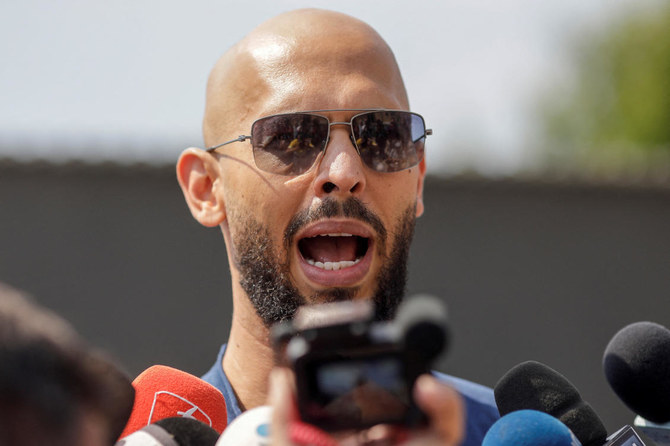
Andrew Tate delivers a press statement outside his house in Voluntari, Ilfov, Romania, in August 2023. (Reuters/File)
Short Url
Updated 22 March 2024
Follow

A Romanian court rejects Andrew Tate’s bid to get his confiscated assets returned

  • The Bucharest Tribunal ruled that all assets seized will remain in possession of Romania’s anti-organized crime agency
  • After the Tates were detained, Romanian authorities seized 15 luxury cars, 14 designer watches and cash in several currencies

BUCHAREST: A court in Romania’s capital on Friday denied a request by online influencer Andrew Tate to return assets that were seized during investigations into the case in which he is charged with human trafficking, rape and forming a criminal gang to sexually exploit women.
The Bucharest Tribunal ruled that all assets seized will remain in possession of Romania’s anti-organized crime agency, DIICOT, Tate’s spokesperson said, adding that the decision will be appealed. Tate, 37, won an appeal in January challenging the asset seizures, which triggered a retrial.
The former professional kickboxer was arrested in December 2022 near Bucharest along with his brother Tristan Tate and two Romanian women. Romanian prosecutors formally indicted all four in June last year. They have denied the allegations.
After the Tates were detained, Romanian authorities seized 15 luxury cars, 14 designer watches and cash in several currencies. The fleet of automobiles included a Rolls-Royce, a Ferrari, a Porsche, a BMW, an Aston Martin and a Mercedes-Benz. The total value of the goods, authorities said at the time, was estimated at 3.6 million euros ($3.9 million).
DIICOT also said it had identified more than 10 properties and land owned by companies registered to the Tate brothers, and that their assets could be used to fund investigations and compensate victims if the authorities could prove they were gained through illicit activities.
Andrew Tate, who has amassed 9 million followers on the social media platform X, has repeatedly claimed that prosecutors have no evidence against him and that there is a political conspiracy to silence him. He was previously banned from various prominent social media platforms for expressing misogynistic views and for hate speech.
The decision on Friday came a week after the Tate brothers appeared at the Bucharest Court of Appeal in a separate case. British authorities issued arrest warrants over allegations of sexual aggression in a UK case dating back to 2012-2015, according to the brothers’ spokesperson.
The court granted the British authorities their request to extradite the Tates, but only after legal proceedings against them have been concluded in Romania.
The Romanian case is still being discussed in the preliminary chamber stages, when defendants can challenge prosecutors’ evidence. No trial date has been set.
Last week, the Bucharest Tribunal, the court of first instance, extended by 60 days geographical restrictions against the Tates, which stipulate they may not leave the country.


EU leaders to reassess US ties despite Trump U-turn on Greenland

Updated 22 January 2026
Follow

EU leaders to reassess US ties despite Trump U-turn on Greenland

  • Diplomats stressed that, although Thursday’s emergency EU talks in Brussels would now lose some of their urgency, the longer-term issue of how to handle the relationship with the US remained

BRUSSELS: EU leaders will rethink their ties with the US at an emergency summit on Thursday after Donald Trump’s threat of tariffs and even military action to ​acquire Greenland badly shook confidence in the transatlantic relationship, diplomats said.
Trump abruptly stepped back on Wednesday from his threat of tariffs on eight European nations, ruled out using force to take Greenland, a semi-autonomous territory of NATO ally Denmark, and suggested a deal was in sight to end the dispute.
German Chancellor Friedrich Merz, welcoming Trump’s U-turn on Greenland, urged Europeans not to be too quick to write off the transatlantic partnership.
But EU governments remain wary of another change of mind by a mercurial president who is increasingly seen as a bully that Europe will have to stand up to, and they are focused on coming up with a longer-term plan on how to deal with the ‌United States under this ‌administration and possibly its successors too.
“Trump crossed the Rubicon. He might do ‌it ⁠again. ​There is no ‌going back to what it was. And leaders will discuss it,” one EU diplomat said, adding that the bloc needed to move away from its heavy reliance on the US in many areas.
“We need to try to keep him (Trump) close while working on becoming more independent from the US It is a process, probably a long one,” the diplomat said.
EU RELIANCE ON US
After decades of relying on the United States for defense within the NATO alliance, the EU lacks the needed intelligence, transport, missile defense and production capabilities to defend itself against a possible Russian attack. This gives the US substantial leverage.
The US ⁠is also Europe’s biggest trading partner, making the EU vulnerable to Trump’s policies of imposing tariffs to reduce Washington’s trade deficit in goods, and, as in ‌the case of Greenland, to achieve other goals.
“We need to discuss where ‍the red lines are, how we deal with this bully ‍across the Atlantic, where our strengths are,” a second EU diplomat said.
“Trump says no tariffs today, but does ‍that mean also no tariffs tomorrow, or will he again quickly change his mind? We need to discuss what to do then,” the second diplomat said.
The EU had been considering a package of retaliatory tariffs on 93 billion euros ($108.74 billion) on US imports or anti-coercive measures if Trump had gone ahead with his own tariffs, while knowing such a step would harm Europe’s economy as well ​as the United States.
WHAT’S THE GREENLAND DEAL?
Several diplomats noted there were still few details of the new plan for Greenland, agreed between Trump and NATO Secretary General Mark Rutte late on ⁠Wednesday on the sidelines of the World Economic Forum in Davos, Switzerland.
“Nothing much changed. We still need to see details of the Greenland deal. We are a bit fed up with all the bullying. And we need to act on a few things: more resiliency, unity, get our things together on internal market, competitiveness. And no more accepting tariff bullying,” a third diplomat said.
Rutte told Reuters in an interview in Davos on Thursday that under the framework deal he reached with Trump the Western allies would have to step up their presence in the Arctic.
He also said talks would continue between Denmark, Greenland and the US on specific issues.
Diplomats stressed that, although Thursday’s emergency EU talks in Brussels would now lose some of their urgency, the longer-term issue of how to handle the relationship with the US remained.
“The approach of a united front in solidarity with Denmark and Greenland while focusing on de-escalation and finding an off-ramp has worked,” a fourth EU diplomat said.
“At the ‌same time it would be good to reflect on the state of the relationship and how we want to shape this going forward, given the experiences of the past week (and year),” he said.