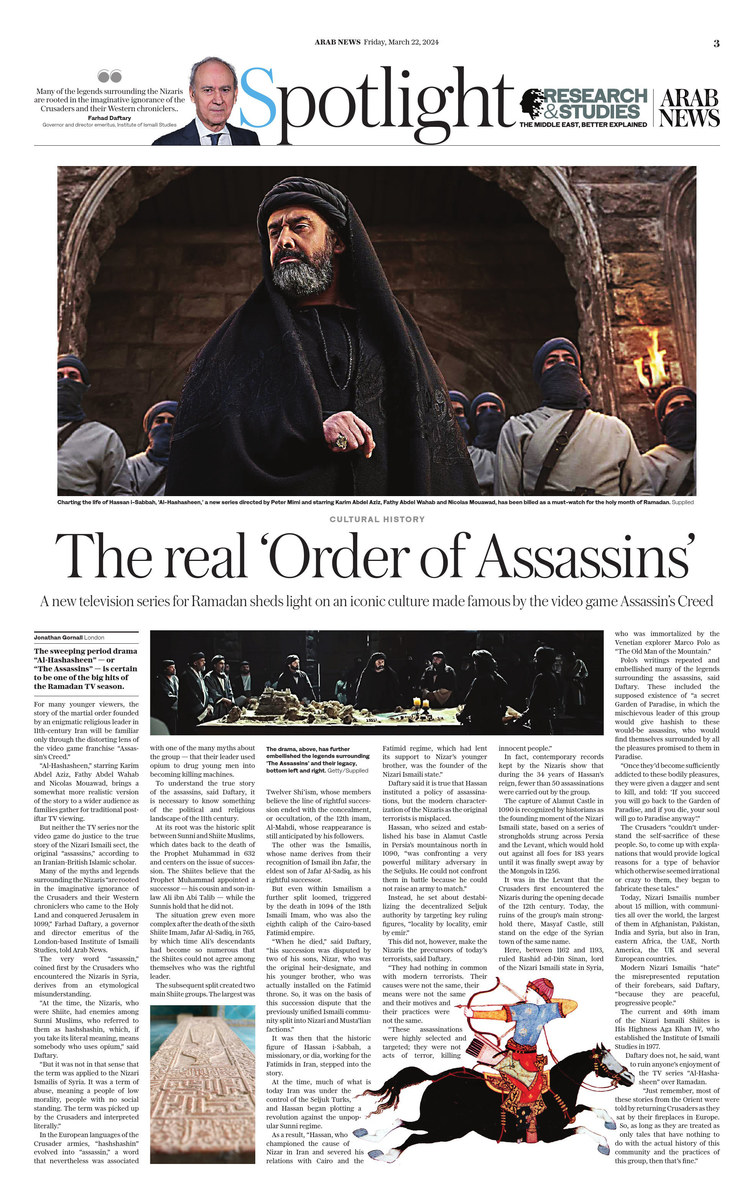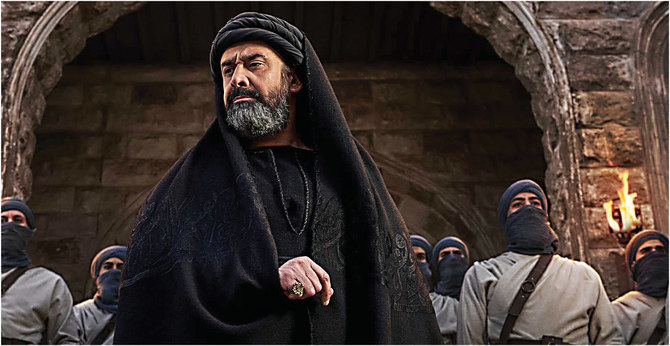




LONDON: The sweeping period drama “Al-Hashasheen” — or “The Assassins” — is certain to be one of the big hits of the Ramadan TV season.
For many younger viewers, the story of the martial order founded by an enigmatic religious leader in 11th-century Iran will be familiar only through the distorting lens of the smash-hit video game franchise “Assassin’s Creed” — now available for the first time in a virtual-reality version compatible with Meta’s Quest headsets.
“Al-Hashasheen,” starring Karim Abdel Aziz, Fathy Abdel Wahab and Nicolas Mouawad, brings a somewhat more realistic version of the story to a wider audience as families across the region gather for traditional post-iftar TV viewing.
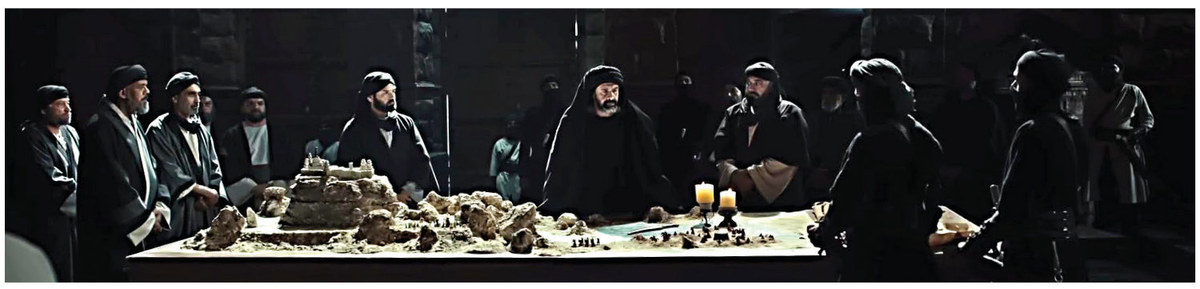
The drama has further embellished the legends surrounding ‘The Assassins’ and their legacy. (Supplied)
But neither the TV series nor the long-running video game franchise do justice to the true story of the Nizari Ismaili sect, the original “assassins,” according to an Iranian-British Islamic scholar.
Many of the myths and legends surrounding the Nizaris “are rooted in the imaginative ignorance of the Crusaders and their Western chroniclers who came to the Holy Land and conquered Jerusalem in 1099,” Farhad Daftary, a governor and director emeritus of the London-based Institute of Ismaili Studies, told Arab News.
The very word “assassin,” coined first by the Crusaders who encountered the Nizaris in Syria, derives from an etymological misunderstanding.
“At the time, the Nizaris, who were Shiite, had enemies among Sunni Muslims, who referred to them as hashshashin, which, if you take its literal meaning, means somebody who uses opium,” said Daftary.
“But it was not in that sense that the term was applied to the Nizari Ismailis of Syria. It was a term of abuse, meaning a people of low morality, people with no social standing. The term was picked up by the Crusaders and interpreted literally.”
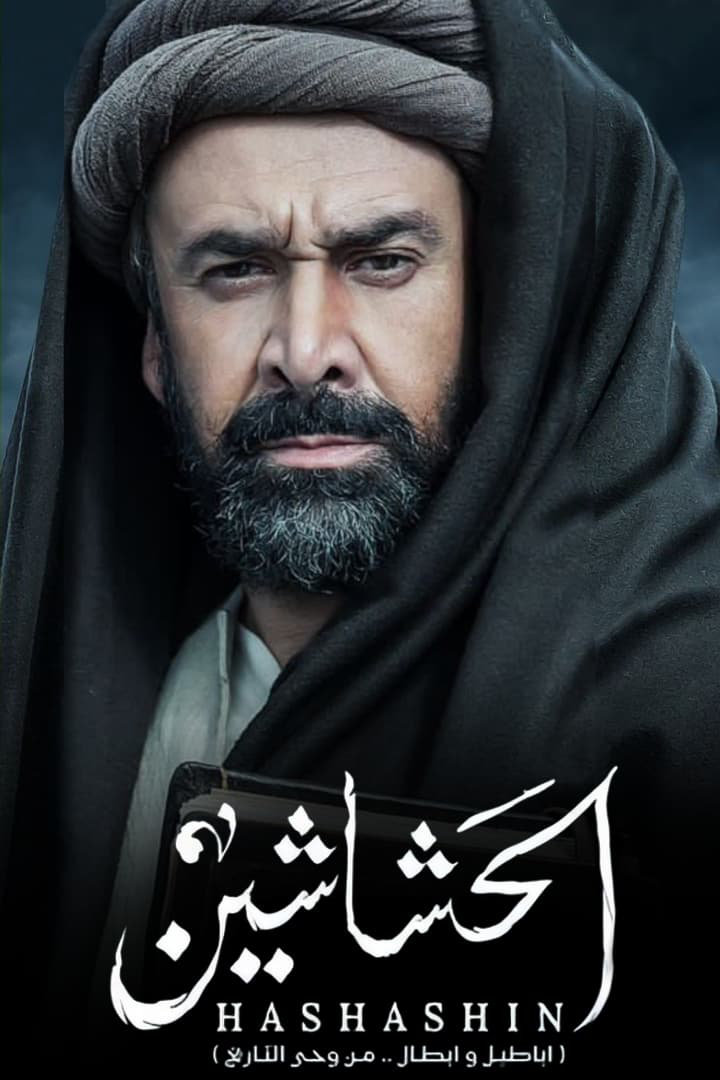
Hashshashin, which evolved into "assassin" in the European languages of the Crusader armies, literally means somebody "who uses opium.” (Supplied)
In the European languages of the Crusader armies, “hashshashin” evolved into “assassin,” a word that nevertheless was associated with one of the many myths about the group — that their leader used opium to drug young men into becoming killing machines.
To understand the true story of the assassins, said Daftary, it is necessary to know something of the political and religious landscape of the 11th century.
At its root was the historic split between Sunni and Shiite Muslims, which dates back to the death of the Prophet Muhammad in 632 and centers on the issue of succession. The Shiites believe that the Prophet Muhammad appointed a successor — his cousin and son-in-law Ali ibn Abi Talib — while the Sunnis hold that he did not.
The situation grew even more complex after the death of the sixth Shiite Imam, Jafar Al-Sadiq, in 765, by which time Ali’s descendants had become so numerous that the Shiites could not agree among themselves who was the rightful leader.

Many of the legends surrounding the Nizaris are rooted in the imaginative ignorance of the Crusaders and their Western chroniclers, says Farhad Daftary, governor and director emeritus of the Institute of Ismaili Studies. (Supplied)
The subsequent split created two main Shiite groups. The largest was Twelver Shi’ism, whose members believe that the line of rightful succession ended with the concealment, or occultation, of the 12th imam, Al-Mahdi, whose reappearance is still anticipated by his followers.
The other was the Ismailis, whose name derives from their recognition of Ismail ibn Jafar, the eldest son of Jafar Al-Sadiq, as his rightful spiritual successor.
But even within Ismailism a further split loomed, triggered by the death in 1094 of the 18th Ismaili Imam, who was also the eighth caliph of the Cairo-based Fatimid empire.
“When he died,” said Daftary, “his succession was disputed by two of his sons, Nizar, who was the original heir-designate, and his younger brother, who was actually installed on the Fatimid throne. So, it was on the basis of this succession dispute that the previously unified Ismaili community split into Nizari and Musta’lian factions.”
It was then that the historic figure of Hassan i-Sabbah, a missionary, or dia, working for the Fatimids in Iran, steps into the story.
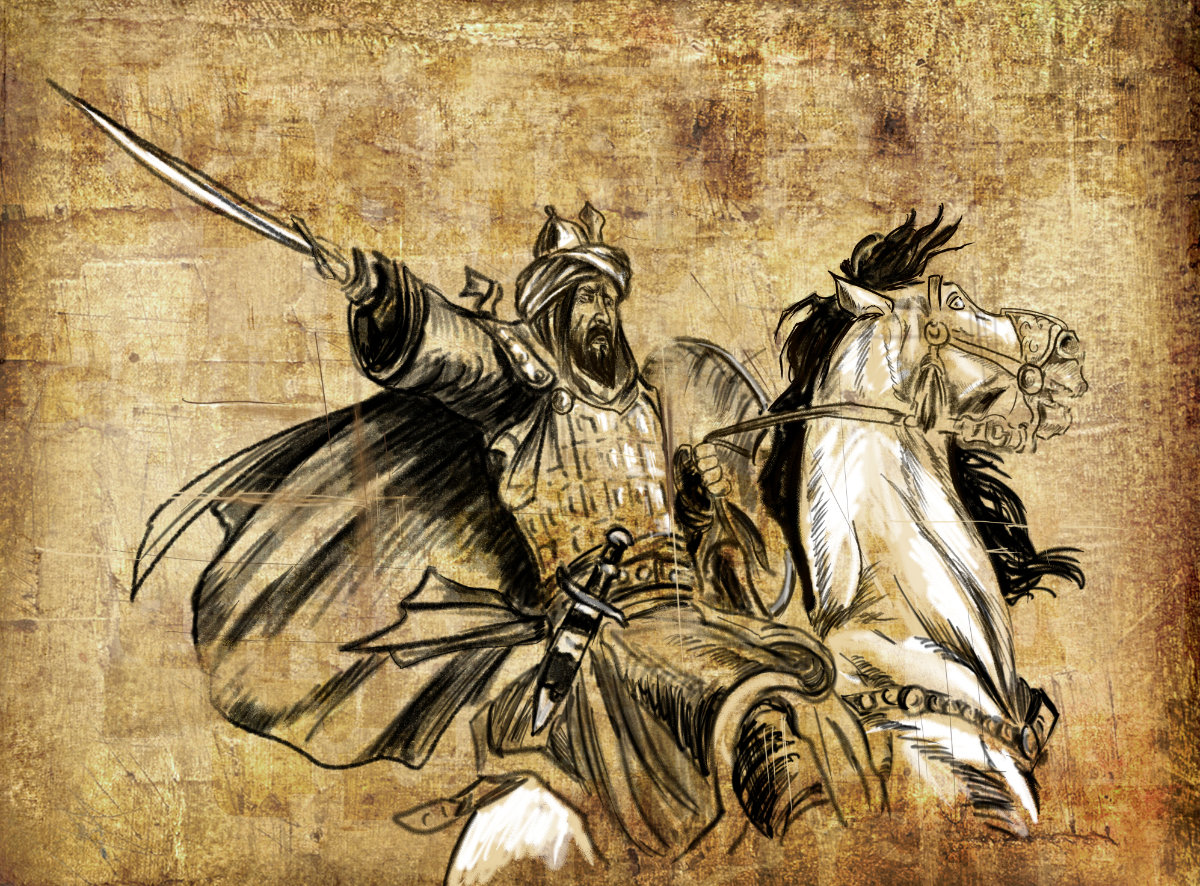
Painting depicting Hasan ibn Sabbah, a prominent Ismaili leader considered as founder of the Nizari state. (Shutterstock)
At the time, much of what is today Iran was under the control of the Seljuk Turks, and Hassan began plotting a revolution against the unpopular Sunni regime.
As a result, “Hassan, who championed the cause of Nizar in Iran and severed his relations with Cairo and the Fatimid regime, which had lent its support to Nizar’s younger brother, was the founder of the Nizari Ismaili state and community.”
Daftary said it is true that Hassan instituted a policy of assassinations, but the modern characterization of the Nizaris as the original terrorists is misplaced.
Hassan, who seized and established his base in Alamut Castle in Persia’s mountainous north in 1090, “was confronting a very powerful military adversary in the Seljuks. He could not confront them in battle because he could not raise an army to match.”
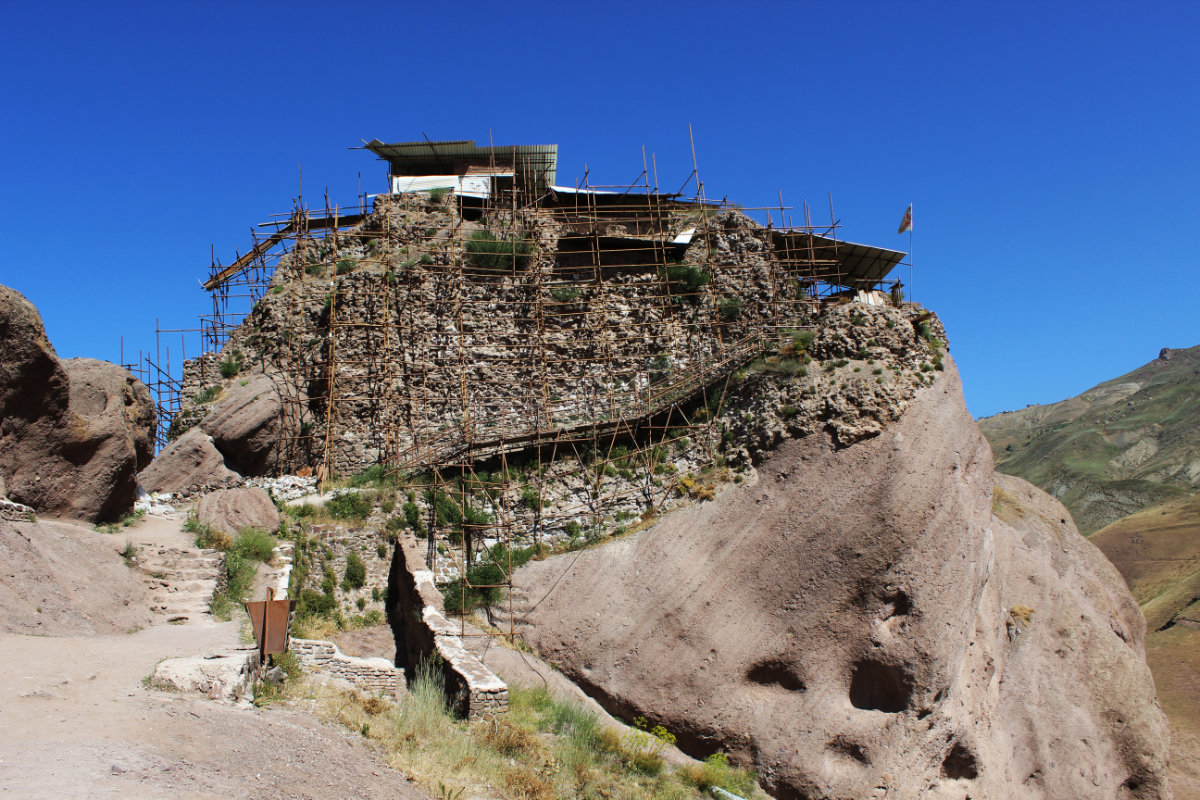
A view of the Alamut Castle in the mountainous Qazvin region of Iran, which is currently being restored. (Shutterstock)
Instead, he set about destabilizing the decentralized Seljuk authority by targeting key ruling figures, “locality by locality, emir by emir.”
This did not, however, make the Nizaris the precursors of today’s terrorists, said Daftary.
“They had nothing in common with modern terrorists. Their causes were not the same, their means were not the same and their motives and their practices were not the same.
“These assassinations were highly selected and targeted; they were not acts of terror, killing innocent people.”
Besides, “they were not the inventors of assassination, which was practiced at the time by the Seljuks themselves and the Crusaders. But there were highly exaggerated reports and rumors, to the effect that almost every assassination of any major significance in the region was attributed to these people.”
In fact, contemporary records kept by the Nizaris show that during the 34 years of Hassan’s reign, fewer than 50 assassinations were carried out by the group.
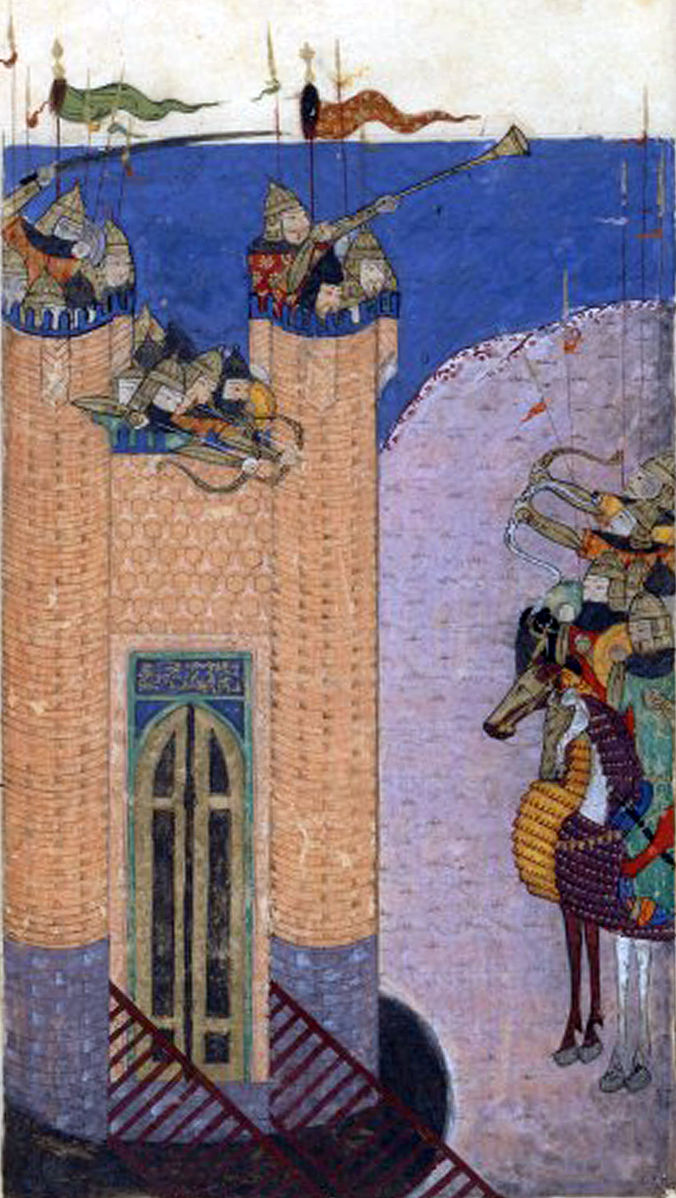
Painting depicting the Siege of Alamut by the Mongols in 1256. (Wikimedia Commons: by Tarikh-i Jahangushay-i Juvaini)
The capture of Alamut Castle in 1090 is recognized by historians as the founding moment of the Nizari Ismaili state, based on a series of strongholds strung across Persia and the Levant, which would hold out against all foes, from Islamic rivals to the Christian Crusaders, for 183 years. The state was finally swept away by the Mongols in about 1256.
It was in the Levant that the Crusaders first encountered the Nizaris during the opening decade of the 12th century. Today, the ruins of the group’s main stronghold there, Masyaf Castle, still stand on the edge of the Syrian town of the same name.

Old stone castle Masyaf on the hill, in Masyaf, Syria
Here, between 1162 and 1193, ruled Rashid ad-Din Sinan, lord of the Nizari Ismaili state in Syria, who was immortalized by the Venetian explorer Marco Polo as “The Old Man of the Mountain.”
Polo’s writings repeated and embellished many of the legends surrounding the assassins, said Daftary. These included the supposed existence of “a secret Garden of Paradise, in which the mischievous leader of this group would give hashish to these would-be assassins, who would find themselves surrounded by all the pleasures promised to them in Paradise.

Rashid ad-Din Sinan. (Wikimedia Commons)
“Once they’d become sufficiently addicted to these bodily pleasures, they were given a dagger and sent to kill, and told: ‘If you succeed you will go back to the Garden of Paradise, and if you die, your soul will go to Paradise anyway’.”
The Crusaders “couldn’t understand the self-sacrifice of these people. So, to come up with explanations that would provide logical reasons for a type of behavior which otherwise seemed irrational or crazy to them, they began to fabricate these tales, which, by the way, we do not find in contemporary Muslim sources, even though they were perhaps even more hostile towards the Ismailis than the Crusaders were.”
Today, Nizari Ismailis number about 15 million, with communities all over the world, the largest of them in Afghanistan, Pakistan, India and Syria, but also in Iran, eastern Africa, the UAE, North America, the UK and several European countries.
Modern Nizari Ismailis “hate” the misrepresented reputation of their forebears, said Daftary, “because they are peaceful, progressive people.”

In this photo taken on March 8, 2018, Britain's Queen Elizabeth II (L) poses with Prince Karim Aga Khan IV (R) at Windsor Castle during a private dinner she hosted in honor of the diamond jubilee of Khan's leadership as Imam of the Shia Nizari Ismaili Muslim Community. (Photo by Dominic Lipinski/POOL/AFP)
The current and 49th imam of the Nizari Ismaili Shiites is His Highness Aga Khan IV, who established the Institute of Ismaili Studies in 1977. The IIS, which has the largest faculty of Islamic studies of any academic institution in the UK, holds the world’s largest collection of original Nizari texts, available in translation to scholars in Persian, Arabic and English.
Daftary does not, he said, want to ruin anyone’s enjoyment of the TV series “Al-Hashasheen” over Ramadan.
“Just remember, most of these stories from the Orient were told by returning Crusaders as they sat by their fireplaces in Europe. So, as long as they are treated as only tales that have nothing to do with the actual history of this community and the practices of this group, then that’s fine.”