

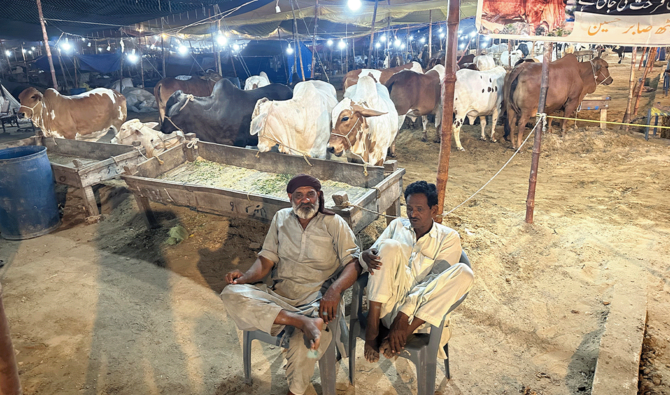

KARACHI: Nabeel Anwar weaves through rows of goats, cows and buffaloes tied to wooden posts at Karachi’s sprawling Northern Bypass cattle market, stopping every few steps to inspect an animal before moving on empty-handed.
Around him, loudspeakers blare prices, traders bargain under canvas tents and children tug at the ropes of decorated calves. The annual market, one of the largest in Pakistan ahead of Eid Al-Adha, usually draws thousands of families eager to buy sacrificial animals for the Islamic festival.
But this year, many visitors are walking away without making purchases.
“It’s been three hours and we are just roaming here,” Anwar told Arab News. “No one here seems to be in the mood to make a deal.”
Eid Al-Adha, one of the two major Islamic festivals, marks the climax of the annual Hajj pilgrimage. Muslims who can afford it slaughter goats, sheep, cows or camels during the festival and distribute meat among relatives, friends and the poor.
In Pakistan, the days leading up to Eid traditionally transform cities into giant livestock bazaars. Families often bring animals home days before the festival, feeding and bathing them as children form emotional attachments to them before the sacrifice.
This year, however, soaring inflation and rising fuel costs have cast a shadow over the ritual for many middle- and lower-income households.
Pakistan’s government has increased petrol prices from Rs285 ($1.02) per liter in February to Rs414.78 ($1.49), an increase of roughly 45 percent, as regional tensions and the conflict involving Iran and the United States pushed global oil prices higher. Transport and animal feed costs have also surged, driving up livestock prices across the country.
Pakistan’s annual inflation rate rose to 10.9 percent in April, returning to double digits for the first time in nearly two years.
For buyers like Anwar, a 29-year-old salesman at a shopping mall who earns around Rs40,000 ($144) a month, the market has become increasingly unaffordable.
“For animals weighing three mounds [around 112 kilograms], an animal trader has been demanding Rs550,000 ($1,964),” Anwar said. “Now, what will a person respond to that?”
Many buyers say they are abandoning the tradition of purchasing animals individually and instead turning to collective sacrifices, in which several people contribute toward a larger cow or bull.
Muhammad Usama, 34, who works at an investment company, said he and his friends had changed their plans this year because prices had nearly doubled.
“I would say that if a person was doing the sacrifice alone previously, he should now also include his friends in it as well,” he said.
Usama said traders were charging between Rs90,000 and Rs95,000 ($323-$341) per maund, a traditional South Asian unit of weight equal to about 40 kilograms.
The animal he bought last year cost nearly half as much, he added.
“I mean, it’s understandable if it’s up by Rs50,000 ($179) or even Rs100,000 ($359),” he said. “If it’s double, it means that the [price] ratio has increased by 100 percent.”
Anwar agreed that collective sacrifice had become the only realistic option for many families.
“A person must go for a collective sacrifice,” he said. “Share it with a brother or run ballot committees. That is how you can offer a sacrifice.”
Ballot committees, common in Pakistan, are rotating savings arrangements in which groups pool money together over time to help members manage major expenses.
Traders at the market say they too are struggling.
Muhammad Abid, a 55-year-old cattle trader from Muzaffargarh in Punjab province, said he had brought more than 40 animals to Karachi after spending heavily on transport and feed, only to find buyers reluctant to pay asking prices.
“We brought 40-42 animals,” he said. “There are no buyers.”
Abid said customers routinely offered Rs200,000-250,000 ($718-$897) for animals he valued at Rs500,000 ($1,795), while million-rupee animals were receiving offers far below expectations.
Keeping the animals at the market has also become expensive.
Traders spend at least Rs3,000 ($11) per animal each day on feed and water, Abid said, while transport costs have surged sharply compared to last year.
“Now, a truck is charging Rs180,000 ($646), Rs160,000 ($574) and Rs170,000 ($610),” he said.
Muhammad Rafique, a 60-year-old farmer from Rahim Yar Khan district, said he had managed to sell only one animal out of 24 after spending five days at the market.
“The buyers are not coming,” he said. “We are sitting here day and night.”
Market administrators insist activity remains strong despite the economic pressure.
Tariq Tanoli, an administrator at the Northern Bypass market, said around 150,000 sacrificial animals had arrived since the market opened on April 4, with thousands sold daily.
“There are about 4,000 to 5,000 animals being sold here daily,” he said.
Still, he acknowledged that inflation and rising fuel costs had changed consumer behavior, with many buyers opting for smaller animals instead of larger cattle.
“Yes, it has a huge impact,” Tanoli said. “It has changed a lot because of the fuel prices and this war.”
As evening falls over the dusty market and traders prepare for another night under tarpaulin shelters beside their livestock, Anwar continues to wander through the rows of animals, still undecided about whether he can afford to take part in the ritual this year.
“As long as there is time, we will go around,” he said. “If it is in our fate, then we will do it. If not, then we will have to skip it.”


