

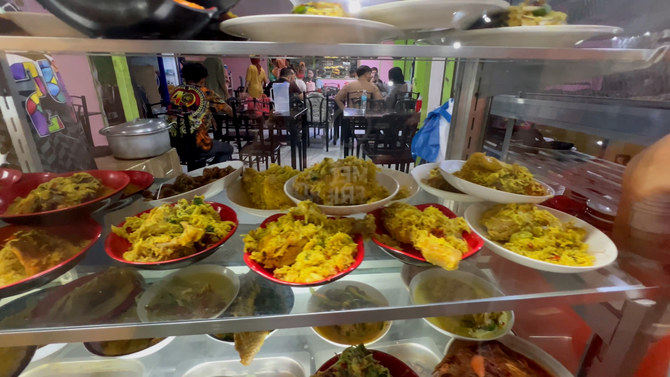

MANILA: From banana with coconut milk to rice with crunchy chicken floss and slow-cooked caramelized meat, Filipino Muslims serve special delicacies during Ramadan — rekindling their Catholic-majority country’s connection to a centuries-old Islamic heritage.
There are some 12 million Muslims in the Philippines, or about 10 percent of the population, living mostly on the island of Mindanao and in the Sulu archipelago in the country’s south, as well as in Manila.
As the third-largest Muslim community in Southeast Asia, after those in Indonesia and Malaysia, Filipino Muslims have been key to the country’s efforts to expand its halal industry. A big part of the expansion concerns food, putting Muslim culinary traditions in the spotlight, especially during Ramadan, when hearty iftar feasts close every fasting day.
Fast is usually broken with pangat, stewed banana in sweetened coconut milk, or sindol, a similar stew but with purple sweet potato and jackfruit.
For Aleem Guiapal, who hails from Maguindanao in south-central Mindanao, and is a project manager of the Philippine government’s Halal Industry Development Program, a sweet stew is a staple during the holy month.
“In the Maguindanao culture, we always have that every day during Ramadan ... for the whole month,” he told Arab News.
“After you drink water and eat dates — which is really part of the Islamic tradition — then you have the pangat or the sindol. It’s sweet, hot and the fruits used as ingredients like banana and purple yam are rich in potassium. So, it’s really filling and gives you energy.”
The light dish in many households is followed by rice with kagikit — an on-the-go meal, which is often sold by street vendors.
“It’s a ready-to-go food. It’s rice with crunchy chicken floss as a topping and wrapped in banana leaves. It’s a ready-to-grab food if you’re on the go. To cook the chicken topping, we add olive or coconut oil and a lot of spices, then we cook it until it becomes crunchy,” Guiapal said.
There are also fish eggs, known as budi among Maranaos in Lanao del Sur province and as pugha among Tausugs in western Mindanao and in the Sulu archipelago.
An expensive delicacy, the salt-cured roe cooked with turmeric and coconut milk becomes a special highlight of Ramadan evenings.
“It is very special,” said Mary Ann Sumpingan, who sells Maranao dishes near the Manila Gold Mosque. “You’re like a VIP when you eat budi.”
Another Maranao dish that Sumpingan recommended is chicken piaparan — chicken cooked in coconut milk, turmeric and a special paste made from ground wild leek, garlic, ginger and chiles.
The wild leak, or sakurab, is a special ingredient in the cuisine of Maranao Muslims, and is also used in another special dish, beef rendang, which is produced in a variety of ways among different communities across Indonesia and Malaysia.
“Sakurab is found only in Marawi. You chop it and combine it with coconut, and then add to the beef,” said Samira Gutoc, a native of Marawi City.
To make rendang, beef is cooked slowly in coconut milk, galangal and lemongrass until almost all the moisture is evaporated and the meat becomes tender and caramelized. It is often served with turmeric rice.
“Beef rendang is a staple ... during Ramadan, when the whole day you are hungry, that’s really one of the special dishes,” Gutoc told Arab News.
“The yellow rice — it’s very special. It gives you the feeling of royal treatment.”
But it is not the aromatic rice that is the highlight of iftar for Gutoc.
Instead, it is the meal, which is breakfast, lunch and dinner all in one, and the experience of sharing it with others — family, neighbors, colleagues and other community members.
“We share the food,” Gutoc said. “With everyone at the table, that’s what makes iftar special.”


