French schools sent threatening messages, beheading videos: ministry

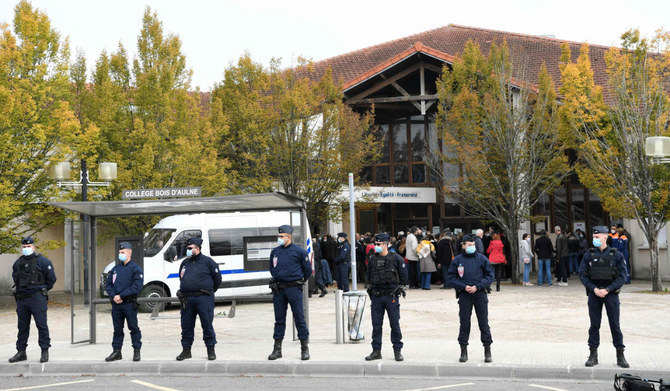
At least 30 schools in the Paris region have this week received threatening messages accompanied by “shocking” footage of beheadings, the education ministry said on Thursday. (AFP/File)
Short Url
Updated 21 March 2024
Follow

French schools sent threatening messages, beheading videos: ministry

  • The messages came through the ENT digital platform
  • According to a police source, at least five high schools in the department of Yvelines received bomb threats

PARIS: At least 30 schools in the Paris region have this week received threatening messages accompanied by “shocking” footage of beheadings, the education ministry said on Thursday.
The establishments — mainly secondary schools — have received “serious threats” containing “justification of and incitement to terrorism,” a representative of the education ministry told AFP.
The messages came through the ENT digital platform that serves as a link between teachers, pupils and parents; internal emails; or the Pronote software used by the education ministry.
Investigators were working to “identify the perpetrators,” said the ministry, adding that psychological support had been offered to children or adults who had watched the “shocking videos.”
According to a police source, at least five high schools in the department of Yvelines, in the west of the Greater Paris region, received bomb threats between Wednesday and Thursday.
Perpetrators “hacked a student’s email address” in order to distribute the message and a beheading video, the source said.
In the department of Seine-et-Marne, to the east of the French capital, a secondary school received a message saying that explosives had been hidden throughout the establishment “in the name of Allah,” a police source said.
The latest threats follow a flurry of false bomb alerts targeted schools, airport and tourist sites in autumn 2023.
In October, a radicalized Islamist stabbed a former teacher to death in the northern town of Arras.
Prime Minister Gabriel Attal was set to chair a meeting on school security on Thursday.


Changes to US security strategy ‘largely consistent’ with Russia’s vision: Kremlin

Updated 58 min 7 sec ago
Follow

Changes to US security strategy ‘largely consistent’ with Russia’s vision: Kremlin

  • Kremlin’s spokesman Dmitry Peskov said that the current US administration was “fundamentally different from the previous ones”

MOSCOW: Russia has welcomed changes in the US National Security Strategy, saying the adjustments that marked a radical departure from Washington’s previous policy were “largely consistent” with Moscow’s vision.
Washington’s new National Security Strategy, published early Friday, took aim at allies in Europe, calling it over-regulated, lacking in “self-confidence” and facing “civilizational erasure” due to immigration.
The document stated that the United States would also prevent other powers from dominating but added: “This does not mean wasting blood and treasure to curtail the influence of all the world’s great and middle powers.”
Commenting on the new US strategy, the Kremlin’s spokesman Dmitry Peskov said that the current US administration was “fundamentally different from the previous ones.”
“The adjustments we’re seeing, I would say, are largely consistent with our vision,” Peskov said in an interview with state TV station Rossiya aired Sunday.
“President Trump is currently strong in terms of domestic political positions. And this gives him the opportunity to adjust the concept to suit his vision,” Peskov added.
The publication of the updated security strategy came as officials from Kyiv held talks in Florida with Trump’s envoys on the US-drafted plan to end the near four-year war in Ukraine.
Three days of talks produced no apparent breakthrough.
President Volodymyr Zelensky committed to further negotiations toward “real peace,” as Russia in the early hours of Saturday launched another series of drone and missile strikes at Ukraine.
Zelensky is due to meet with European leaders — French President Emmanuel Macron, British Prime Minister Keir Starmer and German Chancellor Friedrich Merz — in London on Monday to take stock of the negotiations.