US official Donald Lu rejects ex-PM Khan’s foreign interference allegations as a ‘lie’

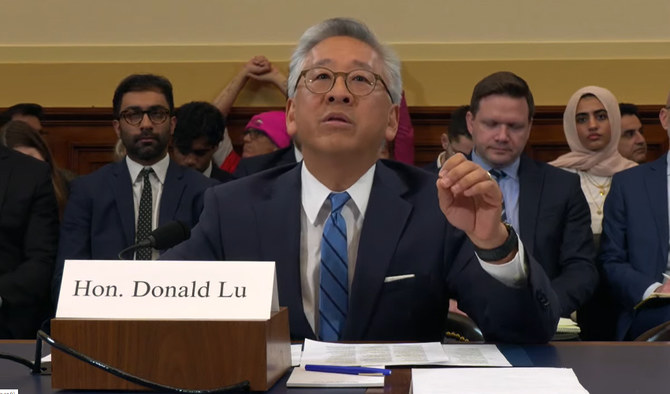
US Assistant Secretary of State Donald Lu is seen speaking during a hearing held by the Committee on Foreign Affairs in the US House of Representatives in US in March 20, 2024. (US Capitol)
Short Url
Updated 20 March 2024
Follow

US official Donald Lu rejects ex-PM Khan’s foreign interference allegations as a ‘lie’

  • Ex-PM Khan accused Washington of conspiring to remove him from office in April 2022
  • Donald Lu testifies in congressional hearing on relations between Pakistan and the US

ISLAMABAD: US Assistant Secretary of State Donald Lu on Wednesday rubbished former Pakistan prime minister Imran Khan’s allegations his government was ousted via a conspiracy orchestrated by Washington, describing it as a “conspiracy theory” and a “lie.”

Lu testified as a subcommittee of the Committee on Foreign Affairs in the US House of Representatives held a hearing on relations between the two countries. The hearing was titled: “Future of democracy in Pakistan and the US-Pakistan relationship.”

The American official is at the center of the “cipher” controversy as it is popularly known in Pakistan. It relates to an alleged diplomatic correspondence between Washington and Islamabad that Khan said was proof his ouster as PM was part of a US conspiracy to remove him. Washington has repeatedly denied Khan’s accusations.

In January, a Pakistani court handed Khan and his close aide Shah Mahmood Qureshi, who was the country’s foreign minister during Khan’s premiership, a 10-year jail term each on charges of leaking the diplomatic cable to unauthorized individuals for political gain.

“I want to be very clear on this point. These allegations — this conspiracy theory — is a lie,” Lu said during the hearing when asked whether the US had conspired to remove Khan from office. 

“It is a complete falsehood.”

Khan became Pakistan’s first prime minister to be ousted from office via a parliamentary vote in April 2022. The former prime minister remains incarcerated since August on a slew of charges he says are politically motivated, 

Lu pointed out that the then-Pakistan ambassador to the US even testified to his government that there was no conspiracy to remove Khan. 

His testimony was marred by chants of “liar” and Free Imran Khan” by a person attending the proceedings. 

“We respect the sovereignty of Pakistan, we respect the principle that Pakistanis should be the only ones choosing their leaders through a democratic process,” Lu said. 

The hearing was announced last week after over 30 members of the US Congress wrote to President Joe Biden and US Secretary of State Antony Blinken, asking them not to recognize Pakistan’s new government under Prime Minister Shehbaz Sharif. 

Sharif was elected prime minister of Pakistan this month after the contentious Feb. 8 election. Khan has accused Pakistan’s election regulator of manipulating votes in favor of his political opponents. His Pakistan Tehreek-e-Insaf (PTI) party claims it won a two-thirds majority in polls.

Pakistan’s national polls were marred by violence, the suspension of mobile networks on election day for security reasons, and unprecedented delays in announcing results. 

Despite countrywide protests by the PTI and other political parties against alleged rigging, Pakistan’s election regulator and its previous caretaker government have denied that polls were rigged. 


Pakistan, global crypto exchange discuss modernizing digital payments, creating job prospects 

Updated 05 December 2025
Follow

Pakistan, global crypto exchange discuss modernizing digital payments, creating job prospects 

  • Pakistani officials, Binance team discuss coordination between Islamabad, local banks and global exchanges
  • Pakistan has attempted to tap into growing crypto market to curb illicit transactions, improve oversight

ISLAMABAD: Pakistan’s finance officials and the team of a global cryptocurrency exchange on Friday held discussions aimed at modernizing the country’s digital payments system and building local talent pipelines to meet rising demand for blockchain and Web3 skills, the finance ministry said.

The development took place during a high-level meeting between Finance Minister Muhammad Aurangzeb, Pakistan Virtual Assets Regulatory Authority (PVARA) Chairman Bilal bin Saqib, domestic bank presidents and a Binance team led by Global CEO Richard Teng. The meeting was held to advance work on Pakistan’s National Digital Asset Framework, a regulatory setup to govern Pakistan’s digital assets.

Pakistan has been moving to regulate its fast-growing crypto and digital assets market by bringing virtual asset service providers (VASPs) under a formal licensing regime. Officials say the push is aimed at curbing illicit transactions, improving oversight, and encouraging innovation in blockchain-based financial services.

“Participants reviewed opportunities to modernize Pakistan’s digital payments landscape, noting that blockchain-based systems could significantly reduce costs from the country’s $38 billion annual remittance flows,” the finance ministry said in a statement. 

“Discussions also emphasized building local talent pipelines to meet rising global demand for blockchain and Web3 skills, creating high-value employment prospects for Pakistani youth.”

Blockchain is a type of digital database that is shared, transparent and tamper-resistant. Instead of being stored on one computer, the data is kept on a distributed network of computers, making it very hard to alter or hack.

Web3 refers to the next generation of the Internet built using blockchain, focusing on giving users more control over their data, identity and digital assets rather than big tech companies controlling it.

Participants of the meeting also discussed sovereign debt tokenization, which is the process of converting a country’s debt such as government bonds, into digital tokens on a blockchain, the ministry said. 

Aurangzeb called for close coordination between the government, domestic banks and global exchanges to modernize Pakistan’s payment landscape.

Participants of the meeting also discussed considering a “time-bound amnesty” to encourage users to move assets onto regulated platforms, stressing the need for stronger verifications and a risk-mitigation system.

Pakistan has attempted in recent months to tap into the country’s growing crypto market, crack down on money laundering and terror financing, and promote responsible innovation — a move analysts say could bring an estimated $25 billion in virtual assets into the tax net.

In September, Islamabad invited international crypto exchanges and other VASPs to apply for licenses to operate in the country, a step aimed at formalizing and regulating its fast-growing digital market.