- An IMF team is currently holding talks in Islamabad for the second and final review of the $3 billion loan program
- The global lender is expected to conclude the review today after the agenda could not be completed on Monday
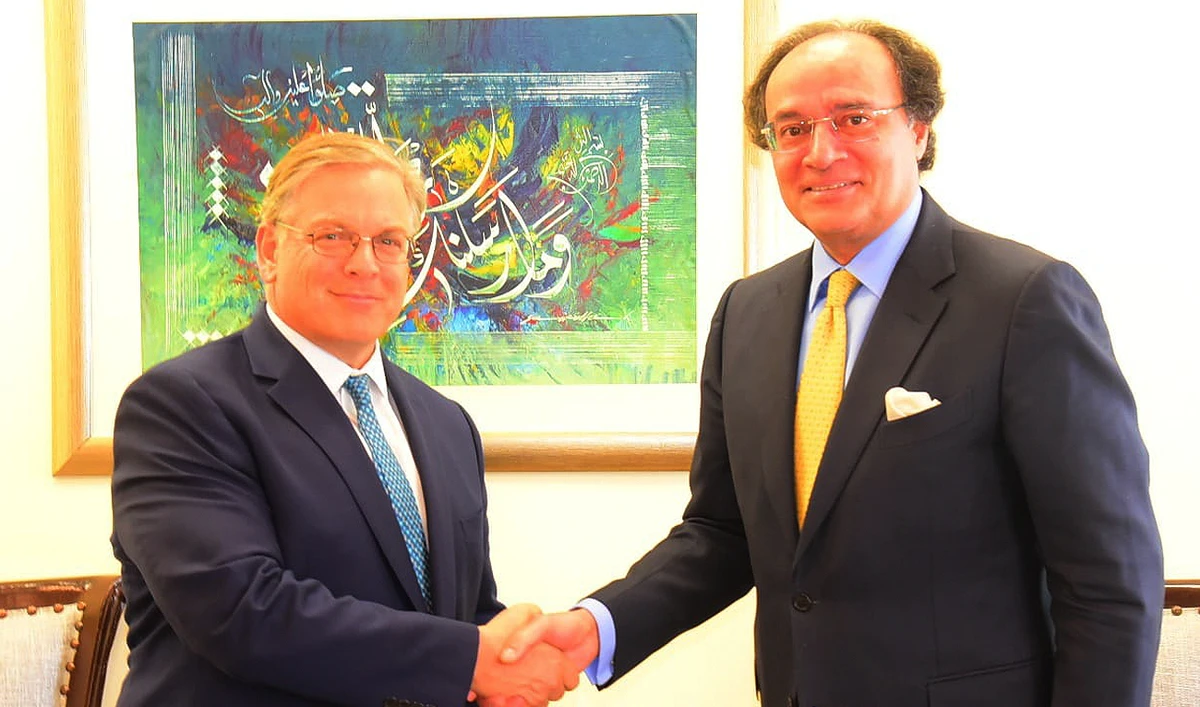
ISLAMABAD: United States (US) Ambassador Donald Blome on Tuesday met with Finance Minister Muhammad Aurangzeb and assured him support for the completion of Pakistan’s ongoing $3 billion International Monetary Fund (IMF) loan program, the US embassy said.
The statement came amid talks between Pakistan and the IMF for the second and final review of the program secured by Islamabad last summer. Pakistan says it has met all structural benchmarks and targets set by the global lender. A successful completion of the evaluation will release the remaining $1.1 billion to the South Asian country.
In his meeting with the finance minister, Ambassador Blome discussed US cooperation and support for Pakistan’s efforts to meet its reform targets, including improvement of the country’s tax administration and investment climate, according to the US embassy.
“Ambassador Blome noted the US government’s support for Pakistan’s work with the IMF to complete its current Stand-By Arrangement (SBA),” the embassy said in a statement.
The IMF review was expected to conclude on Monday, but a Pakistani finance ministry official told Arab News on condition of anonymity the visiting IMF delegation had decided to extend the review by a day after the two sides could not complete its agenda.
“The review agenda couldn’t be completed in the scheduled period, therefore the mission has extended it for a day for now,” the official said on Monday. “The letter of intent and staff-level agreement will be discussed tomorrow [Tuesday] now.”
Islamabad has also expressed its interest in securing a new loan under the Extended Fund Facility (EFF) program as it continues to carry out reforms to strengthen its debt-ridden economy.
On Monday, Pakistani financial authorities briefed the IMF mission on the country’s annual taxation targets, ways to abolish subsidies in different sectors, digitization of the tax system and expansion in the tax net, according to the official.
“At the moment, Pakistan has been lagging on two fronts that are digitization of the taxation and bringing over 3 million retailers in the tax net,” he said. “The FBR has signed a memorandum this week for the digitization while the work on bringing the retailers into the tax net is underway.”
The global lender wants Pakistan to continue the economic stabilization and reforms agenda “till negotiation of the new loan program,” the official added.
Citing officials, Pakistani state media last week reported that Islamabad’s talks with the global lender for the second review of the program were “progressing positively.”
Pakistan secured the $3 billion IMF program in last June after it narrowly escaped a sovereign default. Its economy has been under extreme stress with low reserves, a balance of payment crisis, inflation at 23 percent, policy interest rates at 22 percent and record local currency depreciation.