

Pakistan cabinet reviews private Hajj policy as mandatory pilgrim training enforced

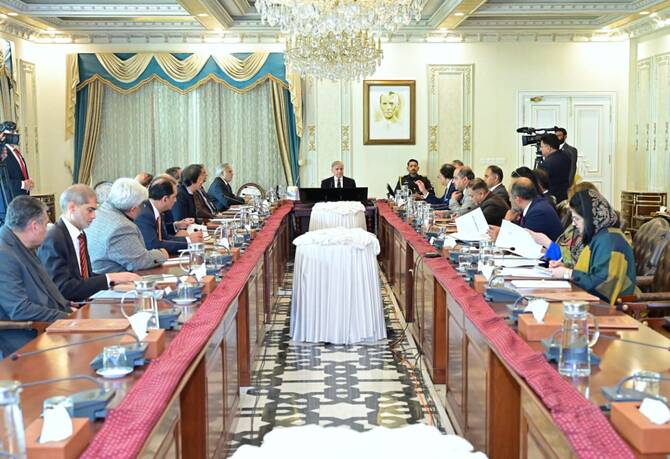
Prime Minister of Pakistan, Shehbaz Sharif (center) chairing a cabinet committee to review private Hajj policy 2027-2030 in Islamabad, Pakistan, on January 14, 2026. (Government of Pakistan)
Short Url
Updated 14 January 2026
Follow

Pakistan cabinet reviews private Hajj policy as mandatory pilgrim training enforced

  • Cabinet sends draft Private Hajj Policy 2027–2030 to committee for further review
  • Religion minister warns pilgrims who skip mandatory training will be barred from Hajj

ISLAMABAD: Pakistan’s federal cabinet on Wednesday reviewed proposals for stricter oversight of private Hajj operators, as authorities separately warned that pilgrims who failed to complete mandatory training would be barred from performing Hajj next year.

The cabinet, chaired by Prime Minister Shehbaz Sharif, was briefed on a draft Private Hajj Policy for 2027–2030, which includes third-party registration and scrutiny of private Hajj operator companies, according to a statement from the Prime Minister’s Office.

“The Federal Cabinet directed that the draft Private Hajj Policy 2027–2030, presented by the Ministry of Religious Affairs and Interfaith Harmony regarding third-party registration and scrutiny of private Hajj operators’ companies, be referred to the Hajj Policy Committee for further deliberation in light of the views of Cabinet members,” the prime minister’s office said in a statement.

The development comes as Religious Affairs Minister Sardar Muhammad Yousaf said on Wednesday pilgrims who failed to attend both phases of mandatory Hajj training would not be allowed to perform the pilgrimage.

“Pilgrims who do not complete mandatory Hajj training will be barred from performing Hajj,” the ministry quoted Yousaf as saying during a training workshop in Islamabad.

Around 120,000 pilgrims are currently undergoing training at 200 locations nationwide, with the second phase scheduled to begin after Ramadan. The training aims to familiarize pilgrims with Saudi laws, Hajj rituals and safety protocols to prevent accidents in crowded areas.

Saudi Arabia has allocated 179,210 pilgrims to Pakistan for Hajj 2026, including about 118,000 seats under the government scheme, while the remainder will be handled by private tour operators.

Under Pakistan’s government Hajj package, the estimated cost ranges from Rs1.15 million to Rs1.25 million ($4,049.93 to $4,236), subject to final agreements with service providers.


Pakistan capital market transitions to T+1 settlement cycle ahead of multiple advanced markets

Updated 7 sec ago
Follow

Pakistan capital market transitions to T+1 settlement cycle ahead of multiple advanced markets

  • A T+1 settlement cycle means that securities transactions are finalized and settled one business day after trade date
  • Effective from Feb. 9, all eligible trades at the PSX are now settled on a T+1 basis, replacing the previous T+2 cycle

KARACHI: Pakistan’s capital market has officially transitioned to the Trade plus one (T+1) settlement cycle, a landmark reform that strengthens efficiency, reduces risk and aligns the country with international best practices, the Pakistan Stock Exchange (PSX) said on Tuesday.

A T+1 settlement cycle means that securities transactions are finalized and settled one business day after the trade date, which reduces counterparty risk and improves capital efficiency in the exchange of funds and securities. 

Effective from Feb. 9, all eligible trades at the PSX are now settled on a T+1 basis, replacing the previous T+2 cycle. The transition was implemented under the guidance of the Securities and Exchange Commission of Pakistan (SECP) through close collaboration among all stakeholders, according to the PSX.

It aligns Pakistan’s capital market with leading markets such as the United States, Canada, Mexico, Argentina, Jamaica and China, which have already adopted shorter settlement cycles. Europe, the UK and Switzerland are set to follow by 2027. By moving early, Pakistan has demonstrated its commitment to modernization and investor protection.

“The transition to the T+1 settlement cycle brings important advantages for Pakistan’s capital market. It enables faster access to funds and securities, improving liquidity, while reducing settlement and counterparty risk through shorter exposure periods,” the PSX said.

“Quicker trade finalization enhances efficiency and the reform strengthens investor confidence, particularly among institutional and foreign investors. Together, these benefits support a stronger and more resilient market aligned with global best practices.”

Pakistan’s stock market has touched historic highs in recent months as broad institutional buying boosted investor confidence amid ongoing economic reforms under international lending programs. Pakistani state media reported in Jan. around 135,000 new investors had joined the PSX over the last 18 months.

SECP Chairman Dr. Kabir Ahmed Sidhu commended the PSX, the Central Depository Company and the National Clearing Company of Pakistan for the successful implementation of the T+1 settlement system.

“The reform brings Pakistan’s capital market at par with modern jurisdictions by accelerating trade settlement, reducing counterparty and market risks, and enhancing liquidity,” he was quoted as saying by the PSX.

“The adoption of T+1 will strengthen investor confidence and align Pakistan’s capital market with evolving international standards and global best practices.”