

Pakistan cabinet reviews private Hajj policy as mandatory pilgrim training enforced

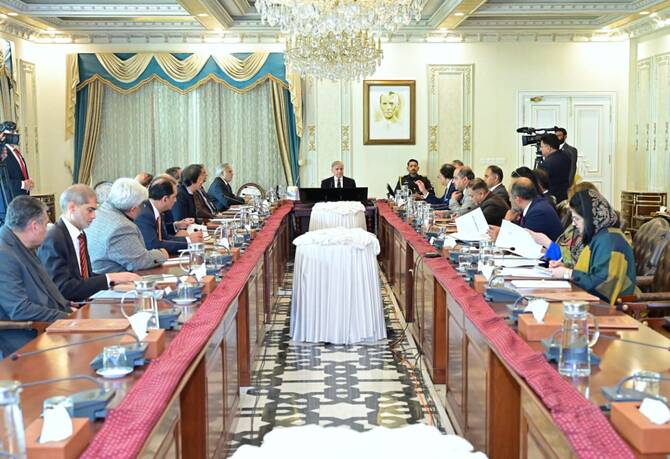
Prime Minister of Pakistan, Shehbaz Sharif (center) chairing a cabinet committee to review private Hajj policy 2027-2030 in Islamabad, Pakistan, on January 14, 2026. (Government of Pakistan)
Short Url
Updated 14 January 2026
Follow

Pakistan cabinet reviews private Hajj policy as mandatory pilgrim training enforced

  • Cabinet sends draft Private Hajj Policy 2027–2030 to committee for further review
  • Religion minister warns pilgrims who skip mandatory training will be barred from Hajj

ISLAMABAD: Pakistan’s federal cabinet on Wednesday reviewed proposals for stricter oversight of private Hajj operators, as authorities separately warned that pilgrims who failed to complete mandatory training would be barred from performing Hajj next year.

The cabinet, chaired by Prime Minister Shehbaz Sharif, was briefed on a draft Private Hajj Policy for 2027–2030, which includes third-party registration and scrutiny of private Hajj operator companies, according to a statement from the Prime Minister’s Office.

“The Federal Cabinet directed that the draft Private Hajj Policy 2027–2030, presented by the Ministry of Religious Affairs and Interfaith Harmony regarding third-party registration and scrutiny of private Hajj operators’ companies, be referred to the Hajj Policy Committee for further deliberation in light of the views of Cabinet members,” the prime minister’s office said in a statement.

The development comes as Religious Affairs Minister Sardar Muhammad Yousaf said on Wednesday pilgrims who failed to attend both phases of mandatory Hajj training would not be allowed to perform the pilgrimage.

“Pilgrims who do not complete mandatory Hajj training will be barred from performing Hajj,” the ministry quoted Yousaf as saying during a training workshop in Islamabad.

Around 120,000 pilgrims are currently undergoing training at 200 locations nationwide, with the second phase scheduled to begin after Ramadan. The training aims to familiarize pilgrims with Saudi laws, Hajj rituals and safety protocols to prevent accidents in crowded areas.

Saudi Arabia has allocated 179,210 pilgrims to Pakistan for Hajj 2026, including about 118,000 seats under the government scheme, while the remainder will be handled by private tour operators.

Under Pakistan’s government Hajj package, the estimated cost ranges from Rs1.15 million to Rs1.25 million ($4,049.93 to $4,236), subject to final agreements with service providers.


Pakistan reports first wild polio case of 2026 despite vaccination campaigns

Updated 05 March 2026
Follow

Pakistan reports first wild polio case of 2026 despite vaccination campaigns

  • Four-year-old girl infected in Sindh’s Sujawal district as virus persists in high-risk areas
  • Pakistan conducted last nationwide campaign in January, vaccinating over 45 million children

ISLAMABAD: Pakistan reported its first wild poliovirus case of the year, health authorities said on Thursday, underscoring the persistence of the disease in high-risk areas despite ongoing vaccination campaigns.

The latest infection was confirmed in a four-year-old girl in Sujawal district of the southern Sindh province, according to the Regional Reference Laboratory for Polio Eradication at the National Institute of Health in Islamabad.

Polio is a highly contagious viral disease that can cause permanent paralysis, mainly in children under the age of five. Pakistan and neighboring Afghanistan are the only two countries in the world where the disease remains endemic.

“The case was reported through the polio surveillance network and confirmed by the Regional Reference Laboratory for Polio Eradication at the National Institute of Health, Islamabad,” the statement said.

“The Polio Eradication Initiative is already analyzing the best response to tackle and prevent further transmission.”

In 2026, Pakistan conducted a nationwide polio campaign in January that vaccinated more than 45 million children, while the next national campaign is planned for April.

Since 1994, Pakistan has cut polio cases by 99.8 percent through vaccination efforts, reducing infections from an estimated 20,000 in the early 1990s to 31 in 2025.

Pakistan reported 31 polio cases in 2025. Southern Khyber Pakhtunkhwa accounted for more than half of the country’s polio cases in 2025, with 17 of the 31 infections reported from the region.

According to health authorities, 74 cases were reported in 2024.

More than 200 polio workers and police officers assigned to protect polio teams have been killed in Pakistan since the 1990s, according to health and security officials.

Militants often falsely claim the vaccination campaigns are part of a Western plot to sterilize Muslim children.

The vaccination campaigns are also undermined by parental refusals in remote regions.