

IMF expected to conclude final review today of Pakistan’s $3 billion loan program

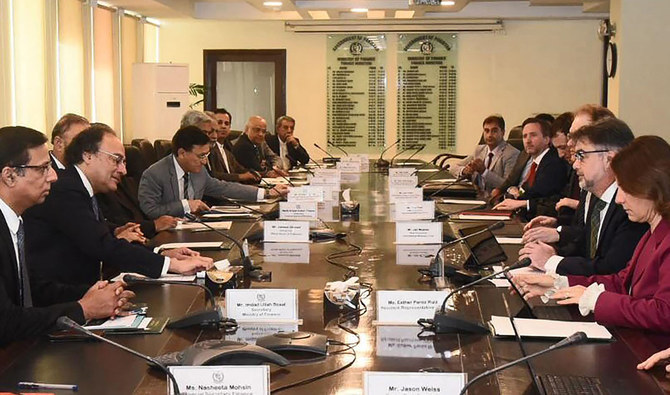
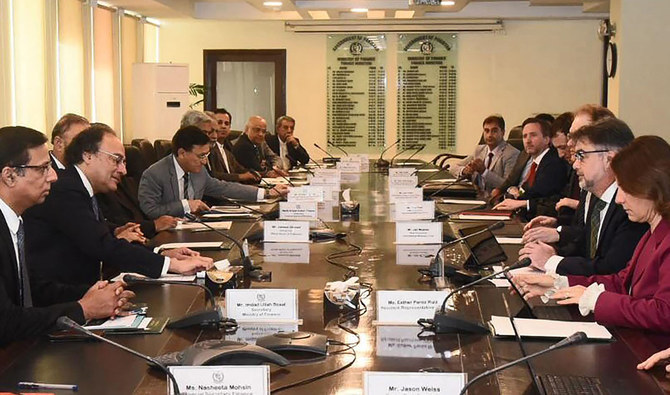
In this handout photograph released by Pakistan’s Press Information Department (PID) and taken on March 14, 2024, Pakistan’s Finance Minister Muhammad Aurangzeb (2L) speaks with International Monetary Fund (IMF) Mission Chief for Pakistan Nathan Porter (2R) during a meeting in Islamabad. (PID/File)
Short Url
Updated 19 March 2024
Follow

IMF expected to conclude final review today of Pakistan’s $3 billion loan program

  • IMF delegation arrived in Pakistan last week to carry out second and final review of its loan program
  • Pakistan, IMF to discuss letter of intent, staff-level agreement today, says finance ministry official 

ISLAMABAD: The International Monetary Fund (IMF) will conclude its review of Pakistan’s $3 billion short-term bailout program today, Tuesday, which was due to be completed on Monday, a Pakistani finance ministry official said amid Islamabad’s efforts to avoid a macroeconomic crisis and stabilize its fragile $350 billion economy.

The finance ministry official, who spoke on condition of anonymity as he was not authorized to speak to the media, said the visiting IMF delegation had decided to extend the deadline by a day on Monday as the review agenda couldn’t be completed in the scheduled period. 

The IMF team arrived in Pakistan last week to carry out the second and final review under the short-term loan program secured by Islamabad last summer. Pakistan has said it has met all the structural benchmarks and targets set by the lender, hoping that a successful completion of the evaluation will be followed by the release of a remaining tranche of around $1.1 billion.

“The review agenda couldn’t be completed in the scheduled period, therefore the mission has extended it for a day for now,” the official told Arab News on Monday. “The letter of intent and staff-level agreement will be discussed tomorrow [Tuesday] now.”

Islamabad has expressed its interest in securing a new loan under the Extended Fund Facility (EFF) program as it continues to carry out reforms to strengthen its debt-ridden economy.

On Monday, Pakistani financial authorities briefed the IMF mission on the country’s annual taxation targets, ways to abolish subsidies in different sectors, digitization of the tax system and expansion in the tax net, the official said.

“At the moment, Pakistan has been lagging on two fronts that are digitization of the taxation and bringing over 3 million retailers in the tax net,” he said. “The FBR has signed a memorandum this week for the digitization while the work on bringing the retailers into the tax net is underway.”

The global lender wants Pakistan to continue the economic stabilization and reforms agenda “till negotiation of the new loan program,” the official added.

Citing officials, Pakistani state media last week reported that Islamabad’s talks with the global lender for the second review of the ongoing program were “progressing positively.”

Pakistan secured the $3 billion IMF program in last June after it narrowly escaped a sovereign default. Its economy has been under extreme stress with low reserves, a balance of payment crisis, inflation at 23 percent, policy interest rates at 22 percent and record local currency depreciation.


Afghan trade resilient in 2025 as Iran, Central Asia routes offset Pakistan closures

Updated 6 sec ago
Follow

Afghan trade resilient in 2025 as Iran, Central Asia routes offset Pakistan closures

  • Tensions with Islamabad this year disrupted established transit corridors that connected Afghanistan to seaports for decades
  • Afghan traders ‌moved cargo ‌through Iran’s Chabahar port , expanded ​overland ‌shipments via Uzbekistan, Turkmenistan, Tajikistan

KABUL:  Afghanistan’s trade remained resilient in 2025 despite repeated closures of key border crossings with Pakistan, commerce ministry data ​showed, as exporters and importers increasingly relied on alternative routes through Iran and Central Asia.

The stability came even as tensions with Islamabad disrupted established transit corridors that have been landlocked Afghanistan’s main gateway to seaports for decades.

Traders instead ‌moved cargo ‌through Iran’s Chabahar port ‌and expanded ⁠their ​overland ‌shipments via Uzbekistan, Turkmenistan and Tajikistan, cushioning the impact of delays and political uncertainty.

Total trade — the value of exports and imports combined — rose from the previous year to nearly $13.9 billion in 2025, according to the ⁠commerce ministry. Exports stood at roughly $1.8 billion, broadly ‌steady year on year, ‍while imports increased to ‍just over $12.1 billion.

India, Pakistan and several ‍Central Asian states remained among Afghanistan’s largest export destinations with shipments dominated by dried fruit, coal, carpets, saffron and agricultural produce.

Imports continued to ​be led by fuel, machinery, food staples and industrial inputs, mainly from ⁠Iran, the United Arab Emirates, China and regional neighbors. Afghanistan is accelerating efforts to reduce its reliance on Pakistan in the wake of border closures linked to security disputes.

 While Pakistan remains its fastest route to the sea, Afghan officials say diversifying its trade corridors has enabled commerce to continue even while relations with its eastern neighbor ‌remain strained.