

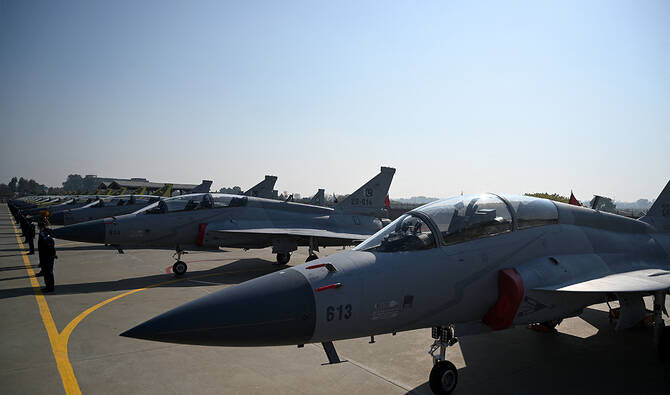

KARACHI: Pakistan’s Air Chief Marshal Zaheer Ahmed Baber Sidhu and a high-level Bangladeshi defense delegation on Tuesday discussed strengthening air force cooperation and the potential sale of JF-17 Thunder aircraft, the Pakistan military’s media wing said.
Pakistan’s JF-17 Thunder, a multi-role fighter jet jointly developed with China, has become the backbone of the Pakistan Air Force (PAF) over the past decade, designed to replace aging legacy aircraft.
Bangladesh Air Force (BAF) Air Chief Marshal Hasan Mahmood Khan led a high-level defense delegation meeting with Sidhu at the Air Headquarters in Islamabad, the Inter-Services Public Relations (ISPR) said.
“The meeting focused on strengthening operational cooperation and institutional synergy, with emphasis on training, capacity building and collaboration in aerospace advancements,” the military’s media wing said.
“Detailed discussions were also held on potential procurement of JF-17 Thunder aircraft,” the ISPR added.
Sidhu reaffirmed Pakistan’s commitment to supporting the BAF through a comprehensive training framework, from basic to advanced flying and specialized courses across PAF institutions, the ISPR said. He also assured fast-tracked delivery of the Super Mushshak trainer aircraft, along with a complete training and long-term support ecosystem, it added.
Super Mushshak is a lightweight, two to three-seater single-engine aircraft. It can operate from short, unprepared strips, according to the Pakistan Aeronautical Complex.
Khan expressed interest in benefiting from the PAF’s operational expertise and sought assistance in maintenance support for his country’s aging fleet, the ISPR said. Khan also discussed the integration of air defense radar systems between both nations to enhance air surveillance.
The Bangladeshi delegation visited key PAF facilities, including the National ISR & Integrated Air Operations Center, PAF Cyber Command, and the National Aerospace Science & Technology Park, during their visit, the ISPR said.
“The visit underscored the strong historical ties between Pakistan and Bangladesh and reflected a shared resolve to deepen defense cooperation and build a long-term strategic partnership,” the statement said.
The JF-17 fighter jet has seen extensive operational use in recent years, taking part in air-to-air and air-to-ground missions across multiple theaters. The aircraft was used in counterterrorism operations in North Waziristan in 2014 and 2017. It was also involved in the 2017 downing of an Iranian drone near the southwestern Balochistan border and in Operation Swift Retort during the 2019 aerial skirmish with India.
The fighter jet also featured in Pakistan’s 2024 cross-border strikes inside Iran and Afghanistan targeting militant groups and was deployed again in combat roles during the May 2025 conflict with India. Pakistan claimed it had downed six Indian fighter jets during the conflict, which New Delhi rejected.
Pakistan’s military announced in November last year that it signed a memorandum of understanding with a “friendly country” to procure the JF-17 Thunder aircraft during the Dubai Airshow 2025.
The meeting between both sides also took place as Pakistan draws closer to Bangladesh, amid Dhaka’s increasingly strained ties with India. India and Bangladesh’s relations have remained tense since the ouster of former Bangladesh PM Sheikh Hasina in 2024.
Hasina fled to India following violent student-led protests in 2024. New Delhi has so far not accepted Bangladesh’s request to extradite the former prime minister.


