

Pakistan’s foreign minister pledges to strengthen economic partnership with UAE in phone call with counterpart

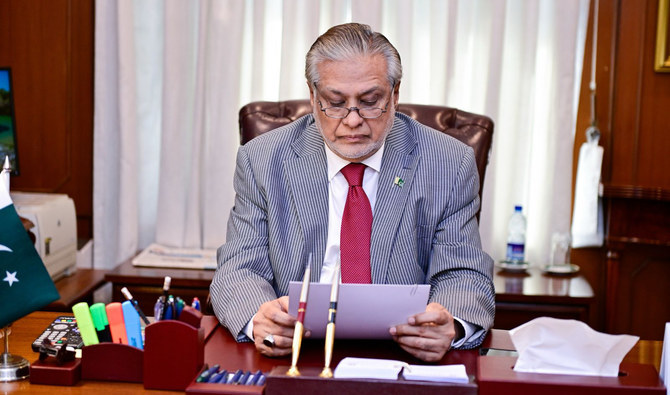
Newly appointed foreign minister Ishaq Dar is pictured at Pakistan's foreign ministry in Islamabad, Pakistan, on March 12, 2024. (Foreign Office/File)
Short Url
Updated 15 March 2024
Follow

Pakistan’s foreign minister pledges to strengthen economic partnership with UAE in phone call with counterpart

  • The two nations have a multifaceted relationship, anchored in deep-rooted historical, diplomatic and economic ties
  • The UAE is Pakistan’s crucial economic ally that provides significant investments and job opportunities to expatriates

ISLAMABAD: Pakistan’s newly appointed foreign minister Ishaq Dar vowed to strengthen the economic partnership with the United Arab Emirates (UAE) during a phone conversation on Friday with his counterpart in the Middle Eastern state.

The two nations enjoy a strong and multifaceted relationship, anchored in deep-rooted historical, diplomatic and economic ties. They maintain close diplomatic relations, regularly consulting on regional security issues and collaborating on initiatives to promote peace in the Middle East and South Asia.

Their engagement in joint military exercises, intelligence sharing, and counterterrorism cooperation also underscores a strong strategic partnership between them.

“Delighted to receive a congratulatory telephone call from my dear brother, His Highness Sheikh Abdullah bin Zayed Al Nahyan @ABZayed,” Dar said in a social media post. “We discussed the sustained momentum of our multi-tiered cooperation.”

“I look forward to working closely with His Highness in transforming the bilateral relations with the UAE into a mutually beneficial economic partnership,” he added.

Earlier this week, Dar, who has served as Pakistan’s finance minister four times, assumed leadership of the foreign ministry, highlighting the importance of economic diplomacy.

Pakistan is keen on attracting international investment and has established the Special Investment Facilitation Council, a civil-military hybrid forum, to expedite decision-making and boost investment from abroad, especially from Gulf countries.

The UAE, having deposited substantial funds into Pakistan’s central bank to bolster its foreign exchange reserves, stands as a crucial economic ally, providing significant investments, job opportunities for Pakistani expatriates and financial aid.

Both countries have also collaborated closely in other areas, with the UAE sending relief items for flood affected families after the unprecedented monsoon rains two years ago that destroyed houses, farmlands and public infrastructure in Pakistan.


Pakistan calls for new global cricket body, says ICC ‘hostage to Indian politics’

Updated 5 sec ago
Follow

Pakistan calls for new global cricket body, says ICC ‘hostage to Indian politics’

  • Pakistan’s government has barred its team from playing against India in World Cup fixture on Feb.15
  • India generates largest share of cricket’s commercial revenue, enjoying overarching influence in the sport

ISLAMABAD: Pakistan’s Defense Minister Khawaja Asif called for a new global cricket governing body on Tuesday, saying that the International Cricket Council (ICC) has become hostage to Indian political interests amid a fresh row between the neighbors ahead of the T20 World Cup 2026. 

Pakistan’s government announced earlier this week that it has cleared its national men’s team to play the upcoming World Cup, scheduled to be held in India and Sri Lanka from Feb. 7. However, Islamabad said the national team will boycott its upcoming fixture against India on Feb. 15 without mentioning a reason. The ICC responded by saying that Pakistan’s decision was “not in the interest of the global game or the welfare of fans worldwide, including millions in Pakistan.”

Pakistan’s dispute with the ICC can be traced back to it expressing displeasure recently at the cricket body’s decision to replace Bangladesh with Scotland for the World Cup. Bangladesh had requested the global governing body shift its matches to any another venue outside India owing to security concerns, as political tensions surge Delhi and Dhaka surge. 

“A new international organization of cricket is needed to keep the spirit of the gentleman’s game alive,” Asif wrote on social media platform X. “ICC has become hostage to Indian political interests in South Asia.”

India generates the largest share of cricket’s commercial revenue and hence enjoys overarching influence over the sport. Critics argue that this financial contribution translates into decisive leverage within the ICC. 

A large part of that revenue comes from the Indian Premier League (IPL), the sport’s most lucrative T20 cricket competition, which is run by the Board of Control for Cricket in India (BCCI). Between 2024 and 2027, the IPL is projected to earn $1.15 billion, nearly 39 percent of the ICC’s total annual revenue, according to international media reports. 

The ICC is headed by Jay Shah, the son of Indian Home Minister Amit Shah. The ICC chair is expected to be independent from any cricket board and hence take impartial decisions.

India and Pakistan engaged in a military confrontation that lasted for four days in May last year before Washington brokered a ceasefire. Militaries of the two countries pounded each other with drones, missiles, fighter jets and exchanged artillery fire in what was the worst fighting between them since 1999. 

These bilateral tensions have made their way to cricket, with India refusing to shake hands with Pakistani cricketers during the September 2025 Asia Cup tournament between both sides. The two teams met for three matches, all of which India won, and did not shake hands before or after the fixtures. 

The two countries have not played a full bilateral series since 2012–13 due to political tensions. They meet largely at neutral venues.