

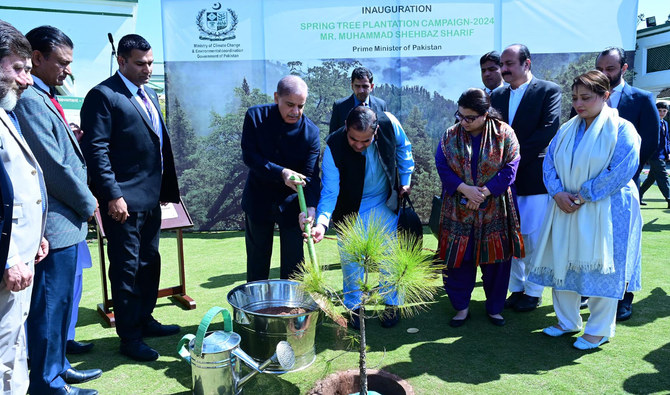
PM Sharif initiates tree plantation campaign, highlights Pakistan as fifth most climate-vulnerable country

Pakistan Prime Minister Shehbaz Sharif plants a sappling to launch the spring tree plantation campaign in Islamabad, Pakistan, on March 15, 2024. (PID)
Short Url
Updated 15 March 2024
Follow

PM Sharif initiates tree plantation campaign, highlights Pakistan as fifth most climate-vulnerable country

  • PM says forests only constitute five percent of Pakistan’s total area, urging everyone to participate in the drive
  • Pakistan will plant 543.8 million trees during the ongoing campaign, an increase from the 490 million in 2023

ISLAMABAD: Prime Minister Shehbaz Sharif on Friday said Pakistan was the fifth most vulnerable country to climate change, as he launched the spring tree plantation campaign and urged the nation to actively participate in the initiative to mitigate environmental threats.

Pakistan periodically launches such campaigns to combat deforestation and preserve biodiversity, involving government agencies, private organizations and local communities.

Initiating the drive by planting a tree, the prime minister emphasized his administration’s goal to double this year’s tree plantation numbers compared to the targets set by the previous government.

“Forests constitute only five percent of the country’s total area,” his office quoted him in a statement. “According to the Global Climate Risk Index Report, Pakistan is the fifth most affected country by climate threats.”

The PM Office provided statistics indicating that between 1999 and 2018, Pakistan lost 10,000 lives to climate change impacts like droughts, heatwaves, torrential rains and flash floods.

These erratic weather patterns also inflicted billions of dollars in losses on the economy during the same period, exacerbating Pakistan’s already distressed economic conditions.

The prime minister advocated for nationwide participation in the tree plantation campaign to safeguard against climate threats and promote a healthy environment, thereby protecting Pakistan from all forms of environmental pollution and threats.

The government aims to plant a total of 543.8 million trees during the current campaign, an increase from the 490 million trees planted in the 2023 monsoon season.

The campaign’s targets are 141 million trees in Punjab, 117.2 million in Sindh, 57.1 million in Khyber Pakhtunkhwa, 30 million in Balochistan, 118.5 million in Azad Jammu and Kashmir and 8 million trees in Gilgit Baltistan.


Sindh cabinet approves compensation for Gul Plaza victims after deadly Karachi fire

Updated 27 January 2026
Follow

Sindh cabinet approves compensation for Gul Plaza victims after deadly Karachi fire

  • Over 70 people were killed in one of Karachi’s worst fires, which took three days to extinguish
  • Deadly blazes have become frequent in the city amid weak fire safety, limited response capacity

ISLAMABAD: The Sindh cabinet on Tuesday approved a major relief and rehabilitation package for victims of the Gul Plaza fire, one of Karachi’s deadliest blazes, which killed more than 70 people and took three days to bring under control earlier this month.

The decision comes weeks after the fire ripped through the multi-story commercial building in the city’s Saddar area, trapping workers and traders as flames spread rapidly through the structure, exposing severe gaps in fire safety enforcement and emergency response.

Under the cabinet-approved package, families of those who died will receive Rs10 million ($35,800) each in compensation, while affected shopkeepers will be provided interest-free loans of Rs10 million per unit, with the provincial government bearing the cost of interest.

An additional Rs500,000 ($1,790) per shopkeeper has been approved as immediate subsistence support.

“There can be no compromise on human life,” Chief Minister Syed Murad Ali Shah said during the cabinet meeting, adding that the government’s priority was to support affected families while ensuring accountability.

“Relief, justice and prevention must go hand in hand,” he added.

The cabinet also constituted a high-level subcommittee, headed by the chief minister, to review the findings of an inquiry committee tasked with determining responsibility for the incident and recommending further action.

Fires have become an increasingly frequent occurrence in Karachi, a megacity of more than 20 million people, where fire services remain severely overstretched and under-resourced relative to population density and the scale of commercial activity.

Successive deadly incidents have drawn criticism of the Sindh administration over lax enforcement of building codes, inadequate inspections and limited emergency response capacity.