

Ceasefire talks with Israel and Hamas expected to restart

1 / 2
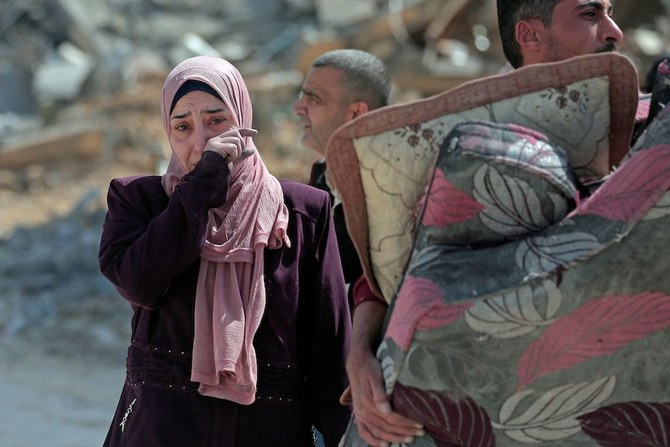
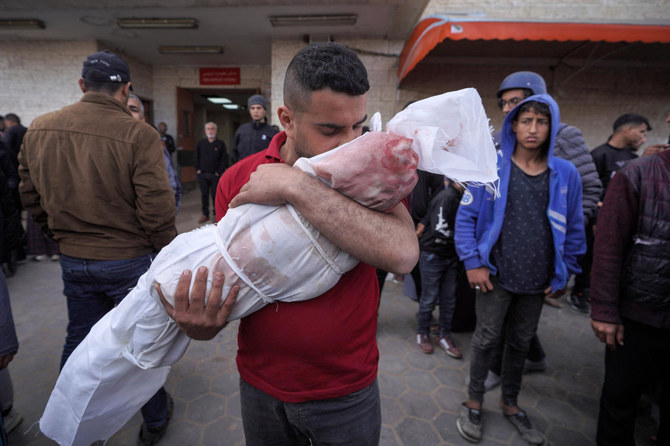
Israel’s air, sea and ground assault on Gaza, in response to a Hamas-led attack on Oct. 7, has killed more than 31,000 people and wounded over 71,500. (AFP)
2 / 2
The releases would include 100 Palestinian prisoners serving life sentences in Israeli prisons. (FILE/AFP)
Short Url
Updated 16 March 2024
Follow

Ceasefire talks with Israel and Hamas expected to restart

  • Group wants truce to lead to ‘complete (Israeli) withdrawal’ from Gaza Strip and permanent ceasefire
  • Netanyahu has approved plan for military offensive on Rafah

CAIRO: Stalled talks aimed at securing a ceasefire in the war between Israel and Hamas are expected to restart in earnest in Qatar as soon as Sunday, according to Egyptian officials.
The talks would mark the first time both Israeli officials and Hamas leaders joined the indirect negotiations since the start of the Muslim holy month of Ramadan. International mediators had hoped to secure a six-week truce before Ramadan started earlier this week, but Hamas refused any deal that wouldn’t lead to a permanent ceasefire in Gaza, a demand Israel rejected.

Prime Minister Benjamin Netanyahu has also approved a plan for a military offensive on Rafah, the city on the southern edge of the Gaza Strip where up to 1.5 million Palestinians are sheltering.

The United States and other countries have warned such an operation could be disastrous, but Israel says it plans to push ahead to destroy Hamas battalions stationed there.  Israel claims it will move people to safety first.

More than two weeks after receiving an Israeli-approved proposal for a truce, Hamas replied with a counter proposal of a six-week truce to allow aid in, and a prisoner-hostage swap at a ratio of up to 50 Palestinian prisoners for every Israeli hostage. It also calls for talks at a later stage on ending the war completely.

Analysts noted a change in Israel’s language in rejecting the new Hamas offer. Netanyahu dismissed last month’s proposal from the militant group as “completely delusional” and “from another planet,” while the most recent one was merely “unrealistic.”

Hamas official Sami Abu Zuhri said Israel’s rejection showed that Netanyahu was “determined to pursue the aggression against our people and undermine all efforts exerted to reach a ceasefire agreement.” Washington should push its ally to accept a truce, he said.

Meanwhile the first ship bringing aid by sea, the Open Arms, arrived off the Gaza coast on Friday towing a barge containing 200 tonnes of food. The charity World Central Kitchen aims to land the cargo using a temporary jetty, although humanitarian agencies say aid delivered by sea or air is inadequate and Israel must stop blocking land deliveries by truck.

If the new sea route is successful, it may ease the hunger crisis affecting Gaza, where hundreds of thousands of people face malnourishment and hospitals in the worst-stricken northern areas have reported children dying of starvation.

The UN says all of Gaza’s 2.3 million people are suffering from food shortages and a quarter of them are on the brink of famine, especially in the north.


Iran president confirms talks with US

Updated 7 sec ago
Follow

Iran president confirms talks with US

  • No official confirmation from Tehran on where the talks would be held

Iran’s president confirmed on Tuesday that he had ordered the start of talks with the US following requests “from friendly governments.”

There has been no official confirmation from Iran on where the talks would be held, but an Arab official, speaking on condition of anonymity, told AFP a meeting was likely to take place in Turkiye on Friday, following diplomatic interventions by Ankara, as well as Egypt, Oman and Qatar.
US President Donald Trump  has spoken of potential military action and sent an aircraft carrier group to the Middle East following anti-government protests in Iran that were met with a deadly crackdown last month.

FASTFACT

On Tuesday, Qatar’s Foreign Ministry said diplomacy with Iran was ‘continuing very intensively,’ in ‘tandem with all our neighbors.’

Trump has maintained he is hopeful that Washington will “work something out” with Tehran, but also warned that “bad things would happen” if a deal was not agreed.
Tehran has insisted it wants diplomacy, while promising a decisive response to any aggression.
“I have instructed my Minister of Foreign Affairs, provided that a suitable environment exists — one free from threats and unreasonable expectations — to pursue fair and equitable negotiations,” President Masoud Pezeshkian wrote in a post on X.
He added that the talks followed requests “from friendly governments.”
On Tuesday, Qatar’s Foreign Ministry said diplomacy with Iran was “continuing very intensively,” in “tandem with all our neighbors.”
Earlier, a senior official from the UAE said Iran needed to reach a deal and “rebuild their relationship with the  US.”

I have instructed my Minister of Foreign Affairs, provided that a suitable environment exists to pursue fair and equitable negotiations.

President, Masoud Pezeshkian

“I would like to see direct Iranian-American negotiations leading to understandings so that we don’t have these issues every other day,” said presidential adviser Anwar Gargash.
Iran has repeatedly stressed that any talks should remain focused solely on the nuclear issue, rejecting the possibility of negotiations over its missile program or defense capabilities.
In an interview with CNN broadcast on Monday, Iranian Foreign Minister Abbas Araghchi said Tehran had lost trust in Washington as a negotiating partner but a deal on the nuclear issue remained achievable.
“So I see the possibility of another talk if the US negotiation team follows what President Trump said: to come to a fair and equitable deal to ensure that there is no nuclear weapons,” he said.
Since his return to office in January last year, Trump has reinstated his “maximum pressure” policy of sanctions against Iran, piling additional pain on a floundering economy.
Protests against the rising cost of living broke out in Tehran in December before evolving into wider nationwide anti-government demonstrations that triggered a deadly crackdown by the authorities.
Iranian officials have acknowledged more than 3,000 deaths during the unrest, but insist that most were members of the security forces and innocent bystanders, attributing the violence to “terrorist acts.”
The Human Rights Activists News Agency, a US-based NGO, says it has confirmed 6,854 deaths, mostly protesters killed by security forces, with other rights groups warning the figure is likely far higher.
On Tuesday, the NGO said it had counted at least 50,235 arrests linked to the protests, with further detentions ongoing.
Meanwhile, local media reported that the authorities had detained 139 foreign nationals in central parts of the country during the protests.