

Two Russian border regions are now active combat zones: Ukraine official

1 / 3
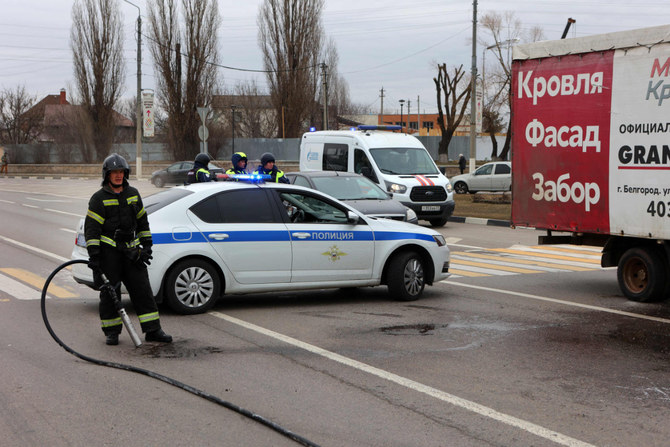
Russian police and firefighters respond at the scene of fresh aerial attacks on Belgorod on March 14, 2024. (AFP)
2 / 3
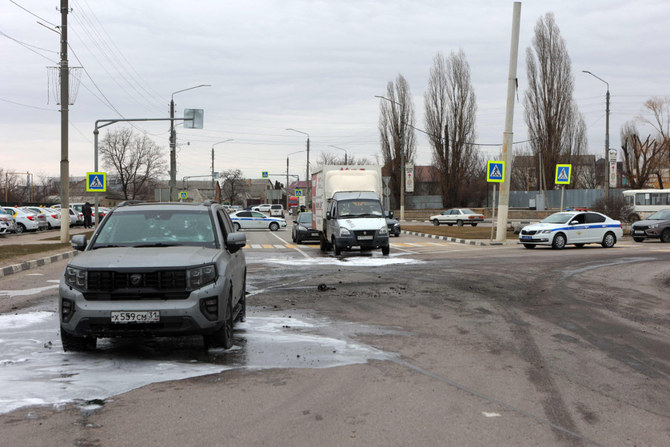
Damaged cars are seen at the scene of fresh aerial attacks on Russia's Belgorod region on March 14, 2024. (AFP)
3 / 3
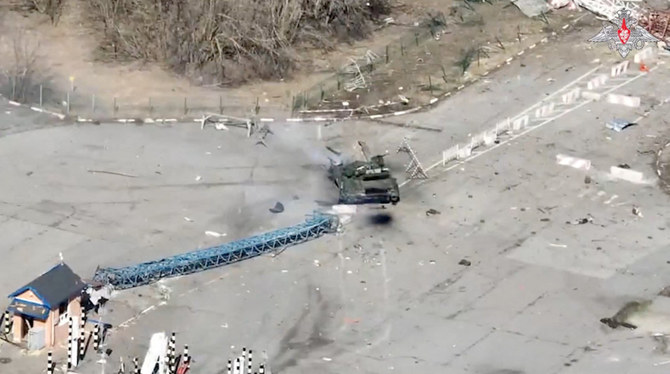
This still image from a video released by the Russian Defense Ministry on March 12, 2024, reportedly shows a destroyed tank of Ukraine-based armed groups after an attempted incursion into Russian territory near the village of Nekhoteevka in Belgorod. (Reuters)
Short Url
Updated 15 March 2024
Follow

Two Russian border regions are now active combat zones: Ukraine official

  • Three Ukraine-based groups issued statements saying they were pursuing armed operations in Belgorod and Kursk regions
  • Belgorod's governor, Vyachslav Gladkov, said earlier that two people were killed and at least 20 injured in attacks inside the border

KYIV: A senior Ukrainian intelligence official said on Thursday that armed groups purporting to be made up of Russians opposed to the Kremlin were pressing an incursion into Russian territory and had turned two border regions into “active combat zones.”

Three Ukraine-based groups issued statements saying they were pursuing armed operations in Belgorod and Kursk regions and asking residents to evacuate towns and villages for their own safety.
“Kursk and Belgorod regions are now an area of active combat actions. This is what we confirm,” Andriy Yusov, a spokesperson for the GUR intelligence directorate, told national television.
“And as stated by the volunteers and rebels, we are talking about Russian citizens who, having no other options, are defending their civil right with arms against the Putin regime.”
Vyachslav Gladkov, governor of Russia’s Belgorod region, said earlier that two people were killed and at least 20 injured in attacks inside the border by Ukrainian armed forces.
Russia’s Defense Ministry said it had foiled an attack by the Ukrainian army.
Posting late in the day on Telegram, Gladkov said he was headed to border districts, specifically to the town of Kozinka, to provide a first-hand account of events. Russian military bloggers had earlier reported that Russian paratroops had been dispatched to the town.
Kursk regional governor, Roman Starovoit, gave few details, but noted on Telegram that “Ukrainian terrorists have not stopped their attempts to bring saboteurs into our territory.”
One of the three armed groups, the Freedom of Russia Legion, said on Telegram that in view of the “limited military operation” being conducted in the two regions, it was asking residents of certain towns to leave the area. ‘ A second, the Siberian Battalion, said it had observed “a mood of panic in the town of Grayvoron — next to Kozinka — with cars queuing to leave.
Two of the groups had reported launching a cross-border incursion earlier this week.
In the past, Russian officials have cast the groups as puppets of the Ukrainian military and US Central Intelligence Agency, which Moscow says is trying to foment chaos in Russia.
The Freedom of Russia legion and the Russian Volunteer Corps have previously claimed responsibility for other cross-border raids into Russia from Ukraine.


Chile votes in presidential race expected to lurch country to the right

Updated 1 sec ago
Follow

Chile votes in presidential race expected to lurch country to the right

  • Right-wing candidate Jose Antonio Kast faces leftist Jeannette Jara
  • Kast is seen as most likely to triumph
SANTIAGO: Chileans will vote in a runoff presidential election on Sunday that is expected to result in the South American country’s sharpest rightward shift since the end of the military dictatorship in 1990. Nearly 15.6 million registered voters in Chile are set to cast ballots. Polls will close at 6 p.m. local time (2100 GMT), pending voter lines, with initial results expected soon after. The runoff pits Jose Antonio Kast, from the far-right Republican Party that he founded, against Jeannette Jara, the incumbent leftist government’s coalition candidate from the Communist Party. While Jara won November’s first round with 26.85 percent of the vote, Kast beat out an array of right-wing candidates to finish second with 23.92 percent. Most of the voters who supported those candidates are projected to go for Kast, which would give him more than 50 percent of the vote and the presidency.
CAMPAIGNS CLOSE WITH FOCUS ON CRIME
As the campaigns wound down, both candidates threw jabs at each other, but also focused on the main topic that has come to define the election: crime.
Speaking on Thursday from behind a clear protective barrier in the southern city of Temuco, the capital of a region rattled by conflict between Indigenous Mapuche groups and the government, Kast described a country in chaos and said he would restore order. “This government caused chaos, this government caused disorder, this government caused insecurity,” the 59-year-old lawyer said. “We’re going to do the opposite, we’re going to create order, security and trust.” While Chile remains one of the safest countries in Latin America, a recent surge in organized crime and immigration has rattled the electorate and become the main concern among voters.
The issue quickly became a thorn in the side of leftist President Gabriel Boric, who rose to power on a wave of progressive optimism following widespread protests against inequality and promises of drafting a new constitution. Boric, who is barred from re-election because of a prohibition on consecutive presidential terms, scrambled to adjust, boosting funding for police forces, creating task forces dedicated to fighting organized crime, and deploying the military to the country’s northern border with Peru and Bolivia.
But it wasn’t enough for many voters. Boric has been struggling with low approval ratings, while Kast’s hard-line proposals against crime and immigration have attracted support. “This country needs important reforms, we need to retake the path we’ve had for decades because we’re completely lost,” Jose Pinochet, a 55-year old lawyer, said while getting his shoes shined on a street in Santiago.
Antonia Moreno, 21, said she would vote for Jara but did not think it likely she would win.
“Regretfully we’ll be part of those countries where the far-right gains in Congress and the executive branch,” she said.
CONSISTENT HARDLINER
A Kast victory is likely to be cheered by investors who are hoping that a market-friendly government will accelerate economic reforms, including deregulation and changes to the copper-rich country’s pension system and capital markets.
The Chilean peso strengthened and MSCI’s Chile equity benchmark surged after the first-round results last month. Although no clear majority emerged in the Senate or Congress in that vote, Kast is expected to eventually be able to pass some economic reforms if he wins the runoff.
“The third time’s a charm,” he said during a speech after he made it to the runoff in November. This is his third run for president, and second runoff after losing to Boric in 2021.
Many of Kast’s views were seen as too extreme by voters in 2021, but now they have found a more sympathetic hearing among an electorate craving security and weary of the traditional political parties. “I see the expression of the right, of the far right, as an escape valve for the rejection of politics in Chile,” said Marta Lagos, an analyst, pollster and founding director of Latinobarometro. This is the first presidential election under a mandatory voting provision with automatic registration for those older than 18 and fines levied on anyone who doesn’t vote. That change adds an element of uncertainty, with opinion polls showing about 20 percent of voters still undecided or saying they will leave their ballots blank.
“There’s a percentage of voters who aren’t comfortable with either Jara or Kast,” said Guillermo Holzmann, a political analyst from the University of Valparaiso. “The question is: Who do those blank or null votes favor?” During her closing campaign event on Thursday in the northern city of Coquimbo, Jara vowed to be tough on crime, touted the need for strong social programs, and urged people not to leave their ballots blank. “Talk to people who are thinking about voting blank. There’s a lot at stake and we have to move forward, not back,” said the 51-year-old lawyer and former minister of labor in the Boric government.