

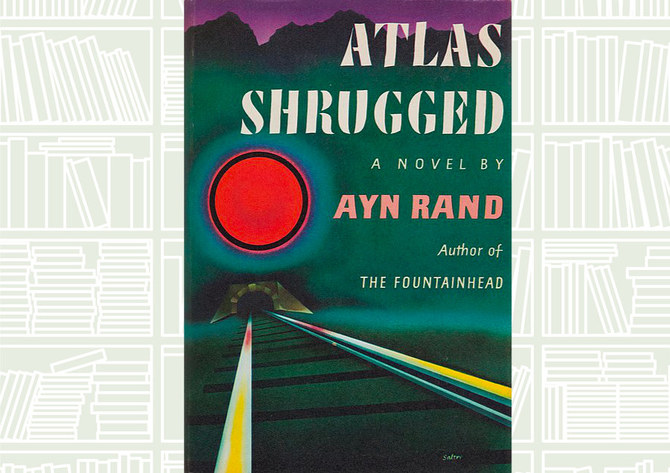
What We Are Reading Today: ‘Atlas Shrugged’

Short Url
Updated 15 March 2024
Follow

What We Are Reading Today: ‘Atlas Shrugged’

“Atlas Shrugged” is a novel by Ayn Rand published in 1957. It is a work of fiction that explores Rand’s philosophy of Objectivism by portraying a dystopian society.

The novel — which took 14 years to write — is set in the US, although it is not explicitly mentioned. It takes place in a future where the world is facing economic collapse due to excessive government regulations and intervention.

The story follows several central characters, including Dagny Taggart, Hank Rearden and John Galt.

Dagny Taggart is a successful railroad executive who struggles to keep her family’s company afloat in the face of government interference and declining economic conditions. Hank Rearden is an innovative steel magnate facing similar industry challenges. 

Both Dagny and Hank are portrayed as talented and productive individuals hindered by the government’s policies.

As the story unfolds, the most productive and talented members of society begin to disappear, leaving behind a crumbling economy and a society on the verge of collapse. These disappearances are orchestrated by John Galt, a brilliant inventor and philosopher who believes in the power of individualism and rejects the notion of sacrifice for the collective.

Rand presents her philosophical ideas throughout the novel, emphasizing the importance of reason, individualism and laissez-faire capitalism. She portrays the government as a stifling force that punishes success and rewards mediocrity.

Since its publication, “Atlas Shrugged” has been celebrated and criticized. Supporters see it as a powerful defense of individualism and capitalism, while critics argue that it promotes a selfish and unrealistic worldview.

The novel is complex and thought-provoking, exploring themes of individualism, capitalism and the role of government in society. It continues to be influential and has sparked discussions and debates about its philosophical content. It won the Prometheus Hall of Fame Award in 1983. 

Other notable works by Rand — born Alice O’Connor — include “We The Living,” “Anthem,” and “The Romantic Manifesto.” 


Decoding villains at an Emirates LitFest panel in Dubai

Updated 25 January 2026
Follow

Decoding villains at an Emirates LitFest panel in Dubai

DUBAI: At this year’s Emirates Airline Festival of Literature in Dubai, a panel on Saturday titled “The Monster Next Door,” moderated by Shane McGinley, posed a question for the ages: Are villains born or made?

Novelists Annabel Kantaria, Louise Candlish and Ruth Ware, joined by a packed audience, dissected the craft of creating morally ambiguous characters alongside the social science that informs them. “A pure villain,” said Ware, “is chilling to construct … The remorselessness unsettles you — How do you build someone who cannot imagine another’s pain?”

Candlish described character-building as a gradual process of “layering over several edits” until a figure feels human. “You have to build the flesh on the bone or they will remain caricatures,” she added.

The debate moved quickly to the nature-versus-nurture debate. “Do you believe that people are born evil?” asked McGinley, prompting both laughter and loud sighs.

Candlish confessed a failed attempt to write a Tom Ripley–style antihero: “I spent the whole time coming up with reasons why my characters do this … It wasn’t really their fault,” she said, explaining that even when she tried to excise conscience, her character kept expressing “moral scruples” and second thoughts.

“You inevitably fold parts of yourself into your creations,” said Ware. “The spark that makes it come alive is often the little bit of you in there.”

Panelists likened character creation to Frankenstein work. “You take the irritating habit of that co‑worker, the weird couple you saw in a restaurant, bits of friends and enemies, and stitch them together,” said Ware.

But real-world perspective reframed the literary exercise in stark terms. Kantaria recounted teaching a prison writing class and quoting the facility director, who told her, “It’s not full of monsters. It’s normal people who made a bad decision.” She recalled being struck that many inmates were “one silly decision” away from the crimes that put them behind bars. “Any one of us could be one decision away from jail time,” she said.

The panelists also turned to scientific findings through the discussion. Ware cited infant studies showing babies prefer helpers to hinderers in puppet shows, suggesting “we are born with a natural propensity to be attracted to good.”

Candlish referenced twin studies and research on narrative: People who can form a coherent story about trauma often “have much better outcomes,” she explained.

“Both things will end up being super, super neat,” she said of genes and upbringing, before turning to the redemptive power of storytelling: “When we can make sense of what happened to us, we cope better.”

As the session closed, McGinley steered the panel away from tidy answers. Villainy, the authors agreed, is rarely the product of an immutable core; more often, it is assembled from ordinary impulses, missteps and circumstances. For writers like Kantaria, Candlish and Ware, the task is not to excuse cruelty but “to understand the fragile architecture that holds it together,” and to ask readers to inhabit uncomfortable but necessary perspectives.