LONDON: Egypt’s foreign minister called on Israel on Thursday to open its land crossings to let more aid into the Gaza Strip and said Egypt was continuing efforts to agree a ceasefire between Israel and Hamas and a hostage-prisoner exchange.
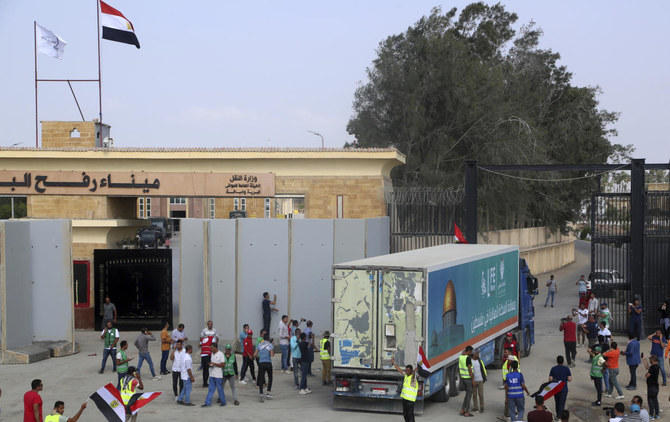
Humanitarian relief has so far mainly been channelled through the Rafah crossing between Egypt and Gaza and the nearby, Israeli-controlled crossing of Kerem Shalom, but aid officials say the quantity delivered is far less than needed.
Egypt’s military has recently taken part in air drops of aid into Gaza as the humanitarian situation in the Palestinian enclave has deteriorated.
Aid officials, however, say land transport is the only effective way of scaling up deliveries to meet needs quickly. Much of the aid provided by international donors has been stockpiled at Al Arish in the north of Egypt’s Sinai Peninsula.
“Israel controls six other crossings that it should open,” Egyptian Foreign Minister Sameh Shoukry told a press conference during a visit by his Spanish counterpart to Cairo.
“There is a long line of trucks waiting to enter but are subject to the procedures of vetting that must be complied to so that the trucks can enter safely, that the drivers are not targeted, that they are received on the other side,” Shoukry said.
“We have the capacity to increase the number of trucks but the authorization has to come,” he added.
Egypt, which fears the displacement of Palestinians crowded near its border with Gaza, has previously said Israel was blocking aid. Aid officials say their inability to distribute aid within Gaza because of Israel’s military campaign is a major impediment.
Israel denies obstructing aid deliveries into Gaza. It has blamed failures by aid agencies for delays and has accused the Islamist group Hamas of diverting aid. Hamas denies this and says Israel uses hunger as a weapon in its military offensive.
Gaza health authorities say more than 31,000 Palestinians have been killed since Israel launched its offensive in response to an Oct. 7 attack by Hamas which left some 1,200 people dead and at least 250 hostages captured.
Egypt alongside Qatar has been trying to mediate between Israel and Hamas to reach an agreement for a ceasefire and the release of Israeli hostages in return for Palestinian prisoners.
Attempts to strike a deal ahead of the start of the Muslim holy month of Ramadan this week fell through.
“We are working to reach a ceasefire, and release hostages and Palestinian prisoners,” Shoukry said, declining to give further details.
Spanish Foreign Minister Jose Manuel Albares said Spain had the backing of more than 90 countries for an international peace conference to deliver a two-state solution for the conflict between Israel and the Palestinians.


![]()
Egypt calls on Israel to open land crossings for Gaza aid

Short Url
https://arab.news/w8r8f
Egypt calls on Israel to open land crossings for Gaza aid
- “Israel controls six other crossings that it should open,” Egyptian Foreign Minister Sameh Shoukry says
Latest updates


© 2026 SAUDI RESEARCH & PUBLISHING COMPANY, All Rights Reserved And subject to Terms of Use Agreement.