

Food aid from Indonesia enters Gaza amid Israeli blockades

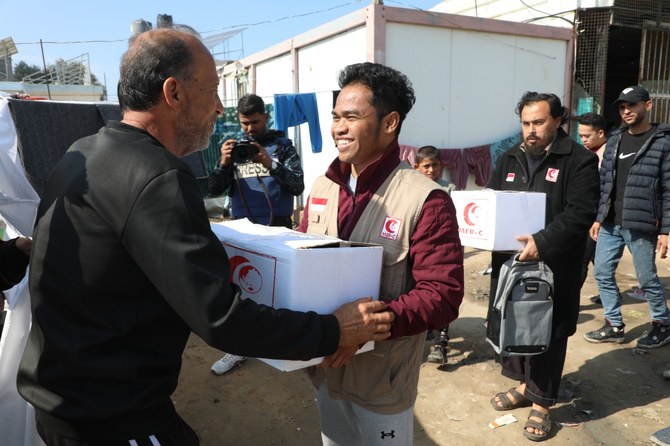
A volunteer from the Indonesian NGO Medical Emergency Rescue Committee, or MER-C, hands over a food package to a Palestinian. (MER-C)
Short Url
Updated 28 February 2024
Follow

Food aid from Indonesia enters Gaza amid Israeli blockades

  • Aid convoys have been targeted by Israeli military, Indonesian volunteer says
  • Hundreds of thousands of Palestinians in Gaza are on the brink of famine

JAKARTA: Some trucks carrying humanitarian assistance from Indonesia have managed to enter Gaza, Indonesian volunteers confirmed, despite Israeli attacks on convoys and the blocking of critical aid.

Thousands of aid trucks have been waiting to enter Gaza on the Egyptian side of the Rafah border crossing, with the UN saying on Tuesday that convoys carrying humanitarian assistance have been targeted by Israeli attacks and prevented from reaching people in need.

Several trucks carrying wheat flour and food packages from the Indonesian NGO Medical Emergency Rescue Committee, or MER-C, are among the few that managed to enter Gaza recently, volunteers from the organization said.

The volunteers, Fikri Rofiul Haq and Reza Aldilla Kurniawan, chose to stay in Gaza when Israeli attacks on the besieged territory escalated in October. They were volunteering at the MER-C-funded Indonesia Hospital in northern Gaza. When the hospital was destroyed by the Israeli military, they sought safety in the southern part of the enclave.

“The aid delivery went through many obstacles, including a long authorization process and also lengthy inspection by Israeli officials, which have resulted in many of the food packages going bad,” Haq told Arab News on Wednesday.

Thousands of food packages were distributed last weekend in central and southern Gaza. MER-C volunteers steered clear from the enclave’s north as they feared being targeted by the Israeli military.

“All this aid from the Indonesian people through MER-C faces potential attacks by Israel,” Haq said. “Until this very second, Israeli forces continue to attack and they are attacking randomly — we never know when they might launch their assault.”

About 30,000 Palestinians have been killed by Israel’s air and ground campaign in Gaza. The UN has warned that hundreds of thousands of people are now on the brink of famine as the enclave’s population relies on inadequate food aid to survive.

Amnesty International and Human Rights Watch said on Monday that the number of food aid trucks entering Gaza had decreased by about one-third since the International Court of Justice ruled last month that Israel must do everything to prevent genocidal acts in the besieged territory, and take “immediate and effective measures” for aid provision.

“Israel continues to obstruct the provision of basic services and the entry and distribution within Gaza of fuel and lifesaving aid, acts of collective punishment that amount to war crimes and include the use of starvation of civilians as a weapon of war,” HRW said in a statement.


Family of Palestine Action hunger-strike detainee warn she could die 

Updated 47 min 15 sec ago
Follow

Family of Palestine Action hunger-strike detainee warn she could die 

  • Teuta Hoxha, among 8 people held on remand for over a year, has not eaten in 43 days
  • Campaigners slam treatment of pro-Palestine prisoners on hunger strike 

LONDON: A Palestine Action prisoner in the UK could die if the government does not step in over her hunger strike, her family have warned, amid claims that authorities have been “deliberately negligent” in the treatment of other detained hunger strikers.

Teuta Hoxha, 29, is on day 43 of her strike, having been held on remand in prison for 13 months over charges relating to a break-in at an Israel-linked arms manufacturing facility in August 2024. 

She is one of eight people on hunger strike who were detained for their part in the incident at the Elbit Systems UK site.

Her sister Rahma said she can no longer stand to pray, and suffers from headaches and mobility issues. 

“I know that she’s already instructed the doctors on what to do if she collapses and she’s instructed them on what to do if she passes away,” Rahma, 17, told Sky News.

“She’s only 29 — she’s not even 30 yet and nobody should be thinking about that,” Rahma added. “She’s been on remand for over a year, her trial’s not until April next year and bail keeps getting denied.”

The eight hunger strikers charged over the Elbit Systems break-in, who deny all charges against them, are demanding an end to the operation of weapons factories in the UK that supply Israel.

They are also calling for Palestine Action, which is banned in the UK, to be de-proscribed, and for their immediate bail.

They are not the only members of Palestine Action in prison carrying out hunger strikes. Amu Gib, imprisoned over a break-in at a Royal Air Force base earlier this year, was taken to hospital last week, having not eaten in 50 days. 

Gib was initially denied access to a wheelchair after losing mobility, and campaigners said it was “completely unacceptable” that this had led to a missed doctor’s appointment, adding that Gib was also denied access to the vitamin thiamine.

Campaign group Prisoners for Palestine said: “At this trajectory, the hunger strikers will die unless there is urgent intervention by the government.

“It is completely unacceptable and deliberately negligent to pretend the hunger strike is not happening, or to dismiss the prisoners’ demands.

“They are in the custody of the state, and any harm that comes to them is a deliberate outcome of the government’s negligence and the politicisation of their detention.”

A relative of Gib told The Independent: “We wouldn’t know if Amu is in a coma or had a heart attack. I’m the next of kin and it’s on Amu’s medical record that I am to be contacted in the event of their hospitalisation.

“But it’s been complete agonising silence for 57 hours. I’m furious and outraged that the prison was withholding thiamine from the hunger strikers, without which they are at high risk of brain damage.”

The treatment of the hunger strikers has drawn high-profile criticism, with Dr. James Smith, an emergency physician and lecturer at University College London, telling The Independent that they “are dying” and would require specialist medical help.

Around 900 medical professionals in the UK have written to government ministers David Lammy and Wes Streeting urging them to facilitate medical treatment for the strikers.

Jeremy Corbyn, former leader of the governing Labour Party, posted on Instagram that he had visited Gib in prison.

Seven hunger strikers have so far been hospitalized since Nov. 2, when the first prisoners began to refuse food.

Jon Cink and Umar Khalid both ended their strikes for medical reasons, having been hospitalized, while Kamran Ahmed told the Sunday Times last week that dying for his cause would be “worthwhile.”

He added: “Every day I’m scared that potentially I might die. I’ve been getting chest pains regularly … There have been times where I felt like I’m getting tasered — my body’s vibrating or shaking. I’ll basically lose control of my feelings.

“I’ve been scared since the seventh day when my blood sugars dropped. The nurse said: ‘I’m scared you’re not going to wake up (when you go to sleep). Please eat something.’

“But I’m looking at the bigger picture of perhaps we can relieve oppression abroad and relieve the situations for my co-defendants … Yes, I’m scared of passing away. Yes, this may have lifelong implications. But I look at the risk versus reward. I see it as worthwhile.”

Under UK law, time limits are set out for those in custody awaiting trial to prevent excessive periods in pre-trial detention.

But UK Prisons Minister Lord Timpson said in relation to the Palestine Action detainees: “These prisoners are charged with serious offences including aggravated burglary and criminal damage.

“Remand decisions are for independent judges, and lawyers can make representations to the court on behalf of their clients.

“Ministers will not meet with them — we have a justice system that is based on the separation of powers, and the independent judiciary is the cornerstone of our system.

“It would be entirely unconstitutional and inappropriate for ministers to intervene in ongoing legal cases.”

Rahma says her sister calls her from prison every day, despite her predicament, to help with her studies.

“Our mother passed away when I was really young. Teuta took care of me and my siblings and made sure to read us bedtime stories.

“She’s always there for me and even from prison, she’s helping me do my homework and revise for exams.”

Rahma added: “My sister is a caring and loving person It feels like the state has taken a piece of me.”

She continued: “The only form of resistance she has is her body and that’s what she is using against the state.”