TEL AVIV: The Israeli military said Wednesday it plans to direct a significant portion of the 1.4 million displaced Palestinians living in the Gaza Strip’s southernmost town of Rafah toward “humanitarian islands” in the center of the territory ahead of its planned offensive in the area.
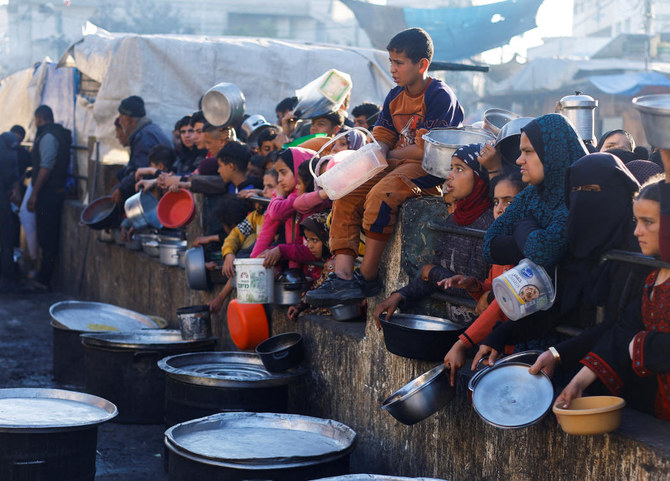
The fate of the people in Rafah has been a major area of concern of Israel’s allies — including the United States — and humanitarian groups, worried an offensive in the region densely crowded with so many displaced people would be a catastrophe. Rafah is also Gaza’s main entry point for desperately needed aid.
Israeli Prime Minister Benjamin Netanyahu has said a Rafah offensive is crucial to achieve Israel’s stated aim of destroying Hamas following the militants’ Oct. 7 attack in which about 1,200 people, mostly civilians, were killed and around 250 taken hostage and brought into Gaza. Israel’s invasion of Gaza has killed more than 31,000, according to Gaza health officials, left much of the enclave in ruins and displaced some 80 percent of Gaza’s 2.3 million people.
Israel’s chief military spokesman, Rear Adm. Daniel Hagari, said moving those in Rafah to the designated areas, which he said would be done in coordination with international actors, was a key part of the military’s preparations for its anticipated invasion of Rafah, where Israel says Hamas maintains four battalions it wants to destroy.
Rafah has swelled in size in the last months as Palestinians in Gaza have fled fighting in nearly every other corner of the territory. The town is covered in tents.
“We need to make sure that 1.4 million people or at least a significant amount of the 1.4 million will move. Where? To humanitarian islands that we will create with the international community,” Hagari told reporters at a briefing.
Hagari said those islands would provide temporary housing, food, water and other necessities to evacuated Palestinians. He did not say when Rafah’s evacuation would occur, nor when the Rafah offensive would begin, saying that Israel wanted the timing to be right operationally and to be coordinated with neighboring Egypt, which has said it does not want an influx of displaced Palestinians crossing its border.
At the start of the war, Israel directed evacuees to a slice of undeveloped land along Gaza’s Mediterranean coast that it designated as a safe zone. But aid groups said there were no real plans in place to receive large numbers of displaced there. Israeli strikes also targeted the area.
More than 31,270 Palestinians have been killed in Gaza and most of its 2.3 million people forced from their homes, Gaza’s Health Ministry says. The ministry doesn’t differentiate between civilians and combatants in its count, but says women and children make up two-thirds of the dead.
Israel blames the civilian death toll on Hamas because the militants fight in dense, residential areas. The military has said it has killed 13,000 Hamas fighters, without providing evidence.
Meanwhile, fighting continued across Gaza. An Israeli strike Wednesday hit a food distribution site in southern Gaza run by UNRWA, the UN agency that works with Palestinian refugees, killing one staff member from the agency and wounding 22 others.
The death brings to 165 the number of workers for the agency killed during the past five months of fighting, according to UNRWA.
Gaza’s health authorities said a total of five people were killed in the strike on the yard of an UNRWA warehouse.
Hagari said the army was looking into the report.
The conflict has sparked a humanitarian disaster that has led to growing hunger. Aid delivery has been hobbled by Israeli restrictions, the ongoing hostilities and the breakdown of order inside Gaza, according to the United Nations. Israel denies it is restricting the entry of aid.
The crisis has been particularly acute in northern Gaza, Israel’s initial target in the early weeks of the war.
Hagari said Wednesday Israel plans to “flood the area” with aid, with plans to scale up the entry of goods from multiple points in northern Gaza, after half a dozen trucks delivered aid entered from the north on Tuesday as part of a pilot program. He did not say how many more trucks were expected to enter and at what frequency.
Hagari also said representatives from the US military were expected in Israel this week to further coordinate a planned US floating pier that will be built off the coast of Gaza, which he said would be “significant” for northern Gaza.
The US and other countries have also been airdropping food into northern Gaza in recent weeks to help alleviate the crisis. Aid groups said air drops and bringing sea shipments are far less efficient and effective than bringing in food by truck.


![]()

Israel says it plans to direct Palestinians out of Rafah ahead of anticipated offensive
Short Url
https://arab.news/ydcuq
Israel says it plans to direct Palestinians out of Rafah ahead of anticipated offensive
- The fate of the people in Rafah has been a major area of concern of Israel’s allies — including the United States — and humanitarian groups
- Rafah has swelled in size in the last months as Palestinians in Gaza have fled fighting in nearly every other corner of the territory


Latest updates


© 2026 SAUDI RESEARCH & PUBLISHING COMPANY, All Rights Reserved And subject to Terms of Use Agreement.