Pakistan seeks resumption of Ravi water flow from India to maintain ecological balance

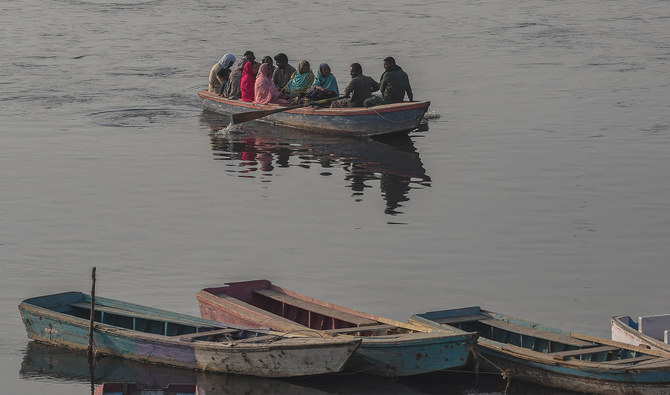
Visitors take a leasure ride on a boat in Ravi river in Lahore on November 14, 2021. (AFP/File)
Short Url
Updated 14 March 2024
Follow

Pakistan seeks resumption of Ravi water flow from India to maintain ecological balance

  • Indian media widely reported last month that India had diverted flow of water from Ravi to barrage in Jammu and Kashmir 
  • Pakistani official admits India’s move to divert Ravi water flow is not a violation of the Indus Water Treaty of 1960

ISLAMABAD: The Pakistani government is seeking the resumption of water flow from India via River Ravi to maintain its ecological balance, a top official confirmed on Thursday after India last month reportedly diverted the flow of water to a barrage in the Jammu and Kashmir territory under its control for irrigation purposes. 

Nuclear-armed neighbors India and Pakistan signed the Indus Water Treaty in 1960, which gives control over the waters of the three eastern Indus River tributaries Beas, Ravi, and Sutlej to India, and control over the waters of the three western rivers, the Indus, Chenab and Jhelum, to Pakistan. 

Under the treaty, both countries can approach the World Bank for arbitration in case of disputes over the use of water resources.

Indian media widely reported last month that India had diverted the water flow from Ravi to Shahpur Kandi Barrage in Jammu and Kashmir for irrigation purposes. The barrage is set to irrigate around 32,000 hectares of land in the Kathua and Samba districts in Indian-administered Kashmir.

“As part of the treaty, India has exclusive rights over the waters of the Ravi but Pakistan has raised the issue with India for environmental flows to maintain ecological balance,” a senior official of Pakistan Commissioner for Indus Waters told Arab News, speaking on condition of anonymity as he was not authorized to speak to media on the issue.

Environmental flow is a term used to describe the quantity, timing, and quality of water flows that are required to sustain freshwater estuarine ecosystems and human livelihoods. 

The official said Pakistan raised the issue of environmental flow with India in the last meeting of Indus Water Commissioners held in New Delhi in May 2022. He said Pakistan was carrying out a study to determine the amount of water flows it needs to maintain the ecological balance. 

“The Punjab Irrigation Department is currently carrying out a study to ascertain quantity and timing of the environmental flow, and then this study will be shared with India for further discussions,” he said.

He admitted that India was under no obligation to accept Pakistan’s demand to release water into the Ravi. “But this is one of the emerging public importance issues that need to be taken care of,” he said. 

Experts said both countries needed to renegotiate the Indus Water Treaty to incorporate crucial elements such as environmental flows to deal with the latest challenges such as climate change. 

“The Indus Water Treaty deals with the surface waters of the rivers only but now the need is to discuss a way out for groundwater, climate change and environmental flow between both countries,” Dr. Pervez Amir, a water expert and council member of the Hisaar Foundation which advocates for water and livelihood security, told Arab News. 

“The treaty should not be static as both countries should show wisdom to address the mutual water challenges through negotiations.”

Arshad Abbasi, a water expert, said environmental flow is crucial to ensure positive effects on River Ravi’s health and to maintain the groundwater level for the future urbanization of Pakistan’s eastern city of Lahore. 

Abbasi proposed the minimum environmental flow should be sixteen to eighteen percent of the total Ravi water flow or greater.

He warned that if Pakistan failed to ensure the resumption of water flow from India, it would lead to a decline in Lahore’s water level, besides impacting other cities that rely on groundwater replenished by the Ravi. 

“Pakistan should take the matter to the World Bank for arbitration before India turns Lahore into a desert,” Abbasi warned. 


Pakistan increases Reko Diq investment to $244 million as Barrick reviews project

Updated 19 February 2026
Follow

Pakistan increases Reko Diq investment to $244 million as Barrick reviews project

  • State-owned PPL injects $50.2 million more in special purpose vehicle formed to manage Islamabad’s 25 percent stake in copper-gold mine
  • Canadian operator Barrick Mining Corporation this month ordered project’s review following deadly separatist attacks in Balochistan province

KARACHI: The state-run Pakistan Petroleum Limited (PPL) has invested an additional Rs14 billion ($50.2 million) equity in the multi-billion-dollar Reko Diq copper-gold mine, the company said in its latest financial report on Thursday, as the project’s Canadian operator reviews the project following recently deadly attacks. 

Canada’s Barrick Mining Corporation owns a 50 percent share in Reko Diq in the southwestern Balochistan province, along with three Pakistani federal state-owned enterprises including PPL that own 25 percent, while the Balochistan government has the remaining 25 percent share in the project.

The Canadian company announced earlier this month it planned to “immediately” begin a comprehensive review of all aspects of the Reko Diq project following coordinated attacks in Balochistan on Jan. 30-31 that killed 36 civilians and 22 security forces personnel. 

“With respect to the Reko Diq project, the company has made further equity investment in Pakistan Minerals Private Limited (PMPL) during the period amounting to Rs14,025 million ($50.2m),” PPL told its shareholders in its financial statement for the half year ending at Dec. 31.

The additional equity has increased PPL’s total cost of investment in the PMPL to Rs68.1 billion ($243.6 million), it added. 

The PMPL is a special purpose vehicle formed to manage the federal government’s 25 percent stake in the Reko Diq project. It is a consortium of three state-owned enterprises (SOEs) namely the PPL, the Oil & Gas Development Company Limited (OGDCL) and Government Holdings (Private) Limited (GHPL) which is responsible for handling financing, equity contributions and strategic, legal or technical dealings with partners like Barrick.

“The project continued to advance site works during the period (July-December FY26),” the PPL said. “The operator (Barrick) is undertaking a review of all aspects of the project, including with respect to the project’s security arrangements, development timetable and capital budget.” 

This week, Balochistan Chief Minister Sarfraz Bugti assured investors that Pakistan has the “capacity and capability” to secure the Reko Diq project amid surging militancy. 

The PPL explores, drills, and produces oil and natural gas. Its current portfolio, together with its subsidiaries and associates, consists of 47 exploratory blocks that include one offshore Block-5 in Abu Dhabi and one onshore block in Yemen.

In December, PPL signed a strategic Deed of Assignment under which it assigned 25 percent of its participating interest (PI) and operatorship of Eastern Offshore Indus C block to Turkish Petroleum Overseas Company, a unit of state-owned Türkiye Petrolleri Anonim Ortaklığı.

Assigning 20 percent PI each to OGDCL and Mari Energies Limited, the company has retained the remaining 35 percent PI to play a key role in the block’s development.