ISLAMABAD: Pakistan’s new government plans to tap Middle Eastern commercial banks for financing after securing a new and long-term bailout loan from the International Monetary Fund (IMF) in the coming months, the new finance chief said on Wednesday.
The first order of business for new finance minister Muhammad Aurangzeb will be to seek a fresh Extended Fund Facility (EFF) from the IMF after a current standby arrangement expires on April 11. Pakistan bagged the last-gasp rescue package last summer to avert a sovereign default. The final review this week, if successful, will release a last tranche of around $1.1 billion.
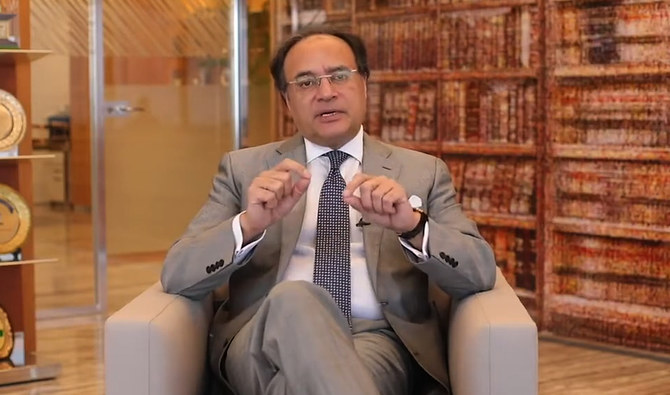
“Once we conclude the [new] Extended Fund Facility, we should be able to approach Middle Eastern banks, which have ended their whole business and appetite, for commercial borrowing and we will be able to get funding and support from them primarily to help us with our trade business, etc.,” Aurangzeb said during an interview with Pakistan’s Geo TV on Wednesday night.
Pakistan has been financially assisted by countries like Saudi Arabia and the United Arab Emirates in the past, with deposits of billions of dollars in its central bank, followed by rollovers.
Gulf states have also regularly provided Pakistan oil on deferred payment facilities and offered direct financial support to help stabilize its economy and shore up its foreign exchange reserves.
Pakistan’s newly appointed finance minister has said he wants to ensure macroeconomic stability and reduce spending and tax system leakages as an IMF team arrived in Islamabad to hold a second and last review of the nation’s $3 billion stand-by arrangement starting today, Thursday.
A set of critical challenges face Aurangzeb, including stabilizing the economy amid soaring inflation and dwindling foreign reserves, managing substantial external debts and navigating negotiations with global lenders. Pakistan also needs fiscal reforms to boost revenue and attract investments, vital for sustainable economic growth and job creation.
The debt-ridden economy, which shrank 0.2 percent last year and is expected to grow around 2 percent this year, has been under extreme stress with low reserves, a balance of payment crisis, inflation at 23 percent, policy interest rates at 22 percent and record local currency depreciation.
“The GDP is better, we have macroeconomic stability and the exchange rate is getting better,” Aurangzeb told Geo. “So we need to bring this macro stability to permanence. If this stability comes toward permeance, we can lead it toward growth.”
The minister said Pakistan had a narrow tax base and needed to reduce revenue leakages, for which it was important to digitize the tax system and make it more transparent.
“This is something we have already started working on,” said the minister, who made his first official visit to the Federal Bureau of Revenue, the national tax collection body, on Wednesday.
On foreign borrowing, the minister said Pakistan needed to improve its economic management to break out of the practice of asking friendly countries to deposit money in its central bank and then seeking rollovers.
“Now even these friendly countries have given us a clear hint that they want to help us but not through aid but through investments,” the finance minister added. “And I think it is the right thing to do for the country.”
Aurangzeb said the government would tap the China bond market in the next fiscal year.
“The one [bond] market that we haven’t tapped is in China,” he said.
“See, our G2G [government-to-government] relationships are good. Their banks are still rolling over and giving aid to us. Chinese government is also helping us.”
“So, the panda market there, the bond market, it’s the second or third most liquid market in the world,” he added. “So I think from the ministry of finance we should go toward inaugural panda bonds during the next fiscal year.”
In February, China rolled over a $2 billion loan to Pakistan due in March.
The lender has said it will formulate a medium-term program if Islamabad applies for one.
Ahead of the current stand-by arrangement, Pakistan had to meet IMF conditions including revising its budget, and raising interest rates and the price of electricity and gas. The IMF also got Pakistan to raise $1.34 billion in new taxes. The measures fueled all-time high inflation of 38 percent year-on-year in May.
The government has not officially stated the size of the additional funding it is seeking through a successor program, but Bloomberg reported in February that Pakistan planned to seek a new loan of at least $6 billion from the lender.


![]()

Pakistan says will seek financing from Middle Eastern banks after securing new IMF bailout
Short Url
https://arab.news/bwqtq
Pakistan says will seek financing from Middle Eastern banks after securing new IMF bailout
- New finance chief hopes better credit ratings post-bailout will make tapping bond markets easier
- Pakistan aims to secure new IMF loan after successful completion of last review under $3 billion facility
Latest updates


Recommended


© 2026 SAUDI RESEARCH & PUBLISHING COMPANY, All Rights Reserved And subject to Terms of Use Agreement.