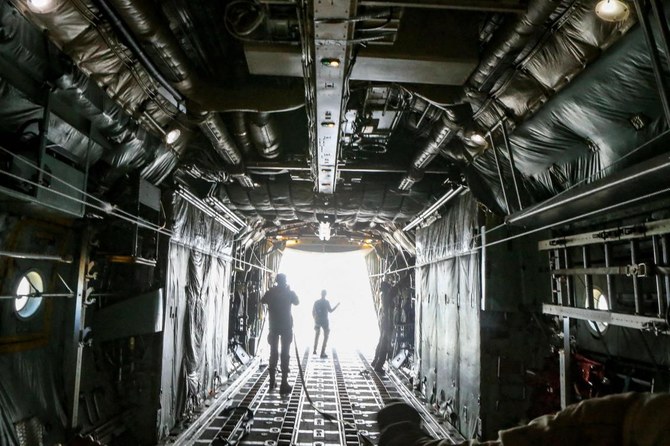
BERLIN: Germany said Wednesday it was joining an air bridge operation along with several other countries to drop desperately needed humanitarian aid into the Gaza Strip.
The operation, initiated by Jordan, already has the participation of several other countries including France and the United States.
The defense ministry said it would deploy the German part of a joint German-French air transport squadron to participate in the mission.
The team is equipped with C-130J Hercules transport planes, said the ministry, adding that Germany’s operation could begin as soon as the end of this week.
“The people in Gaza are lacking the most basic necessities. We want to do our part to ensure that they get access to food and medicine,” said Defense Minister Boris Pistorius.
After one parachuted airdrop turned lethal on March 8, the minister sought to allay fears.
“The truth is that airdrops are not without danger. The crews responsible are trained for the relevant procedures and highly experienced,” he said.
Gaza has faced relentless bombardment by Israel since Hamas launched a cross-border attack on October 7 that resulted in about 1,160 deaths, most of them civilians, according to an AFP tally based on official Israeli figures.
Israel’s retaliatory bombardment and ground offensive has killed 31,184 Palestinians, mostly women and children, according to Gaza’s Hamas-run health ministry.
Aid groups say only a fraction of the supplies required to meet basic humanitarian needs have been allowed into Gaza since October.
With help entering Gaza by truck far below pre-war levels, and Gazans increasingly desperate, foreign governments have turned to airdrops and are now trying to open a maritime aid corridor from Cyprus.

Germany joins operation to airdrop aid into Gaza
https://arab.news/7nvhu
Germany joins operation to airdrop aid into Gaza
- The operation, initiated by Jordan, already has the participation of several other countries including France and the United States
As India claims fourth-largest economy spot, what it means on the ground
- Indian government review says economy grew to $4.19 billion, overtaking Japan
- Claim still needs IMF review as only organized sector counted, economist says
NEW DELHI: When Ramesh Chandra Biswal left his job as a space scientist in the US, he returned to eastern India and ran an agriculture startup on a promise of his country’s rapid economic growth.
Nine years on, as India positions itself as the world’s fourth largest economy, he is still waiting for the promise to come true.
India’s economy was the sixth largest in the world, valued at about $2.6 trillion in 2017, when Biswal launched his Villamart project in his home village in Odisha.
According to calculations in the Indian government’s end-of-year economic review, it has now grown to $4.19 trillion, overtaking Japan’s economy in terms of nominal Gross Domestic Product.
The review also projects that India will overtake Germany to become the world’s third-largest economy within the next three years, trailing only the US and China in economic weight.
But on the ground, Biswal was not sure what the projections meant because they had no impact on his life or business.
“The hype around India becoming the fourth largest economy is not grounded. People cannot relate to that,” he said.
“The number of people here in India is much more than Japan ... We have to improve the per capita income instead of telling the story of being the fourth largest economy.”
Over the years that he has been running his company, Biswal has not noticed much change, but hoped that the news of the country’s growth would at least create a positive hype and motivate everyone.
“People are trying. As an entrepreneur, we are also trying, struggling every day, trying to do something new,” he said.
“I’m getting some respect in society. That way, it is giving me the driving force.”
But not everyone was immediately optimistic. For Sarvesh Sau, a fruit seller in Delhi, it has been increasingly difficult to keep his family afloat.
“Rich people are getting rich, those who have resources ... but a low-income group person like me finds it difficult to manage a decent living despite putting in more than 12 hours of work every day.
“We are a big nation, and we will look big compared to others. Are we able to match Japan?”
The world’s most populous nation, India has about 1.46 billion people and a GDP per capita estimated by the World Bank to be about $2,700. It is about 12 times lower than Japan’s.
Yogendra Kumar, a plumber in Noida, said his income has been rising, but it is consistently outpaced by the cost of living, leaving him feeling poorer over time.
“I have heard that India has become the fourth largest economy, but I don’t know how to react to that. It does not make any difference to our lives. It sounds good that India is growing, but the matter of fact is that for people like me the struggle for survival is more acute now than before,” he said.
“Today I earn more but the inflation takes away all the money, and it makes it difficult to have a comfortable life,” he told Arab News. “Mustard oil was 50 rupees 10 years ago. It is now 200 rupees. A cooking gas cylinder used to cost 500 rupees — now it costs more than double. Everything is so expensive.”
While India’s claim of being the fourth-largest economy is still awaiting review by the International Monetary Fund, Prof. Arun Kumar, a development economist, does not expect it to be confirmed.
“Our GDP data, as the IMF has said, is suspect because it doesn’t include the informal sector ... According to my estimate, we are still the seventh largest economy, just ahead of Italy,” he told Arab News, also estimating India’s actual growth to be much lower than the government’s projection.
“Even though official data shows a 7 percent to 8 percent rate of growth, people realize that it’s not growing so well,” Prof. Kumar said.
“The rate of growth is only of the organized sector, not of the unorganized sector ... The unorganized sector is declining and that is where 94 percent of the employment is.”