

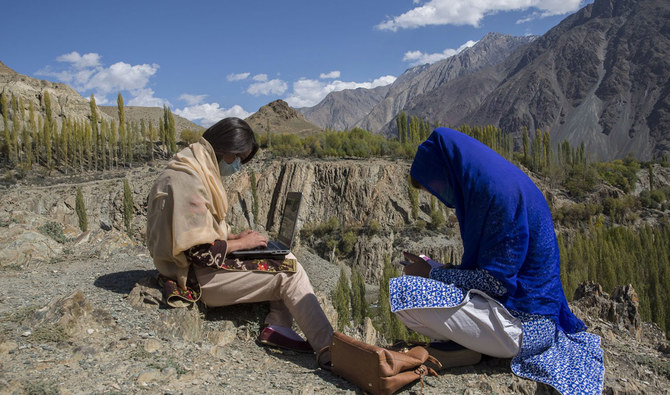

KHAPLU: The government in Pakistan's Gilgit-Baltistan (GB) has constituted an eight-member committee to inquire cellular companies about poor internet connectivity in the remote, mountainous region, amid complaints by residents of poor connection and slow speed of internet.
GB has not officially been part of Pakistan, but forms part of the portion of disputed Kashmir that is administered by Pakistan. The region is Pakistan’s only land link to China and is at the heart of the $65 billion China-Pakistan Economic Corridor (CPEC) infrastructure development program.
Over the past few years, residents of GB have moved towards freelancing and online earning in the absence of sufficient opportunities and industry in the region. But they say poor internet connectivity has multiplied their woes.
“In view of the complete failure of all cellular companies of Gilgit-Baltistan in providing dependable telecom facilities to the customers/masses and the continuous protest and anger shown by the people of Gilgit-Baltistan, the Hon’ble Speaker GB Assembly has been pleased to constitute s special committee consisting of the following [eight] members of GB Assembly to interact with the relevant authorities of cellular companies operating across GB and take immediate steps to ensure smooth and uninterrupted mobile services/telecom facilities to the people of Gilgit-Baltistan,” read a notification issued by the GB Assembly Secretariat on Monday.
Advocate Nazir Ahmad, speaker of the GB Assembly, told Arab News the issue of poor internet connection was not new in GB, but the government had been receiving frequent complaints in this regard from students, freelancers and private sector employees for the last three months.
“So, by keeping the concerns of public in mind and converting them into a public petition, I took notice and formed the [eight-member] committee and now we will check as to why the internet does not work properly in GB,” he told Arab News over the phone from Gilgit on Tuesday.
“The SCO [Special Communications Organization] is the largest telecom company in GB. So, the committee will call representatives of all telecom companies, including the SCO, and ask about their issues. After this stage, we will direct the authorities to provide smooth provision of internet in the region.”
In the past few months, residents have protested slow or no internet browsing in the region say it has cut them off from friends and relatives as well as adversely impacted freelancers in the mountainous region.
“We don’t have verified data. In addition to over 10,000 passive freelancers, there are 3,000-4,000 active freelancers in GB,” Ghulam Rehman, president of the GB Freelancers Association, told Arab News.
“The condition of internet connectivity is very pathetic in GB. We freelancers are losing the trust of clients and facing huge losses [nowadays]. Only the SCO is providing 4G service in GB, but it works like 2G or 3G. Due to this bad connectivity, they [freelancers] are missing deadlines and not getting new assignments.”
Rehman said there should be other competitors in the domain of internet service providers in the region. “Now we will raise the issue with the federal government as well,” he added.
Shireen Karim, a Gilgit-based woman journalist, said internet service depends upon the availability of power in many parts of the region.
“When the power comes, internet works properly. Otherwise, internet does not work,” Karim told Arab News. "Working on assignments, sending visuals and photographs is a big challenge for us. We have to move to different places time and again in search of a stable connection."
The scenic region is one of Pakistan’s most famous tourist destinations and was listed by Forbes among the 10 “coolest places” in the world to visit in 2018.
But its tourism industry is also badly affected because of internet connectivity issues, according to industry stakeholders.
“Like other facilities, internet is basic requirement of every tourist. Whenever tourists arrive, they first ask for the password of wifi,” Ayyaz Shigri, president of the Baltistan Association of Tour Operators (BATO), told Arab News.
“The world is talking about 5G and we have no stable internet connection of 3G or 4G in GB. Without internet, we can’t promote the region and attract tourists. Telecom companies must improve their services.”


