

Iraq Kurds digitize books to save threatened culture

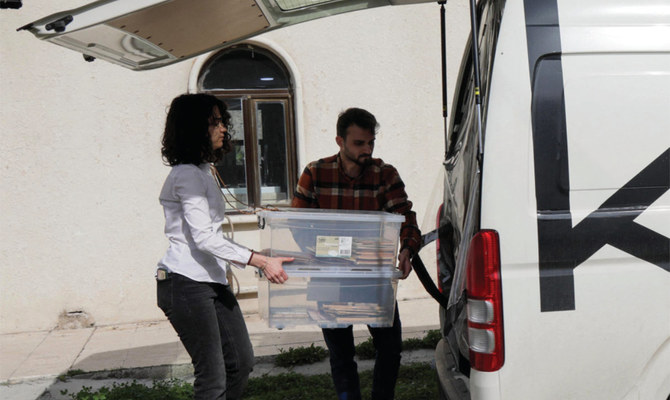
The Kurdistan Center for Arts and Culture, founded by the nephew of regional president Nechirvan Barzani, launched the digitization project in July. (AFP)
Short Url
Updated 11 March 2024
Follow

Iraq Kurds digitize books to save threatened culture

  • In Dohuk’s library, the archiving team scours the wooden bookshelves for hidden gems

DOHUK: Huddled in the back of a van, Rebin Pishtiwan carefully scans one yellowed page after another, as part of his mission to digitize historic Kurdish books at risk of disappearing.

Seen as the world’s largest stateless people, the Kurds are an ethnic group of between 25 and 35 million mostly spread across modern day Iraq, Iran, Syria and Turkiye.

In Iraq, the Kurds are a sizeable minority who have been persecuted, with thousands killed under the rule of late Saddam Hussein and many of their historic documents lost or destroyed.

“Preserving the culture and history of Kurdistan is a sacred job,” said Pishtiwan, perusing volumes and manuscripts from Dohuk city’s public library in Iraq’s northern autonomous Kurdistan region.

“We aim to digitize old books that are rare and vulnerable, so they don’t vanish,” the 23-year-old added, a torn memoir of a Kurdish teacher published in 1960 in hand.

In Iraq, the Kurdish language was mostly marginalized until the Kurds’ autonomous region in the north won greater freedom after Saddam’s defeat in the 1990-1991 Gulf War.

After the US-led invasion of 2003 toppled the leader, remaining documents were scattered among libraries and universities or held in private collections.

Once a week, Pishtiwan and his two colleagues journey in their small white van from the regional capital Irbil to other Kurdish towns and cities to find “rare and old” books.

They seek texts that offer insights into Kurdish life, spanning centuries and dialects.

In Dohuk’s library, the archiving team scours the wooden bookshelves for hidden gems.

With the help of the library’s manager, they carefully gather an assortment of more than 35 books of poetry, politics, language and history, written in several Kurdish dialects and some in Arabic.

Pishtiwan holds up a book of old Kurdish folk stories named after 16th-century Kurdish princess Xanzad, before gently flipping through the fragile pages of another religious volume, tracing the calligraphy with his fingers.

Back in the van, equipped with two devices connected to a screen, the small team starts the hours-long scanning process before returning the books to the library.

In the absence of an online archive, the Kurdistan Center for Arts and Culture, a non-profit founded by the nephew of regional president Nechirvan Barzani, launched the digitization project in July.

They hope to make the texts available to the public for free on the KCAC’s new website in April.

More than 950 items have been archived so far, including a collection of manuscripts from the Kurdish Baban principality in today’s Sulaimaniyah region that dates back to the 1800s.

“The aim is to provide primary sources for Kurdish readers and researchers,” KCAC executive director Mohammed Fatih said.

“This archive will be the property of all Kurds to use and to help advance our understanding of ourselves.”

Dohuk library manager Masoud Khalid gave the KCAC team access to the manuscripts and documents gathering dust on its shelves, but the team was unable to secure permission from the owners of some of the documents to digitise them immediately.

“We have books that were printed a long time ago — their owners or writers passed away — and publishing houses will not reprint them,” Khalid said.

Digitising the collection means that “if we want to open an electronic library, our books will be ready,” the 55-year-old added.

Hana Kaki Hirane, imam at a mosque in the town of Hiran, unveiled a treasure to the KCAC team — several generations-old manuscripts from a religious school established in the 1700s.

Since its founding, the school has collected manuscripts but many were destroyed during the first war pitting the Kurds against the Iraqi state between 1961 and 1970, said Hirane.

“Only 20 manuscripts remain today,” including centuries-old poems, said the imam.

He is now waiting for the KCAC website launch in April to refer people to view the manuscripts.

“It is time to take them out and make them available for everyone.”


Tunisia’s famed blue-and-white village threatened after record rains

Updated 31 January 2026
Follow

Tunisia’s famed blue-and-white village threatened after record rains

  • The one-time home of French philosopher Michel Foucault and writer Andre Gide, the village is protected under Tunisian preservation law, pending a UNESCO decision on its bid for World Heritage status

SIDI BOU SAID, Tunisia: Perched on a hill overlooking Carthage, Tunisia’s famed blue-and-white village of Sidi Bou Said now faces the threat of landslides, after record rainfall tore through parts of its slopes.
Last week, Tunisia saw its heaviest downpour in more than 70 years. The storm killed at least five people, with others still missing.
Narrow streets of this village north of Tunis — famed for its pink bougainvillea and studded wooden doors — were cut off by fallen trees, rocks and thick clay. Even more worryingly for residents, parts of the hillside have broken loose.
“The situation is delicate” and “requires urgent intervention,” Mounir Riabi, the regional director of civil defense in Tunis, recently told AFP.
“Some homes are threatened by imminent danger,” he said.
Authorities have banned heavy vehicles from driving into the village and ordered some businesses and institutions to close, such as the Ennejma Ezzahra museum.

- Scared -

Fifty-year-old Maya, who did not give her full name, said she was forced to leave her century-old family villa after the storm.
“Everything happened very fast,” she recalled. “I was with my mother and, suddenly, extremely violent torrents poured down.”
“I saw a mass of mud rushing toward the house, then the electricity cut off. I was really scared.”
Her Moorish-style villa sustained significant damage.
One worker on site, Said Ben Farhat, said waterlogged earth sliding from the hillside destroyed part of a kitchen wall.
“Another rainstorm and it will be a catastrophe,” he said.
Shop owners said the ban on heavy vehicles was another blow to their businesses, as they usually rely on tourist buses to bring in traffic.
When President Kais Saied visited the village on Wednesday, vendors were heard shouting: “We want to work.”
One trader, Mohamed Fedi, told AFP afterwards there were “no more customers.”
“We have closed shop,” he said, adding that the shops provide a livelihood to some 200 families.

- Highly unstable -

Beyond its famous architecture, the village also bears historical and spiritual significance.
The village was named after a 12th-century Sufi saint, Abu Said Al-Baji, who had established a religious center there. His shrine still sits atop the hill.
The one-time home of French philosopher Michel Foucault and writer Andre Gide, the village is protected under Tunisian preservation law, pending a UNESCO decision on its bid for World Heritage status.
Experts say solutions to help preserve Sidi Bou Said could include restricting new development, building more retaining walls and improving drainage to prevent runoff from accumulating.
Chokri Yaich, a geologist speaking to Tunisian radio Mosaique FM, said climate change has made protecting the hill increasingly urgent, warning of more storms like last week’s.
The hill’s clay-rich soil loses up to two thirds of its cohesion when saturated with water, making it highly unstable, Yaich explained.
He also pointed to marine erosion and the growing weight of urbanization, saying that construction had increased by about 40 percent over the past three decades.
For now, authorities have yet to announce a protection plan, leaving home and shop owners anxious, as the weather remains unpredictable.