

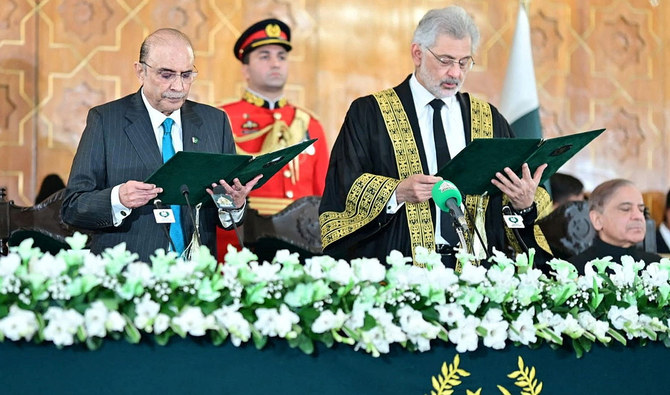

ISLAMABAD: Veteran politician and Pakistan Peoples Party (PPP) Co-Chairman Asif Ali Zardari took oath on Sunday as the 14th president of Pakistan, a day after he was elected to serve as the country’s head of state for a second term.
Zardari secured 411 votes in the indirect electoral contest held in Pakistan’s parliament and provincial assemblies on Saturday to serve another term as president. The opposing candidate, Mahmood Khan Achakzai, who was supported by the Imran Khan-backed Sunni Ittehad Council, could only bag 181 votes.
Prime Minister Shehbaz Sharif, caretaker PM Anwaar-ul-Haq Kakar and others felicitated the president shortly after he was administered oath by Chief Justice Qazi Faez Isa at a televised ceremony in Islamabad.
“I, Asif Ali Zardari, do solemnly swear that... I will bear true faith and allegiance to Pakistan, that, as President of Pakistan, I will discharge my duties, and perform my functions, honestly, to the best of my ability, faithfully in accordance with the Constitution of the Islamic Republic of Pakistan and the law, and always in the interest of the sovereignty, integrity, solidarity, well-being and prosperity of Pakistan, that I will strive to preserve the Islamic ideology which is the basis of the creation of Pakistan, that I will not allow my personal interest to influence my official conduct or my official decisions,” Zardari said as he took oath.
“I will preserve, protect and defend the Constitution of the Islamic Republic of Pakistan, that, in all circumstances, I will do right to all manner of people, according to law, without fear or favor, affection or ill-will, and that I will not directly or indirectly communicate or reveal to any person any matter which shall be brought under my consideration or shall become known to me as president of Pakistan, except as may be required for the due discharge of my duties as president. May Allah Almighty help and guide me, A’meen.”
The swearing-in ceremony was attended by outgoing president Dr. Arif Alvi, military services chiefs, Chairman of the Joint Chiefs of Staff Committee (CJCSC) General Sahir Shamshad Mirza, provincial governors, chief ministers and diplomats.
During his last tenure as president from 2008 to 2013, Zardari ushered in constitutional reforms, including the 18th amendment, to ensure greater autonomy to provinces, and rolled back presidential powers.
On Friday, his predecessor Alvi was accorded a farewell guard of honor. Alvi’s five-year term ended in September last year, but in Pakistan, a president may continue to stay in office constitutionally until his successor is elected.
The tenure of Alvi, who took oath on Sept. 9, 2018 after ex-PM Khan’s Pakistan Tehreek-e-Insaf (PTI) party came to power in election held the same year, was marked by political instability and civil-military tensions, and saw the ouster of Khan in a parliamentary no-trust vote in April 2022.
Besides political instability, an economic crisis gripped Pakistan during this period, with the South Asian country barely averting a default in June last year by securing a $3 billion bailout deal from the International Monetary Fund (IMF).


