

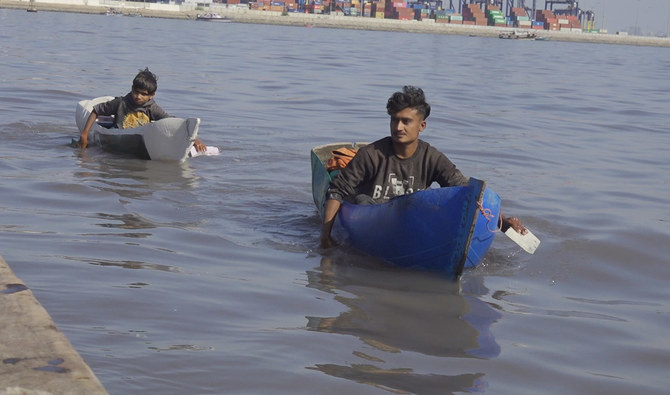

KARACHI: In the pre-dawn haze earlier this week, as fishing communities in the downtrodden coastal settlements of Pakistan’s southern port city of Karachi began to stir, 12-year-old Danish Rafiq set sail from his home on Bhit Island, navigating a rickety boat made of plastic barrels across the vast expanse of the Arabian Sea.
With a sense of determination that belies his tender age, Rafiq cast his net into the deep waters, hoping for a catch that could fetch him some much-needed cash to take home to his poor family. His makeshift, manually operated barrel raft, designed to float and maneuver in deep waters, reflects ingenuity born of necessity.
Given soaring fuel prices in Pakistan, such vessels have become the only hope for many fishermen who can’t afford more secure and efficient petrol or diesel boats.
“I have caught this fish since morning,” Rafiq told Arab News, placing his catch on a weighing scale inside his small boat anchored near the Karachi port channel close to Minora Island. “It’s worth a thousand rupees. It was four kilograms, so it is valued at that much.”
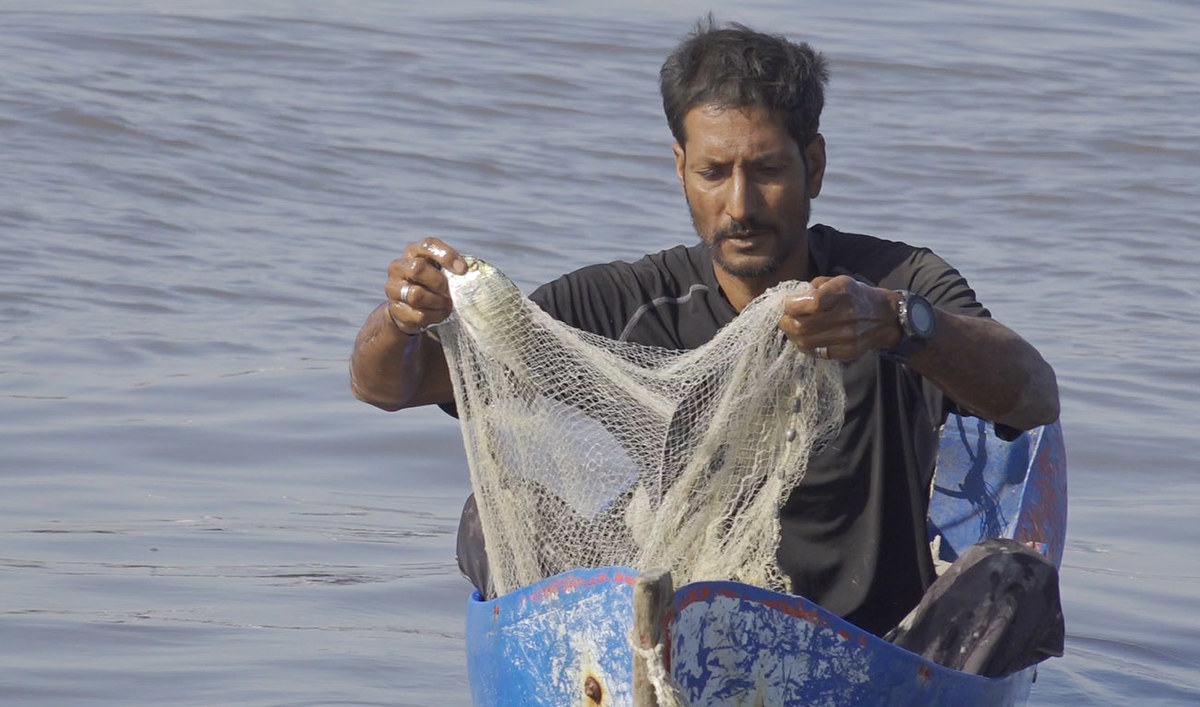
Fisherman Ghulam Pervez takes fish out of the net while sitting in his small plastic boat near the shore at Salehabad Island near Karachi, Pakistan on March 6, 2024. (AN Photo)
Asked if he felt scared sailing the precarious plastic boat, he said:
“What can I do? We earn our livelihood from boats, from these small boats.”
Moosa Omar, a fisherman and a community elder from the nearby Salehabad Island, said there was an increased reliance on smaller boats due to the rising prices of fuel.
“The diesel [price] has become expensive,” he said. “That’s the reason why poor children are forced to go fishing on these vessels. They also want to own bigger boats to have a good fishing business but no one can bear the diesel expense … These people hardly get to eat bread at home.”
He said the increasing availability of plastic barrels had led to a proliferation of these vessels, with thousands now dotting the coastal villages and islands near the sea.
“EXTREMELY DANGEROUS”
On Salehabad Island, Muhammad Mohsin, 42, meticulously applied the final touches to his latest creation: a boat made of a plastic barrel, some small pieces of wood and nut and bolts. In just Rs16,000, the vessel is ready to go out to sea.
“It costs less. If you go in a big boat now, you need Rs8,000-10,000 only for fuel whereas you don’t need to incur such expenses on this,” Mohsin explained, as he hammered a nut into place.
These manually operated boats offered a sustainable livelihood option amid escalating fuel prices, the builder added.
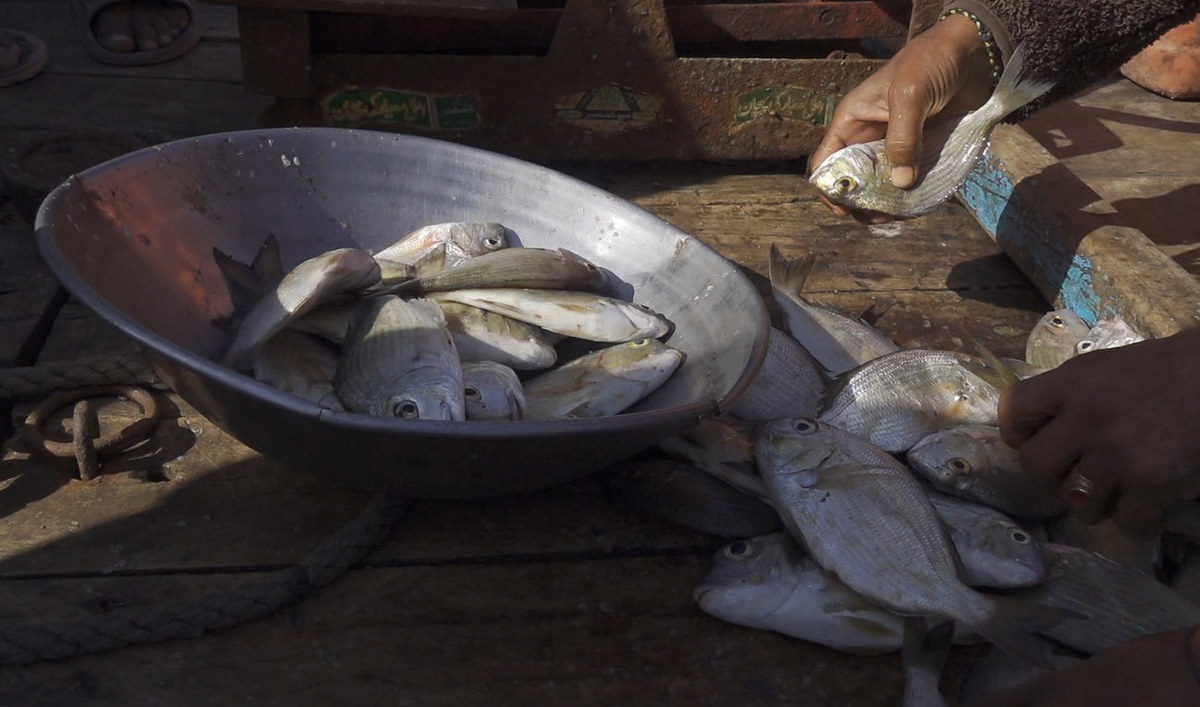
Fisherman transfers his catch in a metal pot on a boat at Salehabad Island near Karachi, Pakistan on March 6, 2024. (AN Photo)
That is why 37-year-old Ghulam Pervez had switched to using them, recognizing their potential to earn an income for his family of six at little expense.
“If one day we catch something good, like earning two and a half thousand, then our day passes with ease,” he said. “If some day it’s too windy or we don’t go out, consider it our fasting day, not only for us but a fasting day for our entire family.”
He recognized the high risk involved in taking the rickety boats out to sea, but said it was a “lifeline” for his family.
“It’s very dangerous, extremely dangerous,” Pervez confessed. “Just sitting in it is very difficult, you have to first learn how to sit in it.”
Turbulence caused by passing boats sometimes caused the makeshift boats to capsize, causing fishermen to lose their earlier catch as they tried to get back on the vessel.
“In the pursuit of one fish,” Pervez lamented, “the three or four previously caught can fall into the water.”


