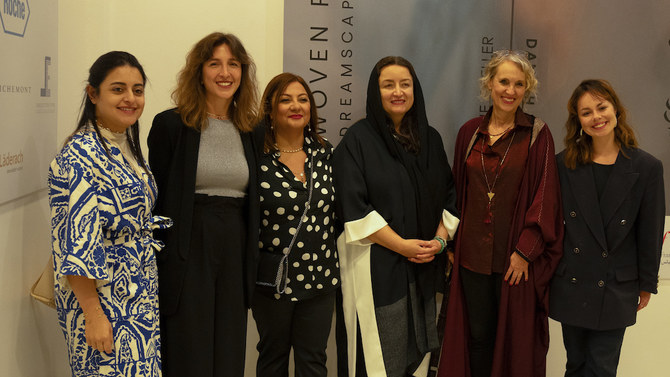

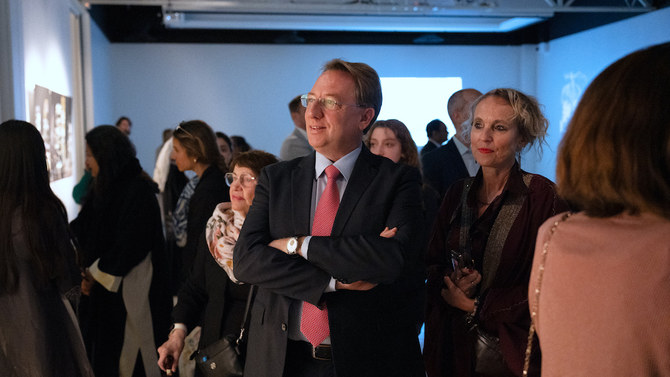

RIYADH: Inspired by intimate conversations with 37 women, Saudi artist Dania Al-Saleh and French-Swiss artist Catherine Gfeller present their striking exhibit “Woven Dreams” at L’Art Pur Foundation, which runs until April 6.
The exhibition features multimedia artworks that reflect the stories of the interviewed women through the breadth of their diverse experiences, aspirations and contributions to society.
The showcase is divided into three sections totaling 540 square meters and created in a museum-like style.
Gfeller says that she interviewed each of the 37 women privately, exploring the deep meaning of their voices, testimonies, and the way they express themselves. “Deep meetings with 37 women is like deeply immersed in 37 different universes, very personal and specific universes,” she said. “It means 37 times more work because I try to adapt myself to each voice in a symbolic way.”
“Each woman has her own voice and her own way of seeing life and connecting to us as artists … they only spent one hour with me but I worked for four months, night and day with them,” she said.
Noting the collaborative nature of the process, she added: “I feel like I know them very deeply as my role is to convey the subconscious version of what they told us … I really tried to be a medium through which I can express their deep thoughts.”
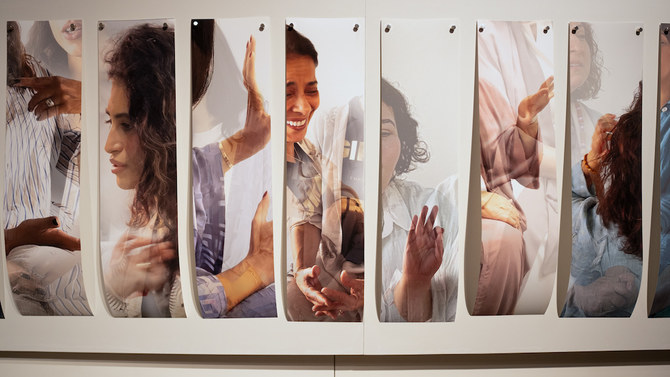
Each room in the exhibition showcases a distinctive art form, inspired by the interviews. From projected short films that capture their personal stories to a room adorned with inspirational quotes plastered on the walls, and another room showcasing striking photos of each woman, visitors are taken on a sensory journey through the lives and experiences of these individuals.
Al-Saleh said that working on the project was a once-in-a-lifetime experience: “I felt so privileged to have these wonderful ladies take us and be a part of their inner private lives and share so many interesting stories and emotions with us.
“We really focused on taking care of the stories they shared with us and treating it as a treasure … we had to really think of creating artwork that does it justice.”
Gfeller knew that she wanted to do an exhibition with Al-Saleh, a Saudi artist, after seeing her work and feeling that she is her “art sister,” adding: “She (Al-Saleh) had a wonderful piece in AlUla and when I saw It, I thought ‘I feel so close to her.’ It was really similar to another project in Switzerland about mythology, power of women, and symbol of women.
“When we did this residency, it was interesting to see how similar we are in how we approach art, and how we approach the emotion of women,” she said.
One of the exhibition’s artistic subjects is Farah Al-Turki, a Saudi writer and producer. She said: “The work hit home for me as it touches on how we all come from very different backgrounds, yet we all fall under ‘Women of Riyadh.’ I’m certain visitors will identify and see themselves within the work.”
The exhibition was curated by, Dalia Chabarek, a Lebanese urban researcher and sociologist working between Lebanon and the UAE.
“Woven Dreams” is supported by the French embassy, L’Art Pur Foundation, Alliance Francaise and the Swiss embassy.
Yannick Reichenau, deputy head of mission at the Swiss embassy, said that intercultural exhibitions would grow in the future, in many directions, because “people-to-people exchanges are always key to bilateral relations.”
“Saudi Arabia is opening with Vision 2030 and one of the key cornerstones is art. For a long time, in bilateral relations, art was not a key pillar but now it is. It’s about younger people connecting as well,” Reichnau said.
Noting the opportunities for artists to learn from each other, he added: “This exchange is some of the best. It’s very enriching to both of our countries.”