

UK foreign secretary urges Israel to open more aid crossings into Gaza

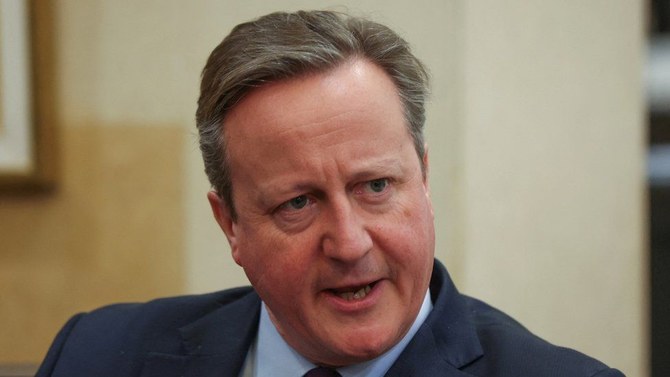
UK foreign secretary David Cameron on Friday called on Israel to open more crossings for aid to be delivered into Gaza amid a “terrible humanitarian situation” in the Palestinian enclave. (Reuters)
Short Url
Updated 08 March 2024
Follow

UK foreign secretary urges Israel to open more aid crossings into Gaza

  • Enclave facing ‘terrible humanitarian situation,’ David Cameron says
  • Review underway into legality of Israel’s military action, minister says

LONDON: The UK foreign secretary on Friday called on Israel to open more crossings for aid to be delivered into Gaza amid a “terrible humanitarian situation” in the Palestinian enclave.

Speaking to the BBC’s Radio 4 “World at One” program, David Cameron said it was frustrating that Israel was not allowing more aid into the territory.

“We need 500 trucks a day or more going into Gaza,” he said. “In the last five days, we’ve been averaging 123.”

More than 30,000 Palestinian civilians have been killed in Israel’s military action against Hamas, launched after the militant group’s attack on Israel on Oct. 7 that left 1,200 people dead.

Countries have been airdropping aid into Gaza to stave off a growing risk of starvation within the enclave, where the UN estimates a quarter of the population is on the brink of famine.

“(Delivery shortages) can be fixed if Israel opens more crossing points, if they allow more UN staff into Gaza to help process the aid and get it round the different bits of Gaza,” Cameron said.

“And they could also do things like full resumption of the water and the electricity that goes into north and south Gaza.

“We’ve set out these points repeatedly and it’s incredibly frustrating that these things haven’t happened when you think of the terrible humanitarian situation.”

Israel has denied blocking aid deliveries to Gaza and has blamed failures in its distribution on aid organizations.

Cameron said the UK would join its allies in creating a maritime corridor to deliver aid directly to Gaza, but was skeptical about the speed with which a US-led plan to build a temporary harbor could deliver aid to those suffering.

“It’s going to take time to build, so the crucial thing is today the Israelis must confirm that they’ll open the port at Ashdod.”

The foreign secretary added that a review into whether Israel’s actions were legal under international humanitarian law would be carried out in the “coming days,” which would lead to a decision on British arms sales to the country.

“In terms of export licensing, that depends on the judgment that we make about international humanitarian law and that judgment is undergoing at the moment,” he said.

“I’ve set out very clearly in Parliament and elsewhere the processes we have to go through and we’re going through them now.”


Nigerian president vows security reset in budget speech

Updated 6 sec ago
Follow

Nigerian president vows security reset in budget speech

  • Government plans to buy 'cutting-edge' equipment to boost the fighting capability of military


ABUJA: Nigeria’s president vowed a national security overhaul as he presented the government budget, allocating the largest share of spending to defense after criticism over the handling of the country’s myriad conflicts.
Nigeria faces a long-running insurgency in the northeast, while armed “bandit” gangs commit mass kidnappings and loot villages in the northwest, and farmers and herders clash in the center over dwindling land and resources.
President Bola Tinubu last month declared a nationwide security emergency and ordered mass recruitment of police and military personnel to combat mass abductions, which have included the kidnapping of hundreds of children at their boarding school.
He told the Senate that his government plans to increase security spending to boost the “fighting capability” of the military and other security agencies by hiring more personnel and buying “cutting-edge” equipment.
Tinubu promised to “usher in a new era of criminal justice” that would treat all violence by armed groups or individuals as terrorism, as he allocated 5.41 trillion naira ($3.7 billion) for defense and security.
Security officials and analysts say there is an increasing alliance between bandits and extremists from Nigeria’s northeast, who have in recent years established a strong presence in the northwestern and central regions.
“Under this new architecture, any armed group or gun-wielding non-state actors operating outside state authority will be regarded as terrorists,” said Tinubu, singling out, among others, bandits, militias, armed gangs, armed robbers, violent cult groups, and foreign-linked mercenaries.
He said those involved in political or sectarian violence would also be classified as terrorists.
On the economic front, Tinubu hailed his “necessary” but not “painless” reforms that have plunged Nigeria into its worst economic crisis in a generation.
He said inflation has “moderated” for eight successive months, declining to 14.45 percent in the last month from 24.23 percent in March this year.
He projected that the budget deficit will drop next year to 4.28 percent of GDP from around 6.1 percent of GDP in 2023, the year he came into office.