ISLAMABAD: Sabika Qureshi had been teaching at various schools and colleges in the Pakistani capital of Islamabad for around six years before her son was born in 2019, making it difficult for her to manage employment outside the home while also looking after her family.
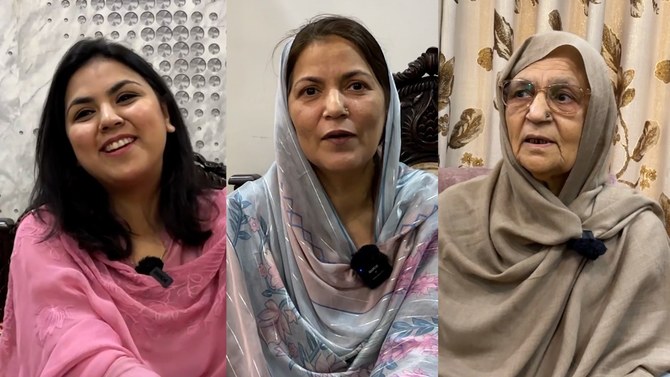
After more than a year of commuting to work while leaving her infant son with her mother who lived at the other end of town, Qureshi realized that this was not working out. The 34-year-old economics graduate and now a mother of two teamed up with her mother Shabnam Qureshi and grandmother Shireen Gul to launch the Three Cooks food delivery service in 2020, as COVID-19 lockdowns ravaged the restaurant industry globally.
The idea not only worked for Sabika, helping her to start her own business, but also financially empowered her mother and became a means to preserve the legacy of her grandmother’s cooking.
“I came up with this idea with my mom and my Nani [grandmother], that let’s move to a house together, and let’s live together, and maybe we can just do something,” Sabika told Arab News at the cooking facility for Three Cooks.
The food business was not new for the family.
In the early 2000s, Shabnam had launched a home catering venture due to financial troubles but discontinued the service once the family’s finances improved. Now, with the encouragement of her children and husband, she is back in the business.
“The real thing is that other than a need, passion is very important, in this profession, you can only cook [good] food if you have a passion,” Shabnam, 55, said. “If you don’t have an interest [in cooking], then you can’t do anything at all.”
Three Cooks is now mainly run by Shabnam and her husband and son, and employs five full-time staff as well as riders to deliver food. Sabika remains involved in customer care.
“When we started this [Three Cooks], I had interest and still do, but in reaching this far, my children have played an important role,” the mother said. “The confidence, it came from my children.”
Meanwhile, Sabika has branched into opening a bakery in Islamabad called Dough Jo, which she manages with her husband and in-laws, employing 20 people.
Shireen Gul, Qureshi’s grandmother, said seeing her daughter and granddaughter work was her reason for “happiness.”
“This is life. Sitting idly, that doesn’t bring joy. The real joy is when a person works,” the grandmother told Arab News.
“And one more thing. A woman who cooks food from her heart, the flavor in that, that flavor cannot be found in anything else.”


Three generations of women serve up ‘homemade goodness’ with food delivery service in Islamabad
https://arab.news/mp3ac
Three generations of women serve up ‘homemade goodness’ with food delivery service in Islamabad

- Sabika Qureshi worked as a teacher for years but had to give it up after her son was born in 2019
- In 2020, she launched ‘Three Cooks’ with mother and grandmother amid COVID-19 lockdowns

Sale of Saudi artist Safeya Binzagr’s work sets record at Sotheby’s auction in Riyadh
RIYADH: A painting by Saudi artist Safeya Binzagr sold for $2.1 million at Sotheby’s “Origins II” auction in Riyadh on Saturday, emerging as the top lot of the evening and setting a new auction record for a Saudi artist.
The work, “Coffee Shop in Madina Road” (1968), sold for $1.65 million before the buyer’s premium, the additional fee paid by the purchaser to the auction house on top of the hammer price.
The result nearly doubled the previous auction record for a Saudi artist and became the most valuable artwork ever sold at auction in the Kingdom. It also ranks as the third-highest price achieved for an Arab artist at auction.
It was presented as part of “Origins II,” Sotheby’s second auction staged in Saudi Arabia, comprising 62 modern and contemporary lots and bringing together Saudi artists alongside regional and international names.
Collectors from more than 40 countries participated in the auction, with around one-third of the lots sold to buyers within Saudi Arabia.
The sale totaled $19.6 million, exceeding its pre-sale estimate and bringing the combined value of works offered across “Origins” and “Origins II” to over $32 million.
Saudi artists were central to the evening’s results. All nine Saudi works offered found buyers, achieving a combined total of $4.3 million, well above pre‑sale expectations.
Ashkan Baghestani, Sotheby’s head of contemporary art for the Middle East, told Arab News at the auction that “Safeya made more than any other artist tonight, which is incredible.”
He said the results demonstrated Sotheby’s broader objective in the Kingdom.
“The results tonight show exactly what we’re trying to do here. Bring international collectors to Saudi Arabia and give them exposure to Saudi artists, especially the pioneers.”
All nine works by Saudi artists offered in the sale found buyers, generating a combined $4.3 million. Additional auction records were set for Egyptian artist Ahmed Morsi and Sudanese artist Abdel Badie Abdel Hay.
An untitled work from 1989 by Mohammed Al-Saleem sold for a triple estimate of $756,000, while a second work by the artist, “Flow” from 1987, achieved $630,000.
The sale opened with the auction debut of Mohamed Siam, whose “Untitled (Camel Race)” sold for $94,500. Also making his first auction appearance, Dia Aziz Dia’s prize-winning “La Palma (The Palma)” achieved $226,800.
The sale coincided with the opening week of the Contemporary Art Biennale in Riyadh, reinforcing the city’s growing role as a focal point for both cultural institutions and the art market.
Baghestani added that Saudi modern artists are now receiving long‑overdue recognition in the market.
“There’s so much interest and so much demand, and the price is where it should be,” he said.
International highlights included works by Pablo Picasso, Roy Lichtenstein, Andy Warhol and Anish Kapoor, underscoring Saudi Arabia’s growing role as a destination for major global art events and collectors.
Picasso’s “Paysage,” painted during the final decade of the artist’s life, sold for $1,600,000, becoming the second most valuable artwork sold at auction in Saudi Arabia.
Seven works by Lichtenstein from the personal collection of the artist and his wife, including collages, prints, works on paper and sculptures, all found buyers. Warhol was represented in the sale with two works: “Disquieting Muses (After de Chirico),” which sold for $1,033,200, and a complete set of four screenprints of “Muhammad Ali,” which achieved $352,000.
Baghestani said the strength of the results was closely tied to the material’s freshness. “These were not works from the trade. Some of them had not been seen since the 1970s,” he said.


