

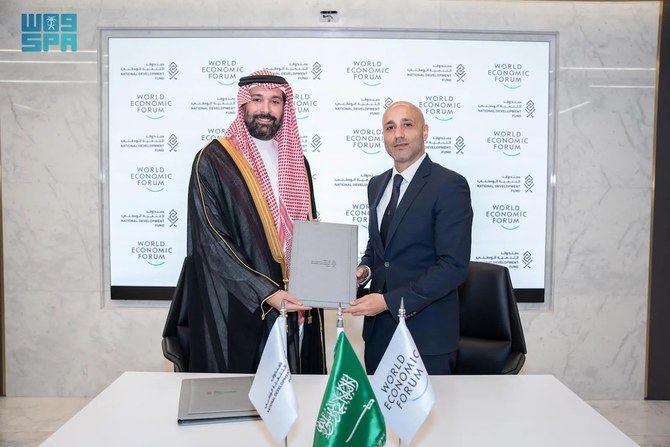
Saudi Arabia’s National Development Fund signs partnership agreement with World Economic Forum

NDF’s Chief of Staff Khalid bin Ibrahim Shareef, and the WEF’s Head of Global Partner Development and Regional Business Strategy Alexandre Raffoul. (SPA)
Short Url
Updated 08 March 2024
Follow

Saudi Arabia’s National Development Fund signs partnership agreement with World Economic Forum

  • Agreement with the WEF will involve promoting the NDF’s position in the global development finance arena

RIYADH: Saudi Arabia’s National Development Fund entered into a partnership agreement with the World Economic Forum on Thursday, the Saudi Press Agency reported.

The NDF, which was established in 2017, acts as an umbrella for 12 development funds and banks in Saudi Arabia.

Its primary role is to enhance their operational efficiency, encourage synergies, increase their contributions to the economy and society, and ensure the continuous provision of finance and development loans across diverse sectors.

The agreement with the WEF will involve promoting the NDF’s position in the global development finance arena and fostering collaboration with leading financial institutions to tackle challenges in the sector.

WEF’s network already includes institutions like the Islamic Development Bank, the African Development Bank, the World Bank Group, the China Development Bank, the Development Bank of Japan, and the Export-Import Bank of China, which will help facilitate the NDF’s access to best practices, policy development strategies, and avenues to amplify its economic influence.

The NDF will gain from engaging in the WEF’s extensive schedule of conferences, seminars, and workshops throughout the year, enhancing its exposure to cutting-edge information, research, and insights in various economic, business, and social domains, the SPA added.

This is expected to keep the NDF at the forefront of global economic trends and technological advances within the finance and economic sectors.

The agreement was signed by the NDF’s Chief of Staff Khalid bin Ibrahim Shareef, and the WEF’s Head of Global Partner Development and Regional Business Strategy Alexandre Raffoul.


Saudi deputy foreign minister calls for Sudanese unity during meeting in Cairo

Updated 8 sec ago
Follow

Saudi deputy foreign minister calls for Sudanese unity during meeting in Cairo

  • Waleed Al-Khuraiji says a political solution to the civil war in Sudan must be based on respect for its sovereignty
  • He rejects quasi-government formed by one of the warring factions in July, denounces external intervention in form of weapons supplies and foreign fighters

LONDON: Saudi Arabia’s deputy foreign minister, Waleed Al-Khuraiji, on Wednesday stressed the important need to maintain the territorial integrity of Sudan.

Speaking at the fifth Sudan peace coordination meeting in Cairo, he said a political solution to the civil war that began in April 2023 must be based on respect for Sudanese sovereignty and unity.

He highlighted the efforts the Kingdom is making in an attempt to ensure stability in Sudan, help reach a ceasefire agreement that ends the conflict, prevent the collapse of state institutions, and maintain the unity, territorial integrity and capabilities of the country, the Saudi Press Agency reported.

Al-Khuraiji also said that Saudi efforts to address the worsening humanitarian crisis caused by the war are continuing, in an attempt to alleviate the suffering of the Sudanese people.

It is important that the conflicting factions return to political dialogue, he added, as stated in the Jeddah Declaration of May 2023 and the short-term ceasefire deal that was agreed that same month.

The war in Sudan, between rival military factions the Sudan Armed Forces and the paramilitary Rapid Support Forces, poses a threat to regional stability, Al-Khuraiji warned.

He rejected the quasi-government formed by the Rapid Support Forces in July last year as an obstruction to ongoing efforts to resolve the crisis, a threat to the unity and sovereignty of Sudan, and a risk to regional security and the safety of the Red Sea.

“The announcement of parallel entities outside the framework of legitimate institutions is worrying and disrupts efforts through the political track to solve the crisis,” he said.

The prevention of external intervention in the conflict, including illegal support in the form of weapon supplies and foreign fighters, is crucial for efforts to achieve a ceasefire and facilitate humanitarian operations, Al-Khuraiji added.

He also called for the establishment of safe corridors so that deliveries of aid can reach those in need, similar to a mechanism established in August last year at the Adre crossing on Sudan’s border with Chad.