Pakistan seeks UNSC support to push Afghan regime to cut off ‘links’ with militants

Ambassador Munir Akram, Islamabad’s permanent representative to the United Nations speaks at the UNSC’s United Nations Assistance Mission in Afghanistan (UNAMA) briefing on December 21, 2023, in New York, USA. (Photo courtesy: Pakistan Mission to the United Nations)
Short Url
Updated 07 March 2024
Follow

Pakistan seeks UNSC support to push Afghan regime to cut off ‘links’ with militants

  • Munir Akram says TTP in Afghanistan can soon pose a ‘global terrorist threat’ with the support of Afghan state sponsors
  • The Pakistani diplomat asks the UN to investigate how the banned militant network acquired advanced military weapons

ISLAMABAD: Pakistan’s top diplomat at the United Nations urged the world body on Wednesday to demand that Afghanistan’s interim administration sever ties with a banned militant network targeting Pakistani nationals and security forces, and to halt all cross-border attacks.
Ambassador Munir Akram addressed the issue during a briefing to the UN Security Council (UNSC) on the situation in Afghanistan in the wake of the withdrawal of international forces from the neighboring state more than two years ago.
Pakistan has experienced an increase in militant violence, including deadly suicide bombings that have claimed hundreds of lives, which it attributes to the proscribed Tehreek-e-Taliban Pakistan (TTP), whose leaders are believed to be in hiding in Afghan frontier regions.
Last year, Pakistan’s caretaker government said it had forcefully communicated to the Kabul administration to decide between supporting them or the TTP leaders, who are reported to have sworn allegiance to the Taliban authorities in Afghanistan. Additionally, Pakistan initiated a deportation campaign against illegal immigrants, predominantly Afghan nationals, citing security concerns.
Addressing the UNSC members, Akram highlighted the “failure” of the Afghan Interim Government (AIG) to control the TTP and other militant networks, pointing out that it implied the Kabul government was not in full control of its territory which it asserted to secure international recognition.
“I am confident that this Council will join Pakistan in demanding that the AIG terminates its relationship with the TTP and its affiliates and prevents them from having free rein to conduct cross border attacks against Pakistan or other neighbors,” he said.
“Left unchecked, the TTP, supported by Al-Qaeda and some State sponsors, could soon pose a global terrorist threat,” he added.

Akram also raised Pakistan’s concern that TTP militants had been using advanced military equipment, including sophisticated assault rifles and night-vision devices, which originally belonged to the international forces operating in Afghanistan before their 2021 withdrawal.
“The United Nations should undertake an investigation to find out how the TTP has acquired advanced military equipment and weaponry and to identify the sources of the TTP’s financing, which is helping sustain its 50,000 fighters and their dependents and its terrorist operations,” he continued.
Pakistani officials have maintained in the past that the military equipment was left behind by the international forces in the wake of their chaotic pullout that was widely criticized internationally.
However, the United States rebutted the claim, saying its troops left these weapons with the Afghan National Army which later melted away ahead of the Taliban takeover of Kabul.
The Pakistani diplomat also said the international community should revive Afghanistan’s financial system to help its people who were facing a tough economic situation.

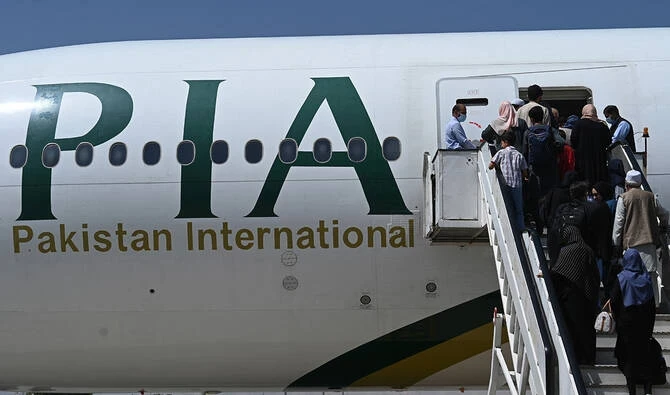
IMF board to approve Pakistan reviews today ‘if all goes well,’ say officials

Updated 4 sec ago
Follow

IMF board to approve Pakistan reviews today ‘if all goes well,’ say officials

  • IMF’s executive board is scheduled to meet today to discuss the disbursement of $1.2 billion
  • Economists say the money will boost Pakistan’s forex reserves, send positive signals to investors

KARACHI: The International Monetary Fund’s (IMF) executive board is scheduled to meet today, Monday, to approve the release of about $1.2 billion for Pakistan under the lender’s two loan facilities, said IMF officials who requested not to be named.

The IMF officials confirmed the executive board was going to decide on the Fund’s second review under the $7 billion Extended Fund Facility (EFF) and first review under the $1.4 billion Resilience and Sustainability Facility (RSF), a financing tool that provides long-term, low-cost loans to help countries address climate risks.

“The board meeting will be taking place as planned,” an IMF official told Arab News.

“The board is on today yes as per the calendar,” said another.

A well-placed official at Pakistan’s finance ministry also confirmed the board meeting was scheduled today to discuss the next tranche for Pakistan.

The IMF executive board’s meeting comes nearly two months after a staff-level agreement (SLA) was signed between the two sides in October.

Procedurally, the SLAs are subject to approval by the executive board, though it is largely viewed as a formality.

“If all goes well, the reviews should pass,” said the second IMF official.

On approval, Pakistan will have access to about $1 billion under the EFF and about $200 million under the RSF, the IMF said in a statement in October after the SLA.

The fresh transfer will bring total disbursements under the two arrangements to about $3.3 billion, it added.

Experts see smooth sailing for Pakistan in terms of the passing of the two reviews, saying the IMF disbursements will help the cash-strapped nation to strengthen its balance of payments position.

Samiullah Tariq, group head of research at Pakistan Kuwait Investment Company Limited, said the IMF board’s approval will show that Pakistan’s economy is on the right path.

“It obviously will help strengthen [the country’s] external sector, the balance of payments,” he told Arab News.

Until recently, Pakistan grappled with a macroeconomic crisis that drained its financial resources and triggered a balance of payments crisis.

Pakistan has reported financial gains since 2022, recording current account surpluses and taming inflation that touched unprecedented levels in mid-2023.

Economists also viewed the IMF’s bailout packages as crucial for cash-strapped Pakistan, which has relied heavily on financing from bilateral partners such as Saudi Arabia, China and the United Arab Emirates, as well as multilateral lenders.

Saudi Arabia, through the Saudi Fund for Development, last week extended the term of its $3 billion deposit for another year to help Pakistan boost its foreign exchange reserves, which stood at $14.5 billion as of November 28, according to State Bank of Pakistan statements.

“In our view this [IMF tranche] will be approved,” said Shankar Talreja, head of research at Karachi-based brokerage Topline Securities Limited.

“This will help strengthen reserves and will eventually help a rating upgrade going forward,” he said.

The IMF board’s nod, Talreja said, would also send a signal to the international and local investors regarding the continuation of the reform agenda by Pakistan’s government.